Book summary
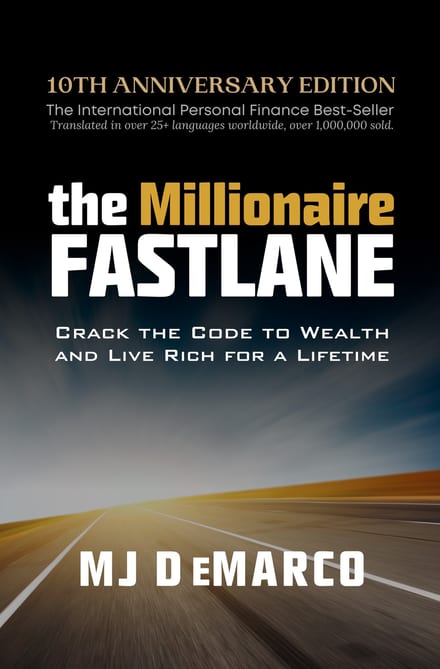
The Millionaire Fastlane: Crack the Code to Wealth and Live Rich for a Lifetime
Crack the Code to Wealth and Live Rich for a Lifetime
The full book runs ~332 pages — roughly 6 hours of reading. You get the key ideas here in 5 minutes.
The key ideas
- Three roadmaps: Sidewalk spends everything, Slowlane trades decades, Fastlane builds systems.
- A job pays intrinsic value, capped at 24 hours and fifty working years.
- Fastlane math: wealth equals net profit plus asset value, both unlimited.
- Asset value multiplies profit, so every extra dollar earned adds several.
- CENTS test: Control, Entry, Need, Time, Scale — fail these and the road stalls.
- Law of Effection: affect millions in scale or magnitude, and money follows.
The summary
A teenage boy in suburban Chicago sets out for the ice cream parlor and never makes it inside. Parked out front is a Lamborghini Countach. Its owner walks out — jeans, oversized flannel, an Iron Maiden shirt underneath, no older than twenty-five. MJ DeMarco works up the nerve to ask what he does for a living. “I’m an inventor.” Ninety seconds, and the book’s argument is set: getting rich young doesn’t take fame, athletic talent, or an inheritance. It takes different arithmetic.
Three roadmaps, three sets of math
DeMarco frames money as a road trip and sorts everyone onto one of three maps, each governed by its own equation.
The Sidewalk has no plan at all. Every surplus dollar goes to the next gadget, trip, or car, so wealth equals income plus debt — which leaves you one layoff, one album, one bad quarter from broke. Plenty of Sidewalkers earn a fortune first: the rapper denied a $60,000 loan while claiming $400,000 a month is the same case as the Escalade with $10,000 rims parked outside a run-down apartment complex. Census figures back him up: median net worth for ages 35–44 is $18,197 excluding home equity.
The Slowlane is the respectable version: college, a job, save 10%, max the 401(k), buy index funds, be patient, retire at 65. Wealth equals job plus market investments. He calls it “wealth in a wheelchair,” and he’s just as hard on FIRE — starve yourself for forty years and the prize is permission to keep starving.
The Fastlane replaces both with wealth = net profit + asset value.
Why the Slowlane numbers can’t reach
The objection is arithmetic, not attitude. He names the flaw Uncontrollable Limited Leverage. A job pays intrinsic value, priced in units of time — an hourly rate times hours, or a salary times years. The ceiling is 24 hours a day and roughly fifty working years, neither negotiable. “Mathematics doesn’t lie; 12 will always be less than 10,000,000.” Compound interest has the same disease: it needs decades you have to survive and a yield nobody lets you set.
Then there’s the trade itself. Five days of work bought with two days of freedom is a negative 60% return, and the five days aren’t even a return — they’re lost principal. That, he says, is what people are actually celebrating on Friday night.
The sharpest evidence is his own. In 1997 he opened a Roth IRA with $1,000, handed it to professionals, and forgot about it. By May 2022 it was worth $1,770. Over those same years he made more than $30 million elsewhere. He isn’t saying frugality is foolish — he’s saying it can’t be the whole plan.
Build the machine instead of lifting the stones
The best image in the book is a parable. Two eighteen-year-old nephews are each told to build a pyramid alone. Azur starts hauling stones immediately and, when they get too heavy, pays a trainer to make himself stronger. Chuma spends three years in a barn building a crane, then finishes his pyramid in five and retires at twenty-six. Azur dies of a heart attack on the twelfth level. Chasing a raise is getting stronger. Building a system is building the crane.
That means switching sides — sell shovels instead of digging for gold, hire instead of getting hired — and planting what he calls a money tree: a business that earns while you’re absent. He grades five seedlings by how passive they run: rental, software, content, distribution, and human resources. People come last: employees need managers, and managers need managers.
His own case was a limo booking site he built while idling at the airport between fares. He moved to Phoenix with $900, taught himself code and SEO at the public library, and swapped ad space for a lead-generation model that earned $473 its first month, then $694, then $970, then $1,832. He sold for $1.2 million in 2000, lost most of it to taxes and tech stocks, bought the wreckage back for $250,000 financed by its own profit, and rebuilt it into months clearing $100,000 to $200,000. The lever underneath is the second half of his equation: asset value = net profit × industry multiple. In his sector that multiple ran around four, so every extra dollar of annual profit added four dollars to what the company was worth.
The CENTS test
Not every business is a Fastlane; some are jobs in costume. He runs each road through five commandments:
- Control — drivers create MLMs, franchises and affiliate programs; they don’t join them.
- Entry — as barriers fall, competition rises. If anyone can start it in a day, the margins will show it.
- Need — 90% of businesses fail on selfish premises. Chase problems, not money; “do what you love” usually violates this one.
- Time — can it earn while you’re not there?
- Scale — a sandwich shop can’t sell 10,000 units a day, so it can’t make you rich.
All five aim at what he calls the only real law of wealth, the Law of Effection: affect millions and you make millions. Net profit is units sold (scale) times unit profit (magnitude). Scale makes millionaires. Magnitude makes millionaires. Both together make billionaires. He has no patience for the Law of Attraction — he spent two years visualizing this book, and it stayed unwritten until he sat down and wrote it.
The bottom line
The claim worth taking seriously is narrow: any plan built on variables you can’t control or multiply will take a lifetime, so pick a vehicle with better math. Everything around it — the Lamborghini, the contempt for 401(k)s, the three hundred numbered “distinctions” — is volume, though he’s straight with you that the process meant sixty-hour weeks with nobody coming to help. Read it if you’ve run the retirement-calculator numbers and hated the answer; skip it if you want steps, because he says outright this isn’t a how-to book.
Fact check
Popular books repeat findings that later research has complicated. Where The Millionaire Fastlane makes a testable claim, here's what the evidence actually shows.
Census figures show median net worth for households aged 35 to 44 is $18,197 excluding home equity.
The measure is a real Census series, but the number is a snapshot from an older wave of the survey. In the Bureau's most recent wealth tables, median net worth for householders aged 35 to 44 was $126,900 in 2021, or $49,000 excluding home equity — well over double the figure quoted. Earlier waves of the same survey ran lower, at $14,050 excluding home equity in 2000 and $9,512 in 2002, so the mid-career median has moved a good deal in both directions across the years. The underlying point holds either way: $49,000 outside the house is thin for a household in its forties.
- U.S. Census Bureau. Table 1. Median Value of Assets for Households, by Type of Asset Owned and Selected Characteristics: 2021. Wealth and Asset Ownership Detailed Tables, Survey of Income and Program Participation. 2023. Source
- Gottschalck AO. Net Worth and the Assets of Households: 2002. Current Population Reports P70-115. Washington, DC: U.S. Census Bureau; April 2008. Table 4. Source
His own Roth IRA — $1,000 in 1997, worth $1,770 by May 2022 — shows that compound interest in market investments is too weak to build wealth.
That result describes the account, not the asset class. $1,000 in the S&P 500 with dividends reinvested from the start of 1998 through the end of 2021 would have grown to roughly $7,500, about 8.8% a year, against the 2.3% a year his $1,000-to-$1,770 works out to over the same stretch. Broad-market compounding was not the binding constraint in those years. His separate argument — that a retirement account alone rarely produces $30 million — stands untouched by this, but the anecdote does not carry it.
- Damodaran A. Historical Returns on Stocks, Bonds and Bills: 1928-2024. New York, NY: Stern School of Business, New York University; updated January 2026. Source
Real wealth comes from owning a business system that keeps earning while you are absent, not from selling your time.
Business ownership genuinely is where top US incomes concentrate, but most of that income turns out to be payment for the owner's own work. Drawing on tax records covering 11 million firms and their owners, Smith and colleagues found roughly three-quarters of pass-through business profit is human capital income, and that profit falls by about three-quarters after the owner retires or dies prematurely. Top pass-through earners are largely working-age owner-operators of mid-market firms in skill-intensive industries — closer to a demanding job you own than to a machine that runs without you.
- Smith M, Yagan D, Zidar O, Zwick E. Capitalists in the Twenty-First Century. NBER Working Paper No. 25442. Cambridge, MA: National Bureau of Economic Research; January 2019. Source
Frequently asked questions
What is The Millionaire Fastlane about?
MJ DeMarco's case is that "get rich slow" — college, a job, 10% savings, index funds, retire at 65 — is built on numbers that can't move fast, because a salary is capped at 24 hours a day and compound interest needs decades you have to survive. He sorts financial lives onto three roadmaps: the Sidewalk (wealth = income + debt), the Slowlane (wealth = job + market investments), and the Fastlane (wealth = net profit + asset value). The Fastlane means building a business system that earns while you're absent, so income stops being a trade for your time.
What are the key takeaways from The Millionaire Fastlane?
Five ideas carry the book. Uncontrollable Limited Leverage: a job and a 401(k) both run on time and yields you don't control. The money tree: build a system — rental, software, content, distribution, or people — that earns without you, illustrated by the parable of Chuma, who spends three years building a crane while his brother hauls stones by hand. Asset value = net profit × industry multiple, so raising profit multiplies what the business is worth. The CENTS test for whether a business is worth starting: Control, Entry, Need, Time, Scale. And the Law of Effection: affect millions in scale or magnitude, and money follows.
Who should read The Millionaire Fastlane?
It's for anyone who has run the retirement-calculator math and found the answer depressing, and for would-be founders trying to judge whether an idea can actually scale. Readers who like index funds and a steady job will find it hostile from page one.
Is The Millionaire Fastlane worth reading?
The core argument is sharp and rarely made this plainly: pick a path whose variables you can control and multiply, or expect it to take a lifetime. The CENTS framework alone is a useful filter for killing bad business ideas early. It's repetitive, contemptuous toward conventional finance in a way that gets tiring, and DeMarco says outright it isn't a how-to book — so skip it if you want steps rather than a change of frame.