Book summary
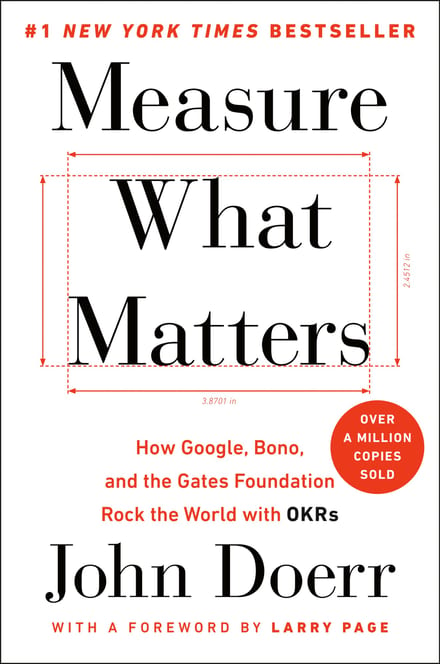
Measure What Matters: How Google, Bono, and the Gates Foundation Rock the World with OKRs
How Google, Bono, and the Gates Foundation Rock the World with OKRs
The full book runs ~320 pages — roughly 6 hours of reading. You get the key ideas here in 5 minutes.
The key ideas
- An objective is a direction; key results are the milestones that settle it.
- Three to five objectives per quarter, five or fewer key results each.
- Pair quantity goals with quality goals; the Ford Pinto shows what happens otherwise.
- Google treats 60–70% attainment on a stretch goal as success.
- Keep OKRs away from bonuses, or people set goals they can safely hit.
- CFRs — conversation, feedback, recognition — replace the annual review Adobe scrapped.
The summary
On a fall day in 1999, John Doerr drove to a two-story building off the 101 freeway with a slide deck. Two months earlier he had put $11.8 million into 12 percent of a company run by two Stanford dropouts, the biggest bet of his nineteen years as a venture capitalist. About thirty Googlers gathered around the ping-pong table that doubled as their boardroom. Sergey Brin’s verdict after ninety minutes: “Well, we need to have some organizing principle. We don’t have one, and this might as well be it.”
An objective is a direction, a key result is a milestone
The system fits in two lines. An objective is what you want to achieve; key results are how you’ll know you got there. Andy Grove’s own example, from a seminar Doerr sat in on as a 1975 intern: the objective is “dominate the mid-range microcomputer component business”; the quarter’s key result is “win ten new designs for the 8085.” One is a direction you can argue about for years. The other you settle by Friday. “Did I do that or did I not do it?” Grove said. “Yes? No? Simple. No judgments in it.”
Grove built on Peter Drucker’s management by objectives and repaired what had killed MBOs — goals planned centrally, refreshed once a year, hardened into context-free KPIs, and worst of all wired to bonuses. If a failed stretch costs you money, you stop stretching. His rules ran the other way:
- Three to five objectives per cycle, five or fewer key results each.
- Roughly half of all goals set from the bottom up.
- Anything can be revised or dropped mid-cycle when the ground shifts.
- Goals stay out of the bonus math — “a stopwatch in his own hand.”
Focus is mostly a list of things you refuse to do
Ask eleven thousand senior executives to name their company’s top priorities and a majority can’t; only half can name even one. So the first job is subtraction, and the danger is subtracting the wrong thing. Ford’s Pinto had two loud numbers, under 2,000 pounds and under $2,000, enforced by Lee Iacocca with an iron hand. When a crash test showed that a one-dollar piece of plastic stopped the gas tank puncturing, it was thrown out as extra cost and extra weight. Safety appeared nowhere in the car’s stated objectives. Hundreds died in rear-end collisions, and Ford recalled 1.5 million cars in 1978.
Grove’s fix is to pair key results, measuring effect and counter-effect: three new features paired with fewer than five bugs each, ten sales calls paired with two new orders. Quantity alone always finds a way to eat quality.
Operation Crush, and what a shared goal buys you
In November 1979, a district sales manager named Don Buckout fired off a desperate eight-page telex: Intel’s 8086 was losing to Motorola’s 68000. Within a week the executive staff had met; within two, a task force had a plan; before Christmas a nine-part program was approved. Jim Lally’s rallying cry needed no polish: “We have to kill Motorola, that’s the name of the game.”
Not one product was modified. What changed was the pitch — from ease of use to long-term systems and support, from selling programmers to selling CEOs — and the fact that each of the nine projects became a corporate key result, cascaded down to deadlines like “Deliver Rev 2.3 masks to fab on April 9.” A near-billion-dollar company turned on a dime. By 1986 the 8086 held 85 percent of the 16-bit market, and a bargain variant sat inside the first IBM PC. Intel graded that quarter’s corporate OKR at 0.625, and the board called it respectable, because they knew how aggressively the targets had been set.
Goals you are supposed to miss
Google sorts OKRs into two baskets. Committed goals get delivered in full. Aspirational goals are pitched so that 60 to 70 percent attainment counts as success. Gmail’s team debated offering 100 megabytes of storage and shipped a full gigabyte, up to five hundred times the competition. Sundar Pichai set Chrome’s 2008 target at 20 million weekly active users from a standing start and missed; in 2009 he aimed at 50 million and finished at 38. For 2010 he proposed 100 million, Larry Page pushed for more, and they settled on 111 million — reached that autumn after a passive alert to lapsed users moved the count from 87 to 107 million in weeks.
YouTube’s version was a billion hours of daily watch time, a 10x goal set in 2012 for the end of 2016. First Cristos Goodrow had to change the company metric from views to watch time, an argument that took six months and cost ad revenue up front. Then his team ground out roughly 150 improvements in 2016 alone, some worth 0.2 percent each, and hit the number ahead of schedule.
Scores can’t hold a conversation
The second half of the book is about what OKRs don’t do. Annual reviews eat 7.5 hours of manager time per direct report, and only 6 percent of HR leaders think they’re worth it. Adobe was burning 80,000 manager hours a year on a process that spiked voluntary attrition every February. Donna Morris scrapped it for “Check-in”: quarterly goals, feedback at least every six weeks, compensation handled separately. Attrition fell. Doerr calls this half CFRs — conversation, feedback, recognition — and the separation from pay is the load-bearing part. Google keeps OKR scores to a third or less of a performance rating and wipes the raw numbers after each cycle. Tie goals to bonuses and people quietly set goals they can hit.
The bottom line
Pick a handful of goals, attach numbers, let everyone see them, check in weekly, and aim high enough that you expect to fall short of some — that’s the whole method, and Intel and Chrome show it holding up under real pressure. Know what else you’re buying, though: half the book is Doerr’s portfolio companies taking turns at the microphone, and in most of those chapters OKRs accompanied the success rather than caused it. Read it if you lead a team and your quarterly plan is really a wish list, and take Bono’s warning seriously — the framework can make you too organized. “If everything’s at green, you failed.”
Fact check
Popular books repeat findings that later research has complicated. Where Measure What Matters makes a testable claim, here's what the evidence actually shows.
A one-dollar part would have stopped the Ford Pinto's gas tank rupturing, hundreds died in rear-end collisions, and Ford recalled 1.5 million cars in 1978.
The recall is real and close to the size stated. NHTSA campaign 78V143000, filed 19 June 1978, covered 1.4 million 1971–1976 Pintos and 1975–1976 Mercury Bobcats, and the remedy was exactly the sort of cheap part the story turns on — a longer fuel filler pipe with an improved seal, plus a polyethylene shield in front of the tank. The dollar figure is the wrong one: the number in Mark Dowie's 1977 Mother Jones exposé, which set the whole case in motion, was eleven dollars per car. The death toll is harder to stand behind. NHTSA's own engineers put the Pinto's rear-impact fire threshold at 30–35 mph against a federal standard (FMVSS 301) that required only 30, knew that other cars in its class performed just as badly in rear-end crashes, and had to run the demonstration test with a rigid bullet car, real gasoline and the headlights left on to produce a fire that would support a defect finding.
- National Highway Traffic Safety Administration. Safety recall 78V143000: Ford Motor Company, fuel system, gasoline storage tank assembly. Report received 19 June 1978. Source
- Lee MT. The Ford Pinto case and the development of auto safety regulations, 1893-1978. Business and Economic History. 1998;27(2):390-401. Source
Stretch goals pitched so that 60–70 percent attainment counts as success raise performance rather than damaging it.
The base is solid: specific, difficult goals reliably beat vague or easy ones, one of the most replicated results in organisational psychology across Locke and Latham's 35 years of studies. The extreme version is where the evidence turns. A 2011 Academy of Management Review analysis concludes that stretch goals are most tempting to precisely the organisations least able to absorb the risk — recent poor performers with little slack — while the firms positioned to benefit are the ones already doing well. A companion critique catalogues the documented costs: attention narrowed onto the measured target, distorted risk-taking, more unethical behaviour, inhibited learning and weaker intrinsic motivation. Google's 60–70 percent convention is a sensible way to contain those costs, not a number the research produced.
- Locke EA, Latham GP. Building a practically useful theory of goal setting and task motivation. A 35-year odyssey. Am Psychol. 2002;57(9):705-17. PubMed
- Sitkin SB, See KE, Miller CC, Lawless MW, Carton AM. The paradox of stretch goals: organizations in pursuit of the seemingly impossible. Acad Manage Rev. 2011;36(3):544-566. Source
- Ordóñez LD, Schweitzer ME, Galinsky AD, Bazerman MH. Goals gone wild: the systematic side effects of overprescribing goal setting. Acad Manage Perspect. 2009;23(1):6-16. Source
Asked to name their company's top priorities, a majority of eleven thousand senior executives could not, and only half could name even one.
The research behind this is Donald Sull's, and it measured something adjacent rather than identical. Across more than 10,000 managers in over 400 organisations, barely half the executives in a typical company named the same company-wide priorities when asked to list them, and in only 27 percent of companies did two-thirds of the top team agree. That is a finding about alignment, not blankness — the executives named priorities readily, they just named different ones from each other. Asked directly, they also overrated their own alignment, so the survey's stated numbers understate the problem; but the specific version in the book, that most senior leaders cannot name their company's priorities at all, is stronger than what was measured.
- Sull D, Turconi S, Sull C, Yoder J. Turning strategy into results. MIT Sloan Management Review. Published September 28, 2017. Source
Frequently asked questions
What is Measure What Matters about?
It's about OKRs — objectives and key results — the goal-setting method Andy Grove built at Intel and John Doerr carried to Google in 1999. An objective is what you want to achieve; key results are the numbered milestones that prove you got there, with no room to argue. The book lays out the mechanics and then works through case studies at Intel, Google, YouTube, Adobe, the Gates Foundation and Bono's ONE Campaign.
What are the key takeaways from Measure What Matters?
Keep it to three to five objectives a cycle with five or fewer key results each, because focus is mostly a list of things you refuse to do. Pair quantity goals with quality goals — Ford's Pinto hit its weight and price targets and never listed safety, and 1.5 million cars were recalled. Make goals public and let roughly half of them come from the bottom up. Set stretch goals you expect to miss: Google counts 60 to 70 percent attainment as success. And keep goals away from bonuses, or people set targets they can safely hit — that's what CFRs (conversation, feedback, recognition) are for.
Who should read Measure What Matters?
Anyone who runs a team or a company and suspects their quarterly plan is really a wish list. It's most useful to founders and managers at a growing organization who need everyone pulling in the same direction without micromanaging.
Is Measure What Matters worth reading?
The core method is genuinely useful and takes about fifty pages to grasp, and the Intel and Chrome chapters show it working under real pressure. The catch is that half the book is Doerr's own portfolio companies taking turns at the microphone, and in most of those chapters OKRs accompanied the success rather than caused it. Read the framework chapters closely and skim the guest stories that don't match your situation.