Book summary
Maus: A Survivor's Tale
A Survivor's Tale
The full book runs ~296 pages — roughly 5 hours of reading. You get the key ideas here in 5 minutes.
The key ideas
- Keep the seams showing: testimony pulled from a man forty years late.
- Mice, cats and pigs hand the Nazis' own imagery back to them.
- Break the metaphor in public — the pig mask concedes its absurdity.
- Leave the father unretouched: miserly, controlling, racist, and a survivor.
- Survival ran on skill and luck, never on virtue.
- Anja's burned diaries leave a hole the book refuses to fake.
The summary
The Holocaust reaches you in Maus the way it reached Art Spiegelman: secondhand, on cassette tape, out of order, from a man who is exhausting to be in a room with. Spiegelman doesn’t treat that as a compromise; he builds the book on it. Across both volumes — My Father Bleeds History (1986) and And Here My Troubles Began (1991), later collected as The Complete Maus — you watch a son in Rego Park, Queens prod his father Vladek into remembering Auschwitz, and you watch what it costs them both. The war story and the story of getting the war story are the same story, and neither one resolves.
The frame is not a frame
Each chapter opens and closes in the present, with Art visiting a father he admits he was never close to. Vladek talks while pedaling an exercycle, breaks off, doubles back, forgets, and drags the conversation toward whatever grievance is nearer. Spiegelman leaves the seams showing. When Vladek says he forgot to mention something from before he moved to Sosnowiec, that stays on the page. He could have straightened the chronology; keeping the memory lapses means you never lose sight of what this is — testimony pulled out of a man in a Queens living room forty years late, not history arriving whole.
Vladek’s account runs from prewar Częstochowa and a marriage into Anja Zylberberg’s wealthy Sosnowiec family, through a POW camp, the seizure of Jewish businesses, the ghetto at Srodula, and the failed escape to Hungary that landed both of them in Auschwitz. Volume two is the camp: teaching English to a block supervisor, picking up tinsmithing and then shoemaking by watching other men, bribing to get Anja moved to barracks nearer his own. He survives on skill and on luck, and the book never lets you separate the two.
A metaphor built to break
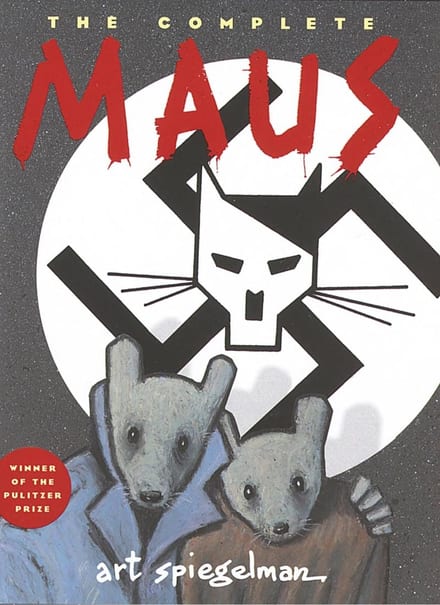
Maus opens with a line of Hitler’s — “The Jews are undoubtedly a race, but they are not human.” Jews are drawn as mice, Germans as cats, Poles as pigs, Americans as dogs. Spiegelman has said he found how routinely Nazi propaganda had already made the comparison — the 1940 film The Eternal Jew showed Jews as rats swarming a sewer. He isn’t inventing the image; he’s handing it back. “Hitler was as much my collaborator as my father was,” he told the Globe and Mail.
What lifts this above a gimmick is that the book keeps breaking its own device in front of you. Vladek passes as a Pole by tying on a pig mask, which concedes the absurdity: there was no mask, only the fact that you cannot tell a Jew from a Pole by looking. Hiding in a cellar, Anja is frightened by rats and Vladek assures her they are only mice. Art notices his psychiatrist’s house is full of strays and asks whether saying so “does it completely louse up my metaphor?” It does, and he prints the question. The animals hand you enough distance to keep reading, and never harden into a system that explains anything.
Vladek is not improved
The book’s riskiest decision was to leave his father unretouched. Vladek is miserly, controlling, endlessly aggrieved about money, and openly racist toward a Black hitchhiker, until Françoise tells him he is talking the way the Nazis talked about Jews. Asked whether he had considered a more flattering portrait, Spiegelman said he thought about it and would never do it: what mattered was making it all true, and truth “wouldn’t be served by retouching the portraits.” The alternative, on his account, is a book whose moral is that virtue got you through the camps. “The point is that everyone should have survived the Holocaust,” he told Terry Gross in 1987. He distrusts the register most Holocaust writing reaches for, where you can hear violins behind the prose.
The hole where Anja is
The largest absence in Maus is one Spiegelman could not fill and refused to fake. Anja survived Birkenau and killed herself in 1968, shortly after Art came out of a month in a mental hospital. She had kept diaries. Vladek burned them. Spiegelman puts that revelation at the close of volume one, ending the chapter with Art walking away from his father calling him a murderer. Bound into the middle of the book is “Prisoner on the Hell Planet,” the jagged expressionist strip he drew years earlier about her death, in which he puts himself in prison stripes. That strip sits at the center of the fights over teaching the book: in January 2022 the McMinn County, Tennessee school board voted 10–0 to drop Maus from its eighth-grade curriculum, going past the district director’s proposal to redact eight curse words and one drawing of Art’s dead mother. And there is Richieu, the brother poisoned by an aunt rather than handed to the gas chambers, whose photograph hung in his parents’ bedroom — “sibling rivalry with a snapshot,” Art calls it.
Volume two turns that doubt on the book itself. In “Time Flies,” Art sits at his drawing table on a heap of bodies in a mouse mask, fielding reporters as the success of volume one closes in. His psychiatrist Pavel asks what the point is, given how much has already been written and how little people change. Vladek’s own verdict is flatter: “About Auschwitz, nobody can understand.”
The bottom line
Maus argues that a story like this can’t be told cleanly, and that telling it partially — through a difficult, unreliable narrator and a metaphor that visibly fails — is the only honest way to tell it at all. Thirteen years of work, serialized a chapter at a time in RAW, the magazine Spiegelman published with Françoise Mouly, made it the first comic to win a Pulitzer: a Special Award in 1992, outside the standing categories. Read it if you want this history without the violins, or to see what comics can do that prose cannot.
Fact check
Popular books repeat findings that later research has complicated. Where Maus makes a testable claim, here's what the evidence actually shows.
Drawing Jews as mice and Germans as cats hands back imagery the Nazis had already put into circulation, rather than inventing a comparison.
The comparison was official German state propaganda before it was a comic panel. Der ewige Jude, the 1940 pseudo-documentary directed by Fritz Hippler with input from propaganda minister Joseph Goebbels, carries what the US Holocaust Memorial Museum calls one of its most notorious sequences: it compares Jews to rats that carry contagion, flood the continent, and devour precious resources. The museum's own catalogue record for the film lists the comparison of Jews with rats among the antisemitic stereotypes the film was built to spread. Spiegelman's account of where his animal cast came from matches the record.
In January 2022 a Tennessee school board voted 10-0 to drop Maus from its eighth-grade curriculum, going further than the redactions its own director had proposed.
The board's own minutes record all of it. At the called meeting of 10 January 2022, Director of Schools Lee Parkison told the McMinn County Board of Education that after consulting the district's attorney they had decided "to redact it to get rid of the eight curse words and the picture of the woman that was objected to" — the panel of Spiegelman's mother after her suicide, which board members went on to discuss in detail. Board member Jonathan Pierce instead moved to remove the book from the reading series entirely, and the roll call came back ten yes votes to none. Instructional staff told the board that Maus was the anchor text of the eighth-grade Holocaust module and could not be swapped out without rewriting the module.
Frequently asked questions
What is Maus about?
Art Spiegelman spent thirteen years drawing his father Vladek's survival of the Holocaust — prewar Poland, the Srodula ghetto, a failed escape to Hungary, Auschwitz — alongside the story of getting that story out of him on cassette tape in a Queens living room forty years later. Jews are drawn as mice, Germans as cats, Poles as pigs. Both volumes, My Father Bleeds History (1986) and And Here My Troubles Began (1991), are collected as The Complete Maus.
What are the key takeaways from Maus?
The frame isn't a frame: Vladek's digressions, grievances and memory lapses stay on the page, so you never mistake this for history arriving whole. The animal metaphor is built to break, and Spiegelman breaks it in front of you — Vladek passing as a Pole in a tied-on pig mask concedes that you can't tell a Jew from a Pole by looking. Vladek is left unretouched, miserly and controlling and openly racist, because a flattering portrait would imply virtue is what got people through the camps. And the largest absence is one Spiegelman wouldn't fake: Anja survived Birkenau, died by suicide in 1968, and Vladek burned her diaries.
Who should read Maus?
Readers who want this history without consolation — no violins behind the prose, no redemptive arc. It's also the clearest demonstration going of what comics can do that prose cannot.
Is Maus worth reading?
It became the first comic to win a Pulitzer, a Special Award in 1992 because it fit none of the standing categories, and the reasons hold up. What you get is a difficult narrator, a device that visibly fails, and a book that turns its doubt on itself — Art at his drawing table on a heap of bodies, his psychiatrist asking what the point is. Anyone wanting a clean or comprehensive account of the Holocaust should look elsewhere; Vladek's own verdict is "About Auschwitz, nobody can understand."