Book summary
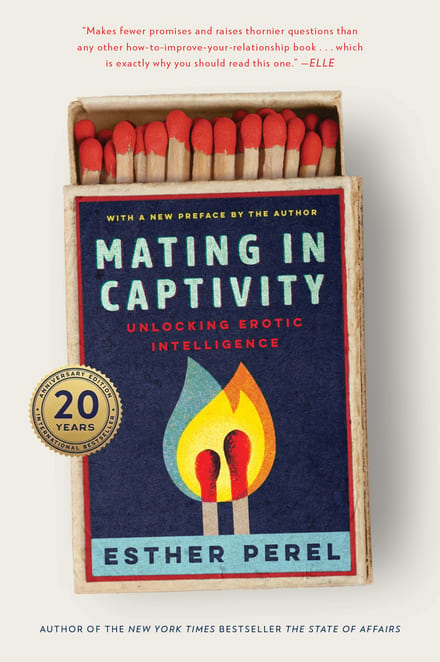
Mating in Captivity: Unlocking Erotic Intelligence
Unlocking Erotic Intelligence
The full book runs ~272 pages — roughly 5 hours of reading. You get the key ideas here in 5 minutes.
The key ideas
- Separate the verbs: love is to have, desire is to want.
- Suspect fusion, not distance, when an affectionate relationship goes sexually flat.
- Build eroticism from imagination and anticipation, not technique or props.
- Notice what draws you: absence, a partner in their element, surprise.
- Guard an inner life — caretaking and total transparency both flatten desire.
- Read it as clinical observation from decades of practice, not controlled research.
The summary
Sex often fades in relationships where the love hasn’t. Esther Perel’s explanation is that this is a structural feature of long-term partnership rather than a fault in it: love and desire run on different fuel, and the conditions that make a couple feel safe are frequently the same conditions that flatten wanting. We now ask one person to supply both. Give me belonging, identity and continuity, Perel says of the modern demand, but also mystery, novelty and surprise — everything a whole village once provided. Then, when the erotic side goes quiet, we treat it as a hardware problem and reach for toys, lingerie, a weekend away.
Love closes the gap; desire needs it open
The verb that goes with love, Perel says, is to have. The verb that goes with desire is to want. Love works to minimise distance — to know the beloved, neutralise the tensions, contract the space between two people. Desire runs the other way. It needs somewhere to go: an other on the far side of a gap, a bridge to cross. “Fire needs air,” is her compressed version. “Desire needs space.”
This is where she parts company with most relationship advice. Sexual trouble is almost always diagnosed as a shortfall of closeness, and the prescription is more talking, more time together, more merging. Perel’s counter-claim is that plenty of couples have the opposite problem. When intimacy collapses into fusion, she argues, it is too much closeness rather than too little that impedes desire, because neither person is left with enough separateness to want anything.
Eroticism is imagination, not technique
Animals have sex; humans have an erotic life. The difference, in Perel’s account, is imagination — sexuality transformed by the capacity to picture, anticipate and play. We can experience something vividly while nothing is physically happening, and that anticipation is the mortar of desire. So eroticism, for her, is not a repertoire. “Sex isn’t something you do,” she says. “Sex is a place you go” — a space you enter inside yourself and with another person.
That reframing changes the useful question. Not which techniques, but which parts of you come out there: transcendence, mischief, surrender, the relief of not being responsible for everything. Novelty, on this reading, has nothing to do with new positions and everything to do with which parts of a person get seen. Calling it an intelligence is deliberate — imagination, playfulness, curiosity and mystery are things you cultivate, not traits you either have or lack.
What people say they are actually drawn to
Travelling to more than twenty countries with the book, Perel put a deliberately non-sexual question to audiences: when do you find yourself most drawn to your partner? Three answers kept coming back across cultures. When the partner is away, or when the two of you reunite — absence and longing let imagination back in. When you watch them in their element: onstage, in the studio, absorbed in work, holding a room at a party. And when you’re surprised, or laughing together.
What links all three is a comfortable distance — near enough to see the person clearly, far enough that someone thoroughly familiar turns briefly elusive again. What’s missing from all three is need. “Caretaking is mightily loving,” Perel says, and “a powerful anti-aphrodisiac.” Wanting someone and needing them pull against each other, which is part of why she sees the move into parenthood as such a reliable drain on a couple’s erotic life. The household fills with responsibility, and responsibility and desire, in her phrase, butt heads.
The case against telling each other everything
The most contested part of the book is its scepticism about total transparency. Love enjoys knowing everything about you; desire needs mystery. Perel points out that treating intimacy as disclosure — wholesale sharing, telling it all, honesty as confession — is a cultural assumption, not a universal one. Other cultures hold that the ability to keep something private is precisely what makes intimacy possible. In trying to insure ourselves against betrayal we demand access, control and transparency, and risk erasing the space between two people that desire needs to survive.
This is not a defence of secrecy or of cheating. It is an argument that each partner keeps an inner erotic life that isn’t jointly owned or jointly audited. Couples who sustain a charge, Perel observes, protect that privacy, and they have also given up on spontaneity as the standard. Committed sex, she says flatly, is premeditated: willful, intentional, a matter of focus and presence rather than something that descends on you while you fold the laundry.
Where the argument comes from
Perel is a practising psychotherapist, and the book rests on decades of clinical work plus those audiences abroad — pattern recognition from the consulting room, not controlled research. Judge it as an argument, then, rather than as settled findings. Its emotional source is unusual: she grew up in Antwerp among Holocaust survivors, and describes two groups there — those who didn’t die, and those who came back to life. The second group, she says, understood the erotic as an antidote to death, the capacity for play and aliveness that vigilance and fear shut down. That is the register the book works in, and it explains why she treats desire as a question about being alive rather than a question about frequency.
The bottom line
Desire is not a byproduct of love, and more closeness will not manufacture it. It needs separateness, imagination and a partner who stays partly a stranger. If your relationship is affectionate and sexually flat, Perel’s diagnosis is that you may have too little distance rather than too little intimacy. Read it if you want a serious account of why desire is hard to sustain over years, instead of another list of tips for reviving it.
Fact check
Popular books repeat findings that later research has complicated. Where Mating in Captivity makes a testable claim, here's what the evidence actually shows.
Sexual desire fades over the years of a committed relationship even where the love does not.
The fade is real but it is not symmetrical. In a survey of 1,865 German students in steady partnerships, sexual activity and sexual satisfaction declined with the duration of the relationship for both women and men — but desire itself declined only in women, while desire for tenderness fell in men and rose in women. A second study on a population sample of 30-, 45- and 60-year-olds found the same split: male sexual motivation held roughly constant regardless of how long the partnership had lasted, female motivation matched it early and then steadily fell. Both studies are cross-sectional snapshots rather than couples followed over time, and the author cautions that reading them as a time course is precarious.
Having children reliably drains a couple's relationship and erotic life.
Satisfaction does drop, but by less than the phrase 'erotic disaster' implies, and the literature disagrees about whether the babies are the cause. A meta-analysis pooling 37 studies that tracked couples from pregnancy through the first year found small declines for mothers and fathers alike, moderate in the five studies that ran 12-14 months — yet the four studies following childless newlyweds over a comparable stretch showed similar declines, which would make the drop a feature of the marriage rather than of the birth. An eight-year prospective study of 218 couples cuts the other way: parents showed a sudden small-to-medium deterioration right after the birth that persisted for years, while childless couples slid only gradually. Neither body of work measures desire in the sense Perel means.
- Mitnick DM, Heyman RE, Smith Slep AM. Changes in relationship satisfaction across the transition to parenthood: a meta-analysis. J Fam Psychol. 2009;23(6):848-52. PubMed
- Doss BD, Rhoades GK, Stanley SM, Markman HJ. The effect of the transition to parenthood on relationship quality: an 8-year prospective study. J Pers Soc Psychol. 2009;96(3):601-619. PubMed
Closeness and total transparency flatten desire, which needs distance and mystery to survive.
Half of this holds up cleanly. Across dyadic, daily-diary, longitudinal and experimental studies, couples who did novel, self-expanding things together reported higher desire, had sex more often and enjoyed it more — Perel's point about novelty, minus the new positions. The distance half runs into trouble. Three studies using a manipulated online interaction, coded face-to-face conversation and a daily diary found that partner responsiveness — attentive, understanding, intimacy-building behaviour, the opposite of holding back — predicted more desire rather than less, and more strongly in women, because a responsive partner reads as valuing you and as a better mate. So being closely known does not itself flatten wanting; the evidence fits Perel's narrower claim about fusion and caretaking better than the broad one about intimacy.
- Birnbaum GE, Reis HT, Mizrahi M, Kanat-Maymon Y, Sass O, Granovski-Milner C. Intimately connected: The importance of partner responsiveness for experiencing sexual desire. J Pers Soc Psychol. 2016;111(4):530-46. PubMed
- Muise A, Harasymchuk C, Day LC, Bacev-Giles C, Gere J, Impett EA. Broadening your horizons: Self-expanding activities promote desire and satisfaction in established romantic relationships. J Pers Soc Psychol. 2019;116(2):237-258. PubMed
Frequently asked questions
What is Mating in Captivity about?
Esther Perel's subject is why sex often fades in relationships where the love hasn't. Her explanation is that this is a structural feature of long-term partnership rather than a fault in it: love and desire run on different fuel, and the conditions that make a couple feel safe are frequently the same ones that flatten wanting. We now ask a single person to supply belonging, identity and continuity as well as mystery, novelty and surprise — everything a whole village once provided.
What are the key takeaways from Mating in Captivity?
The verb that goes with love is to have; the verb that goes with desire is to want. Love works to close the distance between two people, while desire needs that distance kept open — fire needs air. Eroticism is imagination rather than technique: sex isn't something you do, it's a place you go. Asked when they feel most drawn to a partner, audiences in more than twenty countries kept giving the same three answers — during absence or reunion, when watching the partner absorbed in their element, and when surprised or laughing together. And she is sceptical of total transparency: each partner keeps an inner erotic life that isn't jointly owned or jointly audited.
Who should read Mating in Captivity?
Couples whose relationship is affectionate but sexually flat, especially anyone who has been told the fix is more talking and more time together. It's for readers who want a serious account of why desire is hard to sustain over years instead of another list of tips for reviving it.
Is Mating in Captivity worth reading?
It earns its place on the reframe alone — that the problem may be too much closeness rather than too little is a genuinely different diagnosis, and the material on caretaking as an anti-aphrodisiac and on parenthood draining a couple's erotic life lands hard. Perel is a practising psychotherapist, and the book rests on decades of clinical work plus those audiences abroad: pattern recognition from the consulting room, not controlled research. Judge it as an argument, and skip it if you want graded evidence or step-by-step exercises.