Book summary
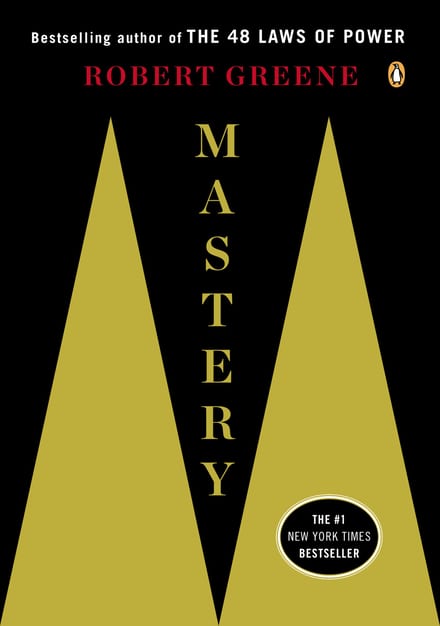
Mastery
The full book runs ~344 pages — roughly 6 hours of reading. You get the key ideas here in 5 minutes.
The key ideas
- Recover the childhood pull that points at your Life's Task.
- Serve the apprenticeship: observe deeply, grind one skill, ship before you're ready.
- Value learning over money through the tedious, badly paid middle years.
- Take everything a mentor has, then leave before the shadow becomes a ceiling.
- Drag knowledge from one field into another, as Calatrava did.
- Discount the 10,000-hour figure — Ericsson called it an average, not a threshold.
The summary
Some people seem to operate on a different frequency inside their field — the trainer who reads a fighter’s flaw from across the gym, the engineer who feels a solution before working it out. Robert Greene’s argument is that this is neither genetic luck nor mystery. It’s the far end of a process with three stages — apprenticeship, creative-active, mastery — open to anyone and finished by almost nobody, because its middle is tedious, badly paid, and looks from outside like standing still. What separates masters isn’t a better brain but years of attention pointed at one thing.
Your calling is something you go back to, not something you find
Greene starts inward. Each of us is wired unusually, and that wiring shows up early as an unexplained pull toward a subject — what he calls a primal inclination. Your Life’s Task is the career built around that pull, and the first move toward mastery is backward: working out what you cared about before parents, peers, and salary expectations papered over it. Asked how someone already in their thirties is supposed to find it, his answer was that they already know. It was there in childhood, before anyone told you to go to law school.
He doesn’t pretend this is fast. Greene drifted through journalism and film work into his mid-thirties before a chance meeting with a book packager turned into The 48 Laws of Power, and his verdict on those years isn’t that they were wasted — he had spent them learning to write to deadline. “I was ready when that opportunity came.” Hence the practical advice: don’t throw away a decade of skill to chase something shinier, adapt what you have toward the work you want.
The apprenticeship is a second education, and you pay for it in time
After formal schooling comes the phase Greene thinks decides everything, split into three modes. Deep observation: mute yourself and learn the rules and power relationships of a new environment before trying to change them. Skills acquisition: grind at one skill until it stops needing conscious thought, and accept the tedium as the price of admission. Experimentation: push work out before you feel ready, so the feedback arrives while you can still use it.
Darwin is the case study. He was twenty-two, out of Cambridge with no scientific post, and his father had to be talked into financing the passage; his Cambridge botany professor John Henslow recommended him not as a finished naturalist but as “amply qualified for collecting, observing, and noting.” The Beagle left Plymouth on 27 December 1831 and didn’t return until 2 October 1836 — almost five years that turned a directionless graduate into a working naturalist.
The governing rule is to value learning over money. In Greene’s own words, the apprenticeship is about “learning, learning, learning. Not making money. Not getting fame and attention.” He attaches the familiar ten thousand hours to it, and that number needs a caveat he doesn’t supply. It comes from Anders Ericsson’s 1993 study of Berlin violin students, and Ericsson spent years objecting to how it travelled: ten thousand was an average for the top group rather than a threshold, half of those players had logged fewer hours by twenty, and what mattered was the structure of the practice, not the total on the clock.
Take everything a mentor has, then leave
A mentor compresses time, the one thing you can’t buy more of. Faraday is the model: apprenticed as a bookbinder to the bookseller George Riebau from 1805 to 1812, he read the books passing through the shop, got tickets to Humphry Davy’s lectures at the Royal Institution from a customer, took meticulous notes, and sent them to Davy — who hired him in 1813.
Greene’s rules here are unsentimental. Choose the mentor who fits your inclinations, not the one with the biggest name. Take the knowledge as fast as you can absorb it. Then go, because staying in someone’s shadow past the point of learning turns a shortcut into a ceiling.
Reading people is part of the craft, not a distraction from it
Most books about skill ignore other people. Greene gives them a full section, on the grounds that the heaviest tax on a working life is energy burned misreading colleagues. He calls the default error the Naive Perspective — assuming people are what they present, then being blindsided. Against it he sets a blunt inventory of what you’ll actually meet: envy, conformism, rigidity, self-obsessiveness, laziness, flightiness, passive aggression. The remedy isn’t manipulation but restraint: speak through your work, let results carry the argument, and stop spending yourself on office theatre. By his own account, he learned this the hard way.
The creative-active phase is where you turn on the rules
Once the rules live in your hands, the mind gets restless. Greene calls the goal the Dimensional Mind: knowledge dragged out of one field and forced into another. Calatrava is the clean example — he qualified as an architect in Valencia in 1974, then went back to school and qualified as a civil engineer at ETH Zurich in 1979, which is why his bridges attempt things architects alone don’t. For the mental habit Greene borrows Keats’s negative capability: stay in uncertainty long enough for something real to surface instead of grabbing the first tidy answer.
He also spends this section demolishing the idea that creativity is madness or chemistry. His counterexample is Coltrane, working in a music famous for spontaneity while practising harder than anyone around him. The remaining dangers are internal: complacency, conservatism, dependency, impatience, grandiosity, inflexibility.
The bottom line
Mastery is the ordinary result of aiming a normal brain at one thing for long enough and staying honest about what you’re actually built for. The bottleneck is rarely talent — it’s the stretch of unglamorous work most people quit in the middle of. Read it if you’re early in a career and want a map of the boring part, or mid-career and suspect you took a wrong turn — Greene is unusually clear that late isn’t the same as too late.
Fact check
Popular books repeat findings that later research has complicated. Where Mastery makes a testable claim, here's what the evidence actually shows.
Roughly ten thousand hours of practice is what an apprenticeship costs — the amount that turns a competent practitioner into a master.
The figure is an average, not a price of admission, and Ericsson said so himself: ten thousand hours was the mean for the top ten violinists in his 1993 study at age twenty, and half of that group had accumulated less than that. Where the hours have been counted directly, the spread is enormous — among 104 Argentinian chess players, the slowest to reach master level needed eight times as much practice as the fastest, and practice came out as necessary but not sufficient for expertise. Greene's underlying point holds: the practice has to be structured and effortful, and years of it are unavoidable. It is the single number bolted onto that point which doesn't survive contact with the data.
- Gobet F, Campitelli G. The role of domain-specific practice, handedness, and starting age in chess. Dev Psychol. 2007;43(1):159-72. PubMed
- Ericsson A, Pool R. Malcolm Gladwell got us wrong: our research was key to the 10,000-hour rule, but here's what got oversimplified. Salon, 10 April 2016 (adapted from Peak: Secrets from the New Science of Expertise). Source
Your Life's Task is recoverable by looking backward — the unexplained pull you felt as a child, before school and family expectations papered over it.
There is a durable set of interests to find, but it arrives later than the childhood-signal story implies. A meta-analysis of longitudinal studies following people from age 12 to 40 found interest stability essentially flat through adolescence, then climbing sharply during the college years (ages 18 to 21.9) and holding at that level for the next two decades. Vocational interests turned out more stable over time than personality traits, which is real support for Greene's premise that something consistent is in there. What the evidence doesn't back is treating what you liked at nine as the reliable reading — and stability varied by kind of interest, higher for hands-on and artistic pulls than for scientific, social, enterprising or clerical ones.
- Low KSD, Yoon M, Roberts BW, Rounds J. The stability of vocational interests from early adolescence to middle adulthood: a quantitative review of longitudinal studies. Psychol Bull. 2005;131(5):713-737. PubMed
The right mentor compresses years off the path to mastery — the one form of time you can't otherwise buy.
Mentored people do come out ahead, but by less than "compresses years" suggests. A meta-analysis pooling youth, academic and workplace mentoring found favourable associations across behavioural, career, attitudinal and relational outcomes with effect sizes that were generally small; in workplace mentoring specifically, the association with job performance was rc = .06 across 11 samples (N = 6,487), rising to about .19 for interpersonal relations and .16 for situational satisfaction. An earlier meta-analysis of career benefits for protégés reached the same conclusion — supportive overall, with the smallest effects on objective outcomes like compensation and promotion. Worth noting what wasn't tested: nobody has studied Greene's actual prescription, which is choosing for fit, absorbing fast, and leaving.
- Eby LT, Allen TD, Evans SC, Ng T, DuBois D. Does mentoring matter? A multidisciplinary meta-analysis comparing mentored and non-mentored individuals. J Vocat Behav. 2008;72(2):254-267. PubMed
- Allen TD, Eby LT, Poteet ML, Lentz E, Lima L. Career benefits associated with mentoring for protégés: a meta-analysis. J Appl Psychol. 2004;89(1):127-36. PubMed
Creativity is not madness or brain chemistry — the romantic link between artistic genius and mental disturbance doesn't hold.
For creative professions as a class, Greene is right. Swedish national registers covering 1,173,763 psychiatric patients matched against population controls found that people in scientific and artistic occupations were no more likely than controls to carry any of the diagnoses examined — schizophrenia, schizoaffective disorder, depression, anxiety, alcohol and drug abuse, autism, ADHD, anorexia — with bipolar disorder the one exception. Writers are where it gets complicated: being an author was associated with raised odds of schizophrenia, bipolar disorder, unipolar depression, anxiety disorders, substance abuse and completed suicide. The tortured-artist picture is mostly folklore, and specifically not folklore for authors.
- Kyaga S, Landén M, Boman M, Hultman CM, Långström N, Lichtenstein P. Mental illness, suicide and creativity: 40-year prospective total population study. J Psychiatr Res. 2013;47(1):83-90. PubMed
Frequently asked questions
What is Mastery about?
Robert Greene's argument is that the people who seem to operate on a different frequency inside their field got there by process, not genetic luck. That process has three stages — apprenticeship, creative-active, mastery — and it's open to anyone but finished by almost nobody, because its middle is tedious, badly paid, and looks from outside like standing still. What separates masters isn't a better brain but years of attention pointed at one thing.
What are the key takeaways from Mastery?
Start with your Life's Task, the career built around the primal inclination you felt before parents, peers and salary papered over it. The apprenticeship that follows has three modes: deep observation (learn a new environment's rules before trying to change them), skills acquisition (grind until the skill stops needing conscious thought), and experimentation (push work out before you feel ready so feedback still helps) — with learning valued over money, as Darwin's five years on the Beagle show. Take everything a mentor has and then leave, the way Faraday used Riebau's bookshop and Davy's lectures. Read people rather than assuming they are what they present, which Greene calls the Naive Perspective. In the creative-active phase you turn on the rules: the Dimensional Mind drags knowledge from one field into another, as Calatrava did by qualifying as both architect and civil engineer.
Who should read Mastery?
Read it if you're early in a career and want a map of the boring part, or mid-career and suspect you took a wrong turn. Greene is unusually clear that late isn't the same as too late.
Is Mastery worth reading?
The biographical case studies carry it — Darwin, Faraday, Coltrane and Calatrava make an abstract process concrete, and the book is refreshingly honest that the bottleneck is unglamorous work rather than talent. One caveat: it attaches the familiar ten thousand hours to the apprenticeship without the correction Ericsson spent years pressing, that the number was an average for the top group rather than a threshold and that practice structure mattered more than the total. If you want tactics for this week rather than a decade-scale map, it will feel slow.