Book summary
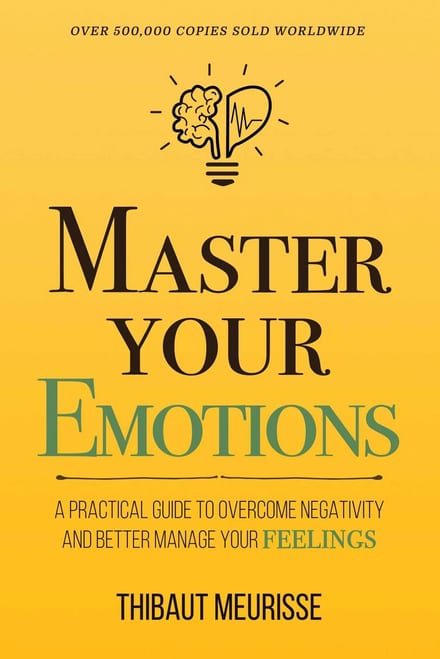
Master Your Emotions
A Practical Guide to Overcome Negativity and Better Manage Your Feelings
The full book runs ~169 pages — roughly 3 hours of reading. You get the key ideas here in 3 minutes.
The key ideas
- Separate emotions from identity to evaluate them objectively
- Events are neutral; expectations turn them into problems
- Decode negative emotions as clues to inner issues
- Treat sleep, exercise, and breathing as emotional infrastructure
- Recognize the ego as a story, not truth
- Prioritize yourself; others think about you far less than you assume
The summary
Your emotions are chemical events moving through you, not the core of who you are. The anger, the anxiety, the low mood — each is a temporary state, more like weather crossing the sky than a permanent feature of your character. Thibaut Meurisse’s argument is that the sooner you see this separation, the more power you gain: you can step back, watch a feeling from a distance, and ask where it actually came from instead of being swept along by it.
This matters because your brain was built to keep you alive, not to keep you happy. In hunter-gatherer times, fear and anxiety were survival tools in a world full of predators. The world is far safer now, but the machinery still runs, so you’re carrying hardware designed for danger through a life that mostly demands something else.
Events are neutral until you supply the meaning
When something goes “wrong” — rain ruins your plans, work piles up, the coffee runs out — you’re reacting to a neutral event you’ve decided to read as bad. The rain carries no built-in meaning. It simply exists. You made it a problem by expecting sun, by telling yourself that to be happy you needed the day to go a certain way. A farmer watching that same rain is delighted.
Problems lose their grip when you stop imposing expectations on reality. Happiness turns into a daily choice, shaped by your attitude toward events rather than the events themselves. If the rain makes you miserable, ask whether a different outlook would change the feeling — the answer is always yes. This isn’t about pretending everything is fine. Negative emotions are useful signals worth reading. Anger can point to unresolved resentment or trauma. Fear often means you’re stepping past your comfort zone, which is usually a good sign that you’re refusing to stagnate. Procrastination tends to hide a fear of failure. Resentment, Meurisse notes, is like drinking poison and hoping it kills your enemy.
Your body is emotional infrastructure
Caring for your emotions means caring for your body, because the two aren’t separate. Studies tie poor sleep to anxiety, depression, and higher mortality, so protect it with a consistent schedule, blackout curtains, and no screens before bed. Regular movement, even something as ordinary as walking, lifts mood and extends life. Slow, deep breathing pulls you toward calm and takes the edge off anxiety. And meditation trains the exact skill this whole approach depends on: it makes you aware of the endless stream of thoughts and separates you from them, so their power fades and you learn to observe your emotions rather than drown in them.
The ego is a story, not the truth
Your ego is the picture you hold of yourself and the stories you tell about who you are. For one person it’s built on having many friends; for another, on expensive cars. Either way it spins a self-centered narrative that pushes you to feel important and superior, which leaves you exposed to every threat against that image. The ego is never satisfied and is always working to prop itself up. The way out is to see that it isn’t real — it’s an arbitrary product of your beliefs, a narrative running in your head rather than a fact about the world. The more clearly you see that, the less it can push you around.
Practical tools for shifting your state
Meurisse offers concrete moves. Write your negative emotions down and interrogate them: would you feel differently with a different opinion, and is there something you can do to limit the feeling, like reading less news or cutting back on social media? Keep a separate list of your accomplishments, however small — chores, errands, the ordinary wins — and let them accumulate as evidence against your worst assumptions. Take action on what you can change and accept what you can’t. Use visualization to seed positive feeling, picturing success or a peaceful scene in real detail. Watch your language, too: drop “I can’t,” and repeat a positive affirmation like “I will” for five minutes a day until it starts to sink in.
Underneath the tools sits a liberating idea about other people. To be genuinely happy, treat yourself as the most important person in your world — and recognize that everyone else is doing the same in theirs. You tend to assume people think about you far more than they do; in truth, most of the time they barely do at all. That can sound bleak, but it’s freeing, because what others think of you is really none of your business. Your job is to express yourself as honestly as you can with good intent, and then let people like you or not. Even presidents are hated by millions.
The bottom line
Your emotions are tools and passing states, not your identity, and events only wound you when your expectations crash into reality. Manage your moods by treating sleep, movement, and breath as emotional infrastructure and by watching your thoughts from a step back. Read this if you’re tired of being yanked around by feelings you don’t understand and want a practical way to steady yourself.
Fact check
Popular books repeat findings that later research has complicated. Where Master Your Emotions makes a testable claim, here's what the evidence actually shows.
Repeating a positive affirmation such as "I will" for five minutes a day makes you feel better.
When this was tested directly, people with low self-esteem who repeated the statement "I'm a lovable person" ended up in a worse mood than those who did not repeat it. People with high self-esteem felt better, but only to a limited degree. The effect therefore runs backwards for exactly the readers most likely to reach for the technique, which is the opposite of how the book presents it.
- Wood JV, Perunovic WQ, Lee JW. Positive self-statements: power for some, peril for others. Psychol Sci. 2009;20(7):860-866. PubMed
Slow, deep breathing measurably calms you down and takes the edge off anxiety.
A meta-analysis of randomised controlled trials found breathwork lowered self-reported stress relative to controls (Hedges' g = -0.35 across 12 trials, 785 adults), with comparable effects on anxiety (g = -0.32, 20 trials) and depressive symptoms (g = -0.40, 18 trials). That is a small-to-moderate benefit, which matches the modest way the book frames it. Most trials carried a moderate risk of bias, and the authors warn that public enthusiasm for breathwork has run ahead of the evidence.
- Fincham GW, Strauss C, Montero-Marin J, Cavanagh K. Effect of breathwork on stress and mental health: a meta-analysis of randomised-controlled trials. Sci Rep. 2023;13(1):432. PubMed
Other people think about you far less than you assume.
This is the spotlight effect, and it replicates across five studies in the original paper. Participants asked to wear a T-shirt with an embarrassing image overestimated how many observers could recall what was on it, and people in group discussions overestimated how noticeable their own good and bad remarks had been. The cause appears to be anchoring: you start from your own vivid experience of yourself and adjust too little for what other people are actually attending to. The book's practical conclusion — that you are less watched than you fear — is the right reading of the finding.
- Gilovich T, Medvec VH, Savitsky K. The spotlight effect in social judgment: an egocentric bias in estimates of the salience of one's own actions and appearance. J Pers Soc Psychol. 2000;78(2):211-222. PubMed
Poor sleep is tied to anxiety, depression and higher mortality.
The depression half is solid: pooling 21 longitudinal studies, people with insomnia who were not depressed at baseline had roughly twice the risk of developing depression later (odds ratio 2.60, 95% CI 1.98-3.42). The mortality half is not simply "less sleep kills". Across 27 cohort samples covering 1,382,999 people and 112,566 deaths, short sleep raised the risk of death modestly (RR 1.12, 95% CI 1.06-1.18) while long sleep raised it more (RR 1.30, 95% CI 1.22-1.38) — a U-shape that observational data cannot separate from underlying illness driving both the sleep and the death.
- Baglioni C, Battagliese G, Feige B, et al. Insomnia as a predictor of depression: a meta-analytic evaluation of longitudinal epidemiological studies. J Affect Disord. 2011;135(1-3):10-19. PubMed
- Cappuccio FP, D'Elia L, Strazzullo P, Miller MA. Sleep duration and all-cause mortality: a systematic review and meta-analysis of prospective studies. Sleep. 2010;33(5):585-592. PubMed
Frequently asked questions
What is Master Your Emotions about?
It treats your emotions as temporary chemical states moving through you, not the core of who you are. The book's central point is that once you can step back and watch a feeling from a distance, you gain the power to ask where it came from instead of being swept along by it. It pairs that mental shift with practical care for your body and a clear-eyed look at the ego that keeps you reactive.
What are the key takeaways from Master Your Emotions?
A few key ideas run through it. Events are neutral until you supply the meaning, so happiness becomes a daily choice about your attitude rather than the circumstances. Negative emotions are useful signals worth reading: anger points to unresolved resentment, fear means you're stepping past your comfort zone, procrastination hides a fear of failure. Your body is emotional infrastructure, so protect sleep, move regularly, breathe slowly, and meditate to separate yourself from your thoughts. The ego is just a story you tell about yourself, not a fact. And concrete tools help: write emotions down and question them, keep an accomplishments list, use visualization and positive affirmations, and remember most people barely think about you at all.
Who should read Master Your Emotions?
Read it if you're tired of being yanked around by feelings you don't understand and want a practical way to steady yourself. It suits anyone who wants tools they can apply today rather than deep theory.
Is Master Your Emotions worth reading?
It does a good job turning a simple insight, that your emotions are passing states rather than your identity, into concrete daily practices around sleep, movement, breath, and watching your thoughts from a step back. The advice is practical and warm rather than clinical. If you already know the Stoic-flavored self-help staples it draws on, some of it will feel familiar, but as a compact starter kit for managing moods it delivers.