Book summary
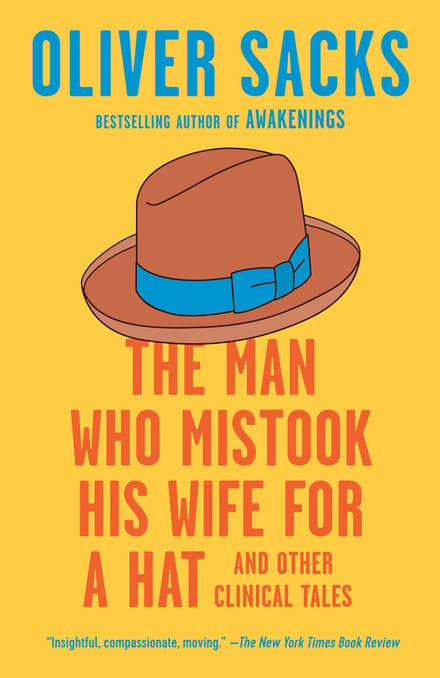
The Man Who Mistook His Wife for a Hat: And Other Clinical Tales
And Other Clinical Tales
The full book runs ~320 pages — roughly 6 hours of reading. You get the key ideas here in 5 minutes.
The key ideas
- Rejects the deficit chart, since a list of losses isn't a patient
- Follows Dr P., who reached for his hat and grabbed his wife's head
- Prescribes a life of music when the diagnosis had no name
- Quotes Luria: a man does not consist of memory alone
- Runs twenty-four cases across Losses, Excesses, Transports and the Simple
- Admits in his journals to lies and pure fabrications afterward
The summary
Neurology’s favourite word, Sacks writes at the head of the book’s first part, is deficit — a vocabulary of subtraction, with a privative term for every faculty a person can lose. His objection is not that the accounting is wrong, but that a list of losses is not a patient. Modern case histories, he complains in the preface, name the subject in a passing phrase — “a trisomic albino female of 21” — that could as well describe a rat. To put the person back at the centre, on Sacks’s argument, a case history has to be deepened into a tale, so that you end up with a who as well as a what. The twenty-four cases that follow are that argument carried out rather than stated.
What a chart leaves out
Dr P., a singer of standing who taught at a local school of music, stopped recognising his students’ faces — though the moment one spoke, he knew the voice. His eyesight was fine; an ophthalmologist sent him on with the verdict that the trouble lay not in his eyes but in the visual parts of his brain.
What the examination turns up is stranger than any deficit list. Handed a rose, Dr P. studies it like a specimen — “a convoluted red form with a linear green attachment” — hesitates over whether it might be a flower, then smells it and comes instantly, delightedly to life. Then, taking the appointment to be over, he reaches for his hat, takes hold of his wife’s head and tries to lift it off.
Sacks could not say what was wrong, so he said what was right: music was Dr P.’s life, and a life made entirely of music was the prescription. By his wife’s account he sang his way through dressing and eating, and stopped dead if the tune broke. A likely diagnosis arrived some fifteen years later, as Sacks recorded in a foreword he added in 2013: the pianist Lilian Kallir wrote to him having lost the ability to recognise the objects around her, and proved to have posterior cortical atrophy — a term introduced after the book was published.
“A man does not consist of memory alone”
Jimmie, the lost mariner, arrived at a home for the aged near New York in early 1975 with a transfer note reading “Helpless, demented, confused and disoriented.” He was forty-nine, and certain that the year was 1945 and that he was nineteen. Sacks held up a mirror — an impulse, he wrote, for which he never forgave himself. Jimmie turned ashen and gripped his chair; two minutes later the episode was gone and he greeted Sacks as a stranger.
The diagnosis was not the hard part: Korsakov’s syndrome, Sacks noted, due to alcoholic degeneration of the mammillary bodies. The hard part was what to do with him. Sacks wrote to the Russian neuropsychologist A. R. Luria and got back the sentence the book leans on — that neuropsychologically there was little to be done, but much in the realm of the individual, because “a man does not consist of memory alone. He has feeling, will, sensibilities, moral being — matters of which neuropsychology cannot speak.” Sacks asked the nursing sisters whether Jimmie had a soul. Outraged, they told him to watch Jimmie in chapel, where he found a steadiness of attention he had never seen in him before.
A form medicine had given up on
The collection runs in four parts — Losses, Excesses, Transports, and The World of the Simple — nine cases, then five, six and four. The form was the provocation: by Sacks’s account, medical journals wanted charts, tables and “objective” language and read a long personal case history as archaic and unscientific. That has since reversed — medical schools teach narrative medicine, and Sacks liked to think this book had a hand in it.
The case against the case histories
The method is also the book’s exposed flank. The disability scholar Tom Shakespeare called Sacks “the man who mistook his patients for a literary career” — the charge being that he capitalised on his patients’ suffering to make handy parables of it. Sacks conceded ground himself: the 2013 foreword lets words like “idiot savant” and “retardate” stand as the terms of their day, and says flatly that he no longer agrees with some of what he wrote.
The sharper problem came in December 2025, when Rachel Aviv reported in the New Yorker on four decades of Sacks’s journals, released by the Oliver Sacks Foundation. In a letter to his brother Marcus, Sacks called the book a set of “fairy tales”; in his journal he wrote that guilt had been much greater since Hat because of “My lies, falsification”, that he had given patients powers they did not have, and that some details were “pure fabrications”. Two of her examples come from this one. Rebecca, who in the book joins a theatre group and emerges from her grief as “a complete person”, does neither in the transcripts and journals from the following year. And the twins’ prime numbers — the scene everyone remembers — Sacks called the most flagrant example of his distortions; a 2007 letter in the Journal of Autism and Developmental Disorders had already questioned it, on the grounds that nobody can test a twenty-digit number for primality in their head and that the book of ten-digit primes Sacks says he read from could not physically exist. Kate Edgar, who edited him for decades, told Aviv she never caught him at anything like it.
The bottom line
Sacks’s claim is that a deficit chart and a person are different objects, and that medicine recording only the first will keep missing the second — a case history has to become a biography before it can be true. That claim helped change how doctors are taught to listen. The instinct that made these tales unforgettable is the same one that pulled them loose from the record.
Read it to understand why medicine started caring about stories — and read the 2025 reporting alongside it, since this is a book about the limits of a chart that took liberties with one.
Fact check
Popular books repeat findings that later research has complicated. Where The Man Who Mistook His Wife for a Hat makes a testable claim, here's what the evidence actually shows.
The autistic twins in the book traded prime numbers of up to twenty digits back and forth as a game, a feat with no known mental method behind it.
Sacks's private journals, opened to The New Yorker by the Oliver Sacks Foundation, record him naming this scene as the most flagrant example of his distortions, and Rachel Aviv reports that the two American Journal of Psychiatry papers written on the twins in the 1960s describe their calendar calculating with no prime-number ability at all. The objection had been in print for years: a 2007 letter in the Journal of Autism and Developmental Disorders pointed out that there is no method for testing a twenty-digit number for primality by inspection, and that the book of ten-digit primes Sacks says he read from could not be printed, since there are 455,052,511 primes below ten billion. Asked about it directly, Sacks said the book and his other records were lost, and allowed that it may have run only to eight digits.
- Yamaguchi M. Questionable aspects of Oliver Sacks' (1985) report. J Autism Dev Disord. 2007;37(7):1396; discussion 1389-9, 1401. PubMed
- Horwitz WA, Kestenbaum C, Person E, Jarvik L. Identical twin - 'idiot savants' - calendar calculators. Am J Psychiatry. 1965;121:1075-9. PubMed
- Aviv R. Oliver Sacks put himself into his case studies. What was the cost? The New Yorker, 8 December 2025. Source
The clinical tales report what Sacks's patients actually did and said.
In four decades of journals released to The New Yorker by the Oliver Sacks Foundation, Sacks wrote that he had given his patients "powers (starting with powers of speech) which they do not have", and that some details were "pure fabrications". Sending the book to his brother Marcus in 1985, he called it a book of "fairy tales" - "half-report, half-imagined, half-science, half-fable". One documented instance: the book has Rebecca join a theatre group and emerge from her grief as "a complete person", while the transcripts and journals from the year that followed show neither happening.
There was no diagnostic name available for Dr P.'s disorder when Sacks examined him.
Posterior cortical atrophy, the condition Sacks later pointed to after a pianist wrote to him with similar losses, was first set out as a distinct syndrome by Benson, Davis and Snyder in Archives of Neurology in July 1988: five patients whose progressive dementia began as a disorder of higher visual function, with memory, insight and judgement relatively preserved until late. That is three years after the book was published. The phrase appears in the title or abstract of no earlier paper indexed in PubMed.
- Benson DF, Davis RJ, Snyder BD. Posterior cortical atrophy. Arch Neurol. 1988;45(7):789-93. PubMed
Frequently asked questions
What is The Man Who Mistook His Wife for a Hat about?
Sacks objects that neurology's favourite word is deficit — a vocabulary of subtraction that lists what a person has lost and calls that a patient. His argument is that a case history has to be deepened into a tale, so you end up with a who as well as a what. The twenty-four clinical tales that follow are that argument carried out rather than stated.
What are the key takeaways from The Man Who Mistook His Wife for a Hat?
The title case is Dr P., a singer who could not recognise faces or objects — he studied a rose as "a convoluted red form with a linear green attachment" and then reached for his hat and took hold of his wife's head. Unable to say what was wrong, Sacks said what was right and prescribed a life made entirely of music; a likely diagnosis, posterior cortical atrophy, only arrived decades later. Jimmie, the lost mariner, had Korsakov's syndrome and was stuck in 1945, and Luria's reply to Sacks supplies the line the book leans on: a man does not consist of memory alone. The collection runs in four parts — Losses, Excesses, Transports, and The World of the Simple — in a narrative form medical journals had written off as archaic.
Who should read The Man Who Mistook His Wife for a Hat?
Read it to understand why medicine started caring about stories, and why narrative medicine is now taught in medical schools. It suits readers curious about the brain who want people rather than mechanisms — and who are willing to read the book critically.
Is The Man Who Mistook His Wife for a Hat worth reading?
The tales are unforgettable and the underlying claim — that a deficit chart and a person are different objects — helped change how doctors are taught to listen. But the method is also the book's exposed flank: Tom Shakespeare called Sacks "the man who mistook his patients for a literary career," and Rachel Aviv's December 2025 reporting on Sacks's journals found him describing "my lies, falsification" and "pure fabrications," including Rebecca's recovery and the twins' prime numbers, the scene everyone remembers. Read it alongside that reporting, since this is a book about the limits of a chart that took liberties with the record.