Book summary
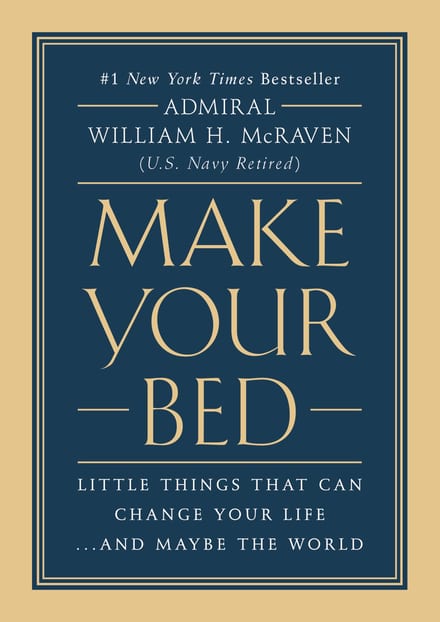
Make Your Bed
The full book runs ~144 pages — roughly 3 hours of reading. You get the key ideas here in 4 minutes.
The key ideas
- Make your bed—one finished task builds daily momentum.
- Paddle together—no one reaches their destination alone.
- Expect unfairness—stand tall, don't complain, drive on.
- Use failure as fuel—setbacks forge strength and speed.
- Measure heart, not stature—courage decides your success.
- Face bullies and despair—never, ever quit.
The summary
Discipline scales up from the smallest thing you can finish. That is the whole argument William McRaven, a four-star admiral and former commander of U.S. Special Operations Forces, distills from his years in the Navy SEALs. The first duty of every day in basic SEAL training was to make your bed to precise standards, and he came to see it as anything but trivial. “It demonstrated my discipline,” he writes. “It showed my attention to detail, and at the end of the day it would be a reminder that I had done something well, something to be proud of, no matter how small the task.” The proof of how much it mattered came later. After a serious parachute accident left him bedridden, the first thing he did once he could stand was make his hospital bed—his way of showing he had conquered the injury and was moving forward with his life. One completed task builds momentum for the next. Sometimes the simple act of making your bed gives you the lift you need to start your day and the satisfaction to end it right.
You cannot paddle the boat alone
None of what follows is a solo effort. In training, seven men had to carry and paddle a ten-foot rubber raft everywhere they went, an exercise built entirely around the fact that no one could do it alone. McRaven learned the same lesson off the obstacle course. After his parachute accident he slid into self-pity, until his wife gave him “the kind of tough love that I needed,” and his friends and commanding officer stepped in with the support that ultimately saved his career. “Like the small rubber boat we had in basic SEAL training, it takes a team of good people to get you to your destination in life. You cannot paddle the boat alone.”
Life is unfair, and failure is fuel
McRaven’s toughest lessons are about setbacks you don’t deserve. During uniform inspections, instructors invented arbitrary flaws and punished trainees by sending them into the ocean to roll in the sand until they were caked head to toe—a “sugar cookie.” The punishment was completely indiscriminate, with no rhyme or reason, which was the point. His instructor Moki Martin spelled it out: “Mr. Mac, life isn’t fair and the sooner you learn that the better off you will be.” Years later Martin was paralyzed in a bicycle accident, and McRaven says he never once heard him complain or ask “Why me?” Martin became an accomplished painter and founded a triathlon. Sometimes, no matter how hard you try, you still end up a sugar cookie. Don’t complain, don’t blame your misfortune—stand tall, look to the future, and drive on.
Failure works the same way if you let it. “The Circus” was two extra hours of grueling calisthenics handed out to trainees who underperformed, and McRaven and his swim buddy landed in it constantly because of their poor swim times. But the punishment that was meant to break them made them stronger, faster, and more confident in the water, and they became the first pair to finish the final five-mile swim. The pattern held across his career. When he was fired from a command and his reputation took a hit, he thought about quitting; instead he used the failure as motivation to outwork and outhustle everyone in the platoon, regained his men’s respect, and eventually went on to command all the SEALs on the West Coast. What decides whether you recover, he argues, isn’t your size or your background but the size of your heart. He recalls silently dismissing a “slightly built, almost frail” civilian at a training facility as someone who could never be a SEAL—only to learn the man was Lieutenant Tom Norris, a Medal of Honor recipient who had nearly been cut from training for being too small, and who proved everyone wrong.
Face the bullies, and never quit
Courage, for McRaven, is mostly refusing to flinch. On a night swim in shark-infested waters, trainees were taught that if a shark comes at you, you stand your ground—do not swim away, do not act afraid. He applies the same rule to human predators. After capturing Saddam Hussein, he watched the deposed dictator still intimidate the new Iraqi leaders, so he isolated him and made it plain that he was no longer important and could no longer frighten anyone. Bullies are all the same, he writes, whether in a schoolyard, a workplace, or ruling a country through terror; they feed on fear, and if you don’t find the courage to stand your ground, they will strike.
The final lesson is the one he holds hardest. After a helicopter crash killed thirty-eight special operators, McRaven struggled to console the grieving families until he watched Lieutenant General John Kelly, who had lost his own son in combat, speak to them. Hope, McRaven concluded, is the most powerful force in the universe: with it you can inspire nations, lift up the downtrodden, and ease the pain of unbearable loss, and sometimes all it takes is one person to make a difference. He saw that hope embodied in a hospital in Afghanistan, where a nineteen-year-old Ranger named Adam Bates, who had lost both legs on his first combat mission and could only communicate by sign language, sensed McRaven’s pity and signed, “I—will—be—OK.” A year later McRaven found him standing on prosthetic legs, laughing and challenging others to a pull-up contest. Quitting looks like an easy escape from temporary pain, but it buys a lifetime of regret. Never, ever quit.
The bottom line
Small acts of discipline compound into extraordinary achievement, but only if you accept that life is unfair, treat failure as fuel, lean on the people around you, and refuse to quit when it hurts. Read this if you need a short, bracing reminder that character gets built in the unglamorous moments when no one is watching.
Frequently asked questions
What is Make Your Bed about?
Drawn from Admiral William McRaven's years in the Navy SEALs, it argues that discipline scales up from the smallest thing you can finish. The first duty of every day in basic SEAL training was making your bed to precise standards, which he came to see as proof of discipline, attention to detail, and a completed task to be proud of. One finished task builds momentum for the next, so the small act can give you the lift to start your day and the satisfaction to end it right.
What are the key takeaways from Make Your Bed?
The book distills SEAL training into life lessons. Start with small wins, since making your bed compounds into larger discipline. You cannot paddle the boat alone, a lesson from the seven-man raft and from the friends and family who saved his career after his parachute accident. Life is unfair, so when you end up a "sugar cookie" through no fault of your own, don't complain, stand tall and drive on. Treat failure as fuel, as "The Circus" punishment did by making him stronger. Face down bullies who feed on fear, hold onto hope as the most powerful force, and never, ever quit.
Who should read Make Your Bed?
Anyone who needs a short, bracing reminder that character gets built in the unglamorous moments when no one is watching. It suits readers wanting a quick jolt of discipline and resilience rather than a detailed system.
Is Make Your Bed worth reading?
Yes, if you want a brief, punchy set of life principles backed by vivid stories, from Tom Norris nearly cut for being too small to Ranger Adam Bates signing "I will be OK" after losing both legs. Its strength is memorable, hard-won lessons delivered without padding. Readers wanting deep, novel frameworks may find the messages familiar and the tone plainly motivational, but the SEAL-training anecdotes give the well-worn advice real weight.