Book summary
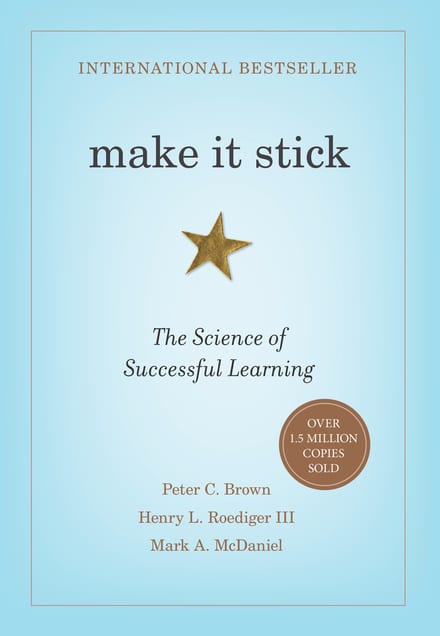
Make It Stick: The Science of Successful Learning
The Science of Successful Learning
The full book runs ~336 pages — roughly 6 hours of reading. You get the key ideas here in 5 minutes.
The key ideas
- Rereading builds fluency, not mastery — familiarity with a text feels like knowing it.
- Quizzed eighth graders averaged 92 percent, and 79 on material only reviewed.
- Spaced surgical training beat same-day training a month later on every measure.
- Interleaved practice scored worse during drills and three times better a week later.
- Learning styles have no evidence behind them; matching method to subject does.
- Trying and failing before you're taught beats being shown, if feedback follows.
The summary
Eight-year-olds spent twelve weeks in gym class tossing beanbags into buckets. Half threw at a bucket three feet away, every time. The other half practiced only at two and four feet, never three. Then everyone was tested at three feet, and the kids who had never practiced that throw won easily. That is Make It Stick in miniature: the practice that feels like it’s working usually isn’t. Peter Brown, a storyteller, wrote it with the cognitive psychologists Henry Roediger and Mark McDaniel, who spent a decade carrying memory research into classrooms.
Fluency is not mastery
Rereading is the most popular study strategy there is — more than 80 percent of college students in some surveys — and it barely works. In the mid-1960s Endel Tulving found that people who had read a list of words six times went on to memorize them no faster than people meeting them for the first time. Decades later a Washington University team gave 148 students five passages from textbooks and Scientific American; some read once, some twice in a row. There was no rereading benefit at all.
What rereading delivers is a feeling. Familiarity with a text gets mistaken for command of its ideas — the student who highlights his notes, reviews the highlights until it all looks obvious, and pulls a D. A UCLA professor of twenty-five years failed a quiz on the nearest fire extinguisher, then found it inches from his own doorknob.
Retrieval ties the knot
Pull a fact out of memory and you change it: you make it easier to pull out next time. Psychologists call this the testing effect — a test is not a measuring stick but the practice itself.
The authors talked a middle school in Columbia, Illinois into a trial. Short no-stakes quizzes covered a third of the material: one before the lesson, one after, one the day before the exam. Another third was simply restated for review. In eighth grade science, students averaged 92 percent on the quizzed material and 79 on the rest — and the restated third scored no better than material nobody revisited. The gap was still there eight months later. Yet in one survey only 11 percent of college students said they quiz themselves.
Space it, mix it, vary it
Thirty-eight surgical residents took four short lessons in microsurgery. Half did all four in one day, the normal schedule; half took one a week. A month later the spaced group was better on every measure — time, hand movements, success at reattaching the severed aortas of live rats. Sixteen percent of the crammed group damaged the vessels beyond repair and couldn’t finish.
Interleaving works the same way and feels worse. Students learning the volumes of four unfamiliar solids either practiced one type at a time or mixed the problems up. During practice the blocked group averaged 89 percent and the mixed group 60. A week later it inverted: 20 against 63. Cal Poly’s batters who faced fastballs, curveballs and changeups in random order struggled for six weeks and came out ahead of teammates who took fifteen of each in blocks — while insisting, even after seeing the scores, that the blocks had served them better.
The difficulties are the point
Elizabeth and Robert Bjork named these obstacles desirable difficulties, and the Army’s jump school at Fort Benning is built out of them. You carry no notebook. You practice the parachute landing fall in a gravel pit, then at escalating heights, and at the end of the harness run the instructor — not you — pulls the release, so you land from a direction you didn’t choose. When Mia Blundetto, a Marine lieutenant who hated falling, came down tangled in another jumper’s chute on her third jump, she simply swam out of it.
Effort does the work. Recalling something after a lapse forces you to rebuild it from long-term memory instead of echoing it back from short-term, and the rebuilding is what strengthens it. It is also why struggling with a problem before anyone teaches you the solution beats being shown — even when your attempt is wrong, if someone corrects you. B. F. Skinner once campaigned for “errorless learning,” material fed in bites too small to fail on. He had it backwards. When French sixth graders got unsolvable anagrams, the half then told that difficulty is normal used their working memory measurably better on the next test; the others had spent it agonizing.
What actually differs between learners
Not learning styles. In 2008 Harold Pashler, Mark McDaniel, Doug Rohrer and Bob Bjork reviewed the central claim — that you learn better when instruction matches your visual, auditory or kinesthetic preference — and found very few studies built to test it, virtually none validating it, and several contradicting it. What matters is matching the method to the subject: pictures for geometry, words for poetry.
The differences that survive scrutiny are more useful. Carol Dweck taught low-performing New York seventh graders that effort physically rewires the brain; without their teachers knowing, those students went on to outwork classmates who got a lesson on memory instead. James Paterson, a Welsh teacher who competes in world memory championships, took up mnemonics as a shortcut and could walk into exams with every name and date filed away — only to find he had “the mountaintops but not the mountain range.” Mnemonics organize knowledge you already own; they can’t buy it.
The bottom line
Durable learning comes from pulling knowledge out of your head rather than pushing it in: spaced far enough apart that you’ve gone rusty, mixed up enough that you must work out which problem you’re facing, effortful enough that it feels like failing. Your own sense of how well you’re learning is the least reliable instrument you own, so the fix has to be external — a quiz, a coach, a score you can’t argue with. Read it if you study, teach, coach or train anyone, yourself included.
Fact check
Popular books repeat findings that later research has complicated. Where Make It Stick makes a testable claim, here's what the evidence actually shows.
Low-stakes quizzing on class material produces markedly better exam scores than restating the same material for review, and the gap lasts for months.
Three experiments in the Columbia, Illinois middle school the book describes found that quizzed material beat material that was only reviewed on both chapter and end-of-semester exams, with the same pattern holding when students quizzed themselves online outside class. The companion paper in the eighth-grade science classes is the source of the summary's 92-versus-79 figures. A meta-analytic review of testing against restudy confirms the effect is general, and that recall-format quizzes deliver a larger benefit than recognition-format ones — the harder retrieval does the work.
- Roediger HL 3rd, Agarwal PK, McDaniel MA, McDermott KB. Test-enhanced learning in the classroom: long-term improvements from quizzing. J Exp Psychol Appl. 2011;17(4):382-95. PubMed
- McDaniel MA, Agarwal PK, Huelser BJ, McDermott KB, Roediger HL. Test-enhanced learning in a middle school science classroom: the effects of quiz frequency and placement. J Educ Psychol. 2011;103(2):399-414. Source
- Rowland CA. The effect of testing versus restudy on retention: a meta-analytic review of the testing effect. Psychol Bull. 2014;140(6):1432-63. PubMed
Spreading surgical training across weeks beats packing the same hours into a single day, as measured a month later.
Thirty-eight junior surgical residents were randomised to learn microvascular anastomosis either in one day or in four weekly sessions with identical total practice time. A month later the weekly group was better on time, hand movements and expert ratings, all at P < 0.05, and transferred better to the live-animal task — the study the summary describes, reported accurately. The wider distributed-practice literature agrees: a synthesis of 839 comparisons from 317 experiments found spacing reliably beats massing, with the best gap growing longer the longer you need to retain the material.
- Moulton CA, Dubrowski A, Macrae H, Graham B, Grober E, Reznick R. Teaching surgical skills: what kind of practice makes perfect?: a randomized, controlled trial. Ann Surg. 2006;244(3):400-9. PubMed
- Cepeda NJ, Pashler H, Vul E, Wixted JT, Rohrer D. Distributed practice in verbal recall tasks: a review and quantitative synthesis. Psychol Bull. 2006;132(3):354-80. PubMed
Mixing different problem types together during practice feels worse in the moment and produces far better retention a week later.
A meta-analysis of 59 studies and 238 effect sizes put the overall advantage of interleaving at Hedges's g = 0.42, so the effect is real — but it swings hard with the material. Interleaving helped most for visual categories such as paintings (g = 0.67) and moderately for mathematics (g = 0.34), the domain of the volume-of-solids experiment the summary cites, while for learning words blocked practice actually won (g = -0.39). It works best when the categories being mixed resemble each other closely enough that telling them apart is the skill worth training, which makes it a targeted tool rather than the general study default.
Teaching to a student's visual, auditory or kinesthetic learning style has no evidence behind it.
The 2008 review the summary names is reported correctly: Pashler, McDaniel, Rohrer and Bjork found very few studies designed to test the meshing hypothesis at all, virtually none supporting it, and several contradicting it, and concluded there is no adequate basis for putting learning-styles assessment into general practice. A later test in 426 undergraduate anatomy students found their VARK scores did not correlate with course performance, and students whose study habits happened to match their assigned style did no better than those whose habits did not. Preferences are real; matching instruction to them does not appear to help.
- Pashler H, McDaniel M, Rohrer D, Bjork R. Learning styles: concepts and evidence. Psychol Sci Public Interest. 2008;9(3):105-19. PubMed
- Husmann PR, O'Loughlin VD. Another nail in the coffin for learning styles? Disparities among undergraduate anatomy students' study strategies, class performance, and reported VARK learning styles. Anat Sci Educ. 2019;12(1):6-19. PubMed
Frequently asked questions
What is Make It Stick about?
It argues that the study habits that feel most productive — rereading, highlighting, cramming, drilling one thing until you've got it down — produce the least durable learning. What works instead feels worse: pulling knowledge back out of memory, spacing sessions apart until you've gone a little rusty, and mixing up problem types so you have to figure out which one you're facing. Two cognitive psychologists, Henry Roediger and Mark McDaniel, supply the research; Peter Brown tells the stories of people who learned hard things well.
What are the key takeaways from Make It Stick?
Four ideas carry the book. Retrieval practice: self-quizzing beats rereading, and the effect is large — quizzed eighth graders in one Illinois school averaged 92 percent against 79 percent on material they had only reviewed, eight months on. Spacing: surgical residents who took four microsurgery lessons a week apart outperformed those who took all four in a day on every measure. Interleaving: students who mixed geometry problem types scored worse in practice and three times better a week later. And desirable difficulties, the Bjorks' term for effort that slows you down now and pays later — including trying to solve something before you're taught it, and getting it wrong.
Who should read Make It Stick?
Anyone who has to learn something hard on a deadline — students, medical and law trainees, people studying a language or an instrument — and anyone responsible for teaching, coaching or training others. It's short, practical, and the final chapter is a set of concrete study routines you can start using the same day.
Is Make It Stick worth reading?
Yes, if you want the evidence rather than the slogan. The research is real, the numbers are specific, and the book is honest about where the science runs out — it says plainly what's still unproven. The catch is repetition: the authors deliberately circle back to the same principles chapter after chapter, since spacing and interleaving are the very things they're arguing for. If you already self-quiz and space your practice, you'll get less out of it than someone still highlighting a textbook.