Book summary
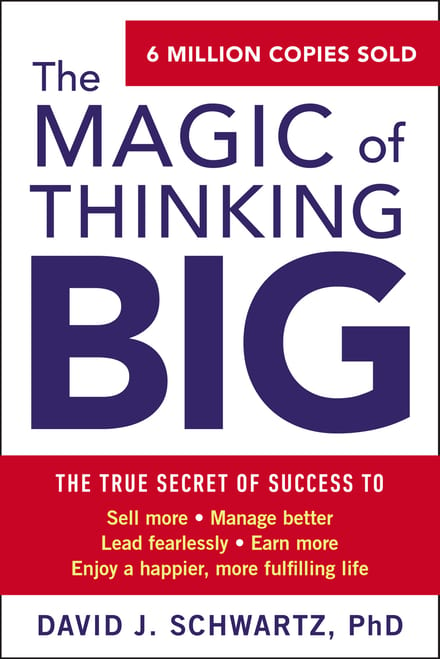
The Magic of Thinking Big
The full book runs ~270 pages — roughly 5 hours of reading. You get the key ideas here in 5 minutes.
The key ideas
- Believe big: your conviction sets the ceiling on success
- Cure excusitis by focusing on assets, not limitations
- Conquer fear through decisive action, not waiting
- Think big by using positive, expansive mental pictures
- Ask 'How can I do better?' to unlock creative solutions
- Act now: ideas mean nothing without execution
The summary
What you believe about your own capacity sets the ceiling on everything you’ll attempt, and attempts are the only thing that ever produces results. That’s the whole engine of David Schwartz’s book. Belief comes first and generates the skill and energy to follow through, not the other way around. “When you believe something can be done, really believe, your mind will find the ways to do it.” People who expect to succeed reach their goals far more often than the equally capable people who doubt themselves, partly because conviction makes others believe in you too. The size of your success tends to match the size of your belief. The trouble is that most people quietly talk themselves out of a bigger life, and they do it in a few predictable ways.
Excusitis and the fears that shrink you
Schwartz names the first mechanism “excusitis,” the disease of explaining away your failures. It comes in familiar strains: health (“I’m not well enough”), intelligence (“I’m not smart enough”), age (“I’m too old, or too young”), and luck (“things never go my way”). The cure is to fix your attention on your assets instead of your limitations and to refuse to argue yourself out of an opportunity. Fear works the same way, and the antidote is the same: isolate the specific fear, then act on it. Afraid of failing a test? Spend the worrying time studying. Afraid of losing a customer? Give better service. Afraid of people? Remember they’re more alike than different. Action starves fear; inaction feeds it. It helps to manage what you keep in your “mind bank”—deposit your achievements and compliments, refuse to withdraw old failures—and to behave confidently until you feel it, which can be as concrete as sitting up front, walking briskly, holding eye contact, speaking up in meetings, and smiling big.
Big thinkers paint big pictures
Schwartz contrasts two neighbors: one sees himself as a poor man fated to a run-down apartment forever, the other treats his current struggle as temporary and pictures himself an executive in a comfortable suburban home. The second man will go further, because big thinkers specialize in building positive, forward-looking pictures in their own minds and other people’s, and they use language that produces those pictures. Just as corrosive as excuses are the petty preoccupations that swallow attention—stewing over a small slip in a speech instead of the message you came to deliver, or winning a trivial argument at the cost of peace. Keep asking “is this really important?” and let the small stuff go. This bleeds directly into creativity, which Schwartz frames not as a gift reserved for geniuses but as finding better ways to do ordinary things. It starts with believing a solution exists, because disbelief shuts the mind down. Ban “it can’t be done,” ask yourself “how can I do this better?” and “how can I do more?”, and listen more than you talk, since ideas arrive faster when you’re taking in other people’s.
You are what you think you are
Your self-image quietly dictates how you act, and how you act shapes how others treat you. Think of yourself as inferior and you’ll behave that way and be taken at your word. So Schwartz has you manage the inputs. Upgrade your appearance and you feel more capable and read as more important. Treat your job as genuinely vital and your mind starts feeding you ways to do it better. Give yourself honest pep talks, and periodically ask “is this how an important person would think?” Environment matters just as much: the people around you either lift your ambition or smother it, so seek out big thinkers, avoid chronic negativity, and stay out of gossip, which he calls poison.
Action is the only thing that counts
Ideas are worthless until you move on them, and the people who wait for perfect conditions wait forever. Take action now and handle obstacles as they show up; the acting itself builds the confidence you were waiting to feel. Be the kind of person who volunteers rather than waits to be told. When something goes wrong, skip the blame—study the setback, find your own part in it, and adjust. Give the whole thing direction by setting ambitious ten-year goals across work, home, and social life, then breaking them into monthly and daily steps so every small task becomes a move toward the big one. The same outlook makes you a better leader: think from other people’s point of view, hold high standards others will rise to, and when you must criticize, do it privately—open with praise, name the one thing to fix, and close with praise again. Lyndon Johnson, Schwartz notes, made a point of learning everyone’s name and praising their work.
The bottom line
Belief is the engine; action is the vehicle. Nearly everyone underestimates what they could attempt, and the gap between them and the people who achieve more is mostly excuses, small thinking, and waiting. Read this if you’re ready to stop hedging and start acting on a bigger version of your ambitions.
Fact check
Popular books repeat findings that later research has complicated. Where The Magic of Thinking Big makes a testable claim, here's what the evidence actually shows.
Vividly picturing yourself already succeeding makes the success more likely to arrive.
Across four longitudinal samples — graduates job-hunting, students pursuing a romantic interest, undergraduates facing exams, and hip-replacement patients — positive expectations (judging the good outcome likely) predicted more effort and better results, while positive fantasies about the outcome predicted the opposite. The two halves of Schwartz's advice pull apart: conviction that a thing can be done tracks with doing it, but the vivid mental picture of yourself in the suburban house is the part that saps effort. Indulging the image appears to work as a partial substitute for the achievement rather than a rehearsal of it.
- Oettingen G, Mayer D. The motivating function of thinking about the future: expectations versus fantasies. J Pers Soc Psychol. 2002;83(5):1198-212. PubMed
People who expect to succeed reach their goals far more often than equally capable people who doubt themselves.
Of 50 candidate correlates assessed across 241 datasets, performance self-efficacy was the single strongest predictor of university GPA — so the association Schwartz describes is real and large when you compare one person with another. Within a single person it can reverse: when students felt more capable than their own baseline before an exam, they studied less and performed worse, and the sign of the effect depends on how ambiguous the performance feedback is. The most defensible reading is that confidence largely tracks competence already acquired rather than manufacturing it.
- Richardson M, Abraham C, Bond R. Psychological correlates of university students' academic performance: a systematic review and meta-analysis. Psychol Bull. 2012;138(2):353-87. PubMed
- Vancouver JB, Kendall LN. When self-efficacy negatively relates to motivation and performance in a learning context. J Appl Psychol. 2006;91(5):1146-53. PubMed
- Schmidt AM, DeShon RP. The moderating effects of performance ambiguity on the relationship between self-efficacy and performance. J Appl Psychol. 2010;95(3):572-81. PubMed
Carrying yourself confidently — sitting up front, walking briskly, holding eye contact — produces the confidence you were only acting.
A meta-analysis of 73 studies found that adopting an expansive, confident posture barely shifted how people felt compared with a neutral one (Hedges's g = 0.06), while a contractive, slumped posture clearly worsened mood and behaviour (g = 0.45). The gain, in other words, comes from not shrinking rather than from puffing up. A larger replication of the original power-posing experiment recovered no effect on hormones or risk-taking, though self-reported feelings of power are the part that has held up best. Schwartz's posture advice points in a defensible direction; the size of the payoff is smaller and more one-sided than he suggests.
- Elkjær E, Mikkelsen MB, Michalak J, Mennin DS, O'Toole MS. Expansive and contractive postures and movement: a systematic review and meta-analysis of the effect of motor displays on affective and behavioral responses. Perspect Psychol Sci. 2022;17(1):276-304. PubMed
- Ranehill E, Dreber A, Johannesson M, Leiberg S, Sul S, Weber RA. Assessing the robustness of power posing: no effect on hormones and risk tolerance in a large sample of men and women. Psychol Sci. 2015;26(5):653-6. PubMed
Frequently asked questions
What is The Magic of Thinking Big about?
Its engine is that what you believe about your own capacity sets the ceiling on everything you'll attempt, and attempts are the only thing that produces results. Belief comes first and generates the skill and energy to follow through, so the size of your success tends to match the size of your belief. The trouble is that most people quietly talk themselves out of a bigger life in a few predictable ways.
What are the key takeaways from The Magic of Thinking Big?
Schwartz names the mechanisms that shrink people and how to beat them. "Excusitis" is the disease of explaining away failure through health, intelligence, age, or luck, cured by focusing on your assets. Isolate a specific fear and act on it, since action starves fear while inaction feeds it. Big thinkers paint positive, forward-looking mental pictures and drop petty preoccupations by asking "is this really important?" Your self-image dictates how others treat you, so manage your inputs, appearance, and environment. And ideas are worthless until you act, so take action now, set ambitious ten-year goals, and break them into daily steps.
Who should read The Magic of Thinking Big?
Anyone ready to stop hedging and start acting on a bigger version of their ambitions. It fits people who sense they're underestimating what they could attempt and want a push to think and act larger.
Is The Magic of Thinking Big worth reading?
Yes, if you want a direct, motivating case that belief plus action beats talent held back by excuses, full of concrete habits like sitting up front, giving yourself honest pep talks, and volunteering rather than waiting. Its strength is naming the specific self-talk that shrinks people. Readers wanting research citations or nuanced psychology may find it dated and anecdotal, leaning on stories like the two neighbors or Lyndon Johnson learning everyone's name, but its practical prompts still land.