Book summary
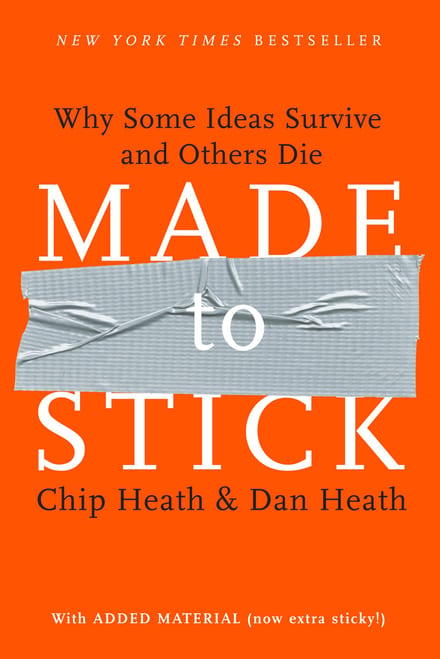
Made to Stick: Why Some Ideas Survive and Others Die
Why Some Ideas Survive and Others Die
The full book runs ~291 pages — roughly 5 hours of reading. You get the key ideas here in 5 minutes.
The key ideas
- Check every idea against SUCCESs: simple, unexpected, concrete, credible, emotional, story.
- Blame the curse of knowledge — knowing something erases the memory of not knowing.
- Remember the tappers: 120 songs drummed out, three guessed, half predicted.
- Find the core and let it decide: Southwest is THE low-fare airline.
- Hand the test to your audience instead of citing an outside authority.
- Build the appeal around one person, because statistics switch off the giving.
The summary
Urban legends travel the world on no budget at all. A memo about the company’s new strategy, backed by a leadership team and a deck, is forgotten by Thursday. Chip and Dan Heath’s answer is uncomfortable for anyone with something important to say: whether an idea sticks is a property of how it’s built, not of how true it is or how often you repeat it. The Kidney Heist — a business traveler, a drink from an attractive stranger, waking up in a bathtub of ice, the missing kidney — has circulated in hundreds of versions for years, and all of them keep the same three parts: the drugged drink, the ice, the punch line. Read it once and you could retell it tomorrow. Nobody can do that with your quarterly priorities.
The Heaths reverse-engineered the ideas that survive and found six traits. The acronym is SUCCESs — one letter short on purpose:
- Simple — find the single core of the idea and be ruthless about the rest.
- Unexpected — break a pattern to buy attention, then open a gap that has to be closed.
- Concrete — say it in things a person can picture.
- Credible — let the audience test it instead of taking your word.
- Emotional — attach it to something someone already cares about.
- Stories — give people a rehearsal, not just information.
None of that is a talent. It’s a checklist, and most people fail it for one specific reason.
The curse of knowledge does the damage
Chip Heath calls it the arch villain of the book: once you know something, you can no longer imagine what it’s like not to know it. Not arrogance — a blind spot, and it gets worse the better you get at your job.
The proof is a game a Stanford graduate student named Elizabeth Newton ran with tappers and listeners. Tappers got a slip of paper with a famous song — “Happy Birthday,” “Twinkle, Twinkle, Little Star” — and drummed out the rhythm on a table for a listener to guess. Out of 120 songs tapped, listeners got three. The tappers had predicted they’d get about half. Inside the tapper’s head there’s a full arrangement, melody and vocals and all; on the table there is Morse code. That gap is every expert presentation, every strategy rollout, every parent explaining something for the fifth time.
Find the core, then let the core do the deciding
Simple doesn’t mean dumbed down; it means core and compact. The Heaths borrow the military’s Commander’s Intent — the one line at the top of an order that survives contact with reality, so a soldier who can’t reach headquarters still knows the mission.
Herb Kelleher’s version at Southwest Airlines was that they are THE low-fare airline: once you understand that fact, he said, you can make any decision about this company’s future as well as I can. Should the Houston–Las Vegas route serve a chicken Caesar salad? Only if it makes Southwest the cheapest airline flying it. It doesn’t.
John F. Kennedy’s version, in his May 1961 address to Congress, was that the nation should commit itself to “landing a man on the moon and returning him safely to the earth” before the decade was out. Unexpected enough in 1961 to sound like science fiction — but the trait Chip Heath keeps pointing to is concreteness. Nobody could quibble about what man, moon, or decade meant. Run it through a modern communications department and you’d get something about becoming the international leader in aerospace, which nobody works weekends for.
Concrete, and testable by the person listening
Art Silverman at the Center for Science in the Public Interest knew that a medium bag of movie popcorn carried 37 grams of saturated fat against a USDA daily limit of 20. He also knew nobody feels a gram. So at a news conference in April 1994, CSPI said that one medium “butter” popcorn had more artery-clogging fat than a bacon-and-eggs breakfast, a Big Mac and fries, and a steak dinner with all the trimmings — combined. They laid the greasy buffet out for the cameras. It made the network news and the front pages. The chains didn’t actually fold, but thirty years on it’s the buffet people remember, not the grams.
Credibility works the same way. The instinct is to cite an outside authority; the Heaths’ better move is to hand the test to the audience. Barry Marshall, unable to convince his field that a bacterium caused stomach ulcers, drank a culture of it in 1984, got properly sick, and produced his own biopsy — an argument nobody could wave away, and one that ended in a share of the 2005 Nobel Prize.
Abstract values need the same treatment. “Customer service” means nothing until it’s the Nordstrom salesperson who gift-wrapped something a shopper had bought at a competitor.
People feel things for people, not for numbers
Emotion is not decoration. The Heaths’ case: we care about individuals, not abstractions — an appeal built around one named child raises more than one built on the scale of the famine. It’s the book’s most-quoted study and the one that has aged worst; a large preregistered replication found no trace of the effect. Write about a person rather than a percentage, but don’t treat it as a law.
Stories do the last job. A story works as a mental flight simulator — people rehearse a situation before they’re in it, so they move faster when it arrives. Which is why a company’s real values live in the anecdotes employees repeat, not in the framed statement in reception.
The bottom line
Sticky ideas aren’t born interesting; they’re designed. Strip yours to one core sentence, make it concrete enough that nobody can misread it, let people test it themselves, and wrap it in a person rather than a percentage. Read this if you have to make anyone remember anything — a teacher, a founder, a manager unveiling a strategy nobody would otherwise recall by Friday.
Fact check
Popular books repeat findings that later research has complicated. Where Made to Stick makes a testable claim, here's what the evidence actually shows.
In the tappers-and-listeners experiment, listeners correctly named only 3 of 120 songs drummed out on a table while the tappers predicted about half would be guessed, showing that knowing something makes it nearly impossible to imagine not knowing it.
The numbers are exactly right. Elizabeth Newton's 1990 Stanford dissertation reports 3 hits in 120 tries, a success rate of 2.5%, against a mean tapper prediction of 50% that ranged from 10 to 95 — a spread whose lowest guess still sat far above the real result, across 40 tapper-listener pairs. Two things worth knowing: it is an unpublished doctoral thesis rather than a peer-reviewed paper, and its own abstract gives a conflicting figure of two songs out of 150 that does not square with the 2.5% in its results table. The underlying bias does not rest on that one study — the curse of knowledge has been demonstrated independently in peer-reviewed work showing that knowing an outcome distorts how adults reason about what other people believe.
A charity appeal built around one named, pictured child raises more than one built on statistics, and putting donors into analytical mode before they give suppresses donations.
The original study found exactly this: participants gave $2.12 on average to a named seven-year-old girl versus $1.21 to statistical victims, and briefing them about the bias beforehand cut giving to $1.31 from $2.00. A preregistered replication with 1,004 participants found no trace of either effect, with an effect-size estimate of .000 (95% CI [.000, .003]) for identifiability and .001 for the debiasing manipulation. The same team re-analysed the 41-effect meta-analysis that had put the identifiable victim effect at r = .05 and found publication bias dragging it down to r = 0.002 (95% CI [0, 0.004]). The replication used hypothetical rather than real donations, which its authors flag as the main reason to keep testing rather than close the file.
- Small DA, Loewenstein G, Slovic P. Sympathy and callousness: The impact of deliberative thought on donations to identifiable and statistical victims. Organ Behav Hum Decis Process. 2007;102(2):143-153. Source
- Maier M, Wong YC, Feldman G. Revisiting and Rethinking the Identifiable Victim Effect: Replication and Extension of Small, Loewenstein, and Slovic (2007). Collabra: Psychology. 2024;9(1):90203. Source
At a press conference on 27 September 1992, the Center for Science in the Public Interest made movie popcorn's fat content vivid by stacking one medium bag against a full day of greasy meals, and the biggest theatre chains responded by dropping coconut oil.
The campaign is real and the comparison is quoted almost verbatim, but it ran in 1994, not 1992. CSPI's own 40th-anniversary timeline dates its pioneering movie-theatre popcorn study to 1994, and the Associated Press carried the bacon-and-eggs breakfast, Big Mac and large fries, and steak dinner comparison on 26 April 1994, the morning after the news conference; the lab work covered 12 theatres in San Francisco, Chicago and Washington across six chains. The 37-gram figure is consistent with what CSPI reported for a plain medium bag, though the number that led the coverage was 56 grams of saturated and trans fat for a medium with butter topping. The industry also did not fold as cleanly as the story suggests — no chain committed to changing oils when the study broke, one defended coconut oil on taste, and when CSPI repeated the study 15 years later only Cinemark, of the three largest chains, was popping in canola.
- Center for Science in the Public Interest. CSPI Annual Report: 40 Years, 1971-2011 (1994 timeline entry on the movie-theater popcorn study). Source
- Popcorn: a horror flick starring your heart. Associated Press, in Arizona Daily Wildcat, 26 April 1994. Source
- Movie popcorn has shocking calories, fat. CBS News, 19 November 2009. Source
Unable to persuade his field that a bacterium caused stomach ulcers, Barry Marshall drank a culture of it in 1984, made himself ill, and the work eventually earned a share of the 2005 Nobel Prize.
Both halves hold up. The self-infection is documented in the paper Marshall published the following year: a volunteer with a histologically normal stomach lining swallowed the organism, developed a mild illness that lasted 14 days, and had biopsy-proven gastritis by the tenth day. Marshall's own Nobel autobiography places it in 1984, after a year of failing to infect an animal model — he did not clear it with his hospital's ethics committee, on the reasoning that forgiveness would be easier to get than permission. He and Robin Warren shared the 2005 Nobel Prize in Physiology or Medicine for the discovery of Helicobacter pylori and its role in gastritis and peptic ulcer disease.
- Marshall BJ, Armstrong JA, McGechie DB, Glancy RJ. Attempt to fulfil Koch's postulates for pyloric Campylobacter. Med J Aust. 1985;142(8):436-9. PubMed
- The Nobel Prize in Physiology or Medicine 2005: Barry J. Marshall and J. Robin Warren [press release]. Nobel Assembly at Karolinska Institutet; 3 October 2005. Source
Frequently asked questions
What is Made to Stick about?
Whether an idea survives is a property of how it's built, not of how true it is or how often you repeat it. Chip and Dan Heath reverse-engineered the ideas that travel on no budget at all — urban legends like the Kidney Heist, which anyone can retell after one hearing — and found six traits the memorable ones share, while the strategy memo backed by a leadership team is forgotten by Thursday.
What are the key takeaways from Made to Stick?
The six traits spell SUCCESs, one letter short on purpose: simple, unexpected, concrete, credible, emotional, stories. The villain that stops people applying them is the curse of knowledge — once you know something you can't imagine not knowing it, and it gets worse the better you get at your job. Elizabeth Newton's tapping experiment is the proof: listeners identified 3 of 120 famous songs drummed on a table, while the tappers predicted about half. The fixes are practical. Find the core and let it decide things, the way Commander's Intent works in the military or Herb Kelleher's "THE low-fare airline" settled whether Southwest served a chicken Caesar salad. Make it concrete enough that nobody can misread it, as Kennedy did with landing a man on the moon and returning him safely before the decade was out. Let the audience test the claim themselves rather than citing authority — the greasy buffet CSPI laid out for the cameras in 1992, or Barry Marshall drinking a culture of the bacterium his field wouldn't accept. And wrap it in a person rather than a percentage, because analytical mode switches off the part of us that gives, while a story acts as a mental flight simulator.
Who should read Made to Stick?
Read it if you have to make anyone remember anything — a teacher, a founder, a manager unveiling a strategy nobody would otherwise recall by Friday.
Is Made to Stick worth reading?
The six traits are a checklist rather than a talent, which is the book's most useful claim, and the examples are chosen well enough that they demonstrate the point while making it. If you already write plainly and reach for stories by instinct, parts of it will confirm what you're doing rather than change it — though the curse of knowledge is exactly the blind spot that makes people think they're already clear.