Book summary
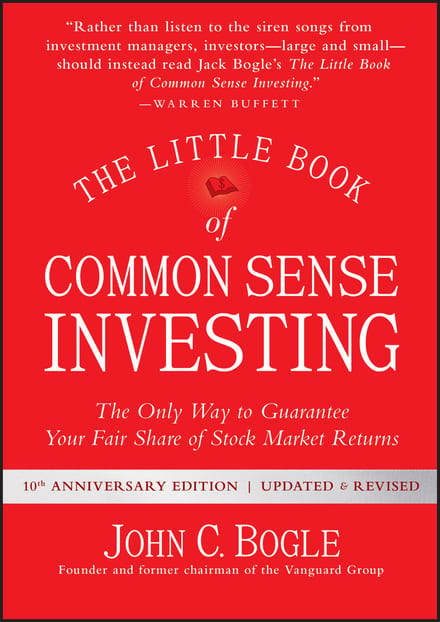
The Little Book of Common Sense Investing: The Only Way to Guarantee Your Fair Share of Stock Market Returns
The Only Way to Guarantee Your Fair Share of Stock Market Returns
The full book runs ~270 pages — roughly 5 hours of reading. You get the key ideas here in 5 minutes.
The key ideas
- Buy the haystack: 281 of the 355 equity funds from 1970 are gone.
- Mind the costs: 2 percent a year consumed 61 percent of a 50-year gain.
- Ignore the stars: only 13 percent of top-quintile funds stayed there five years on.
- Watch your behavior: the average fund investor trailed their own funds by 1.5 points.
- Expect less: 4 percent nominal stock returns for the decade after 2017.
- Allocate simply: Graham's 50/50 stocks and bonds, tuned to your risk tolerance.
The summary
Every dollar American business earns belongs to the people who own it. Bogle opens with a parable borrowed from Warren Buffett: a vast family called the Gotrocks owns every stock in the United States and collects all the dividends and earnings those thousands of companies produce. Then the Helpers arrive. Brokers persuade the smarter cousins to trade shares with each other for a commission; managers are hired to pick better stocks, consultants to pick better managers. Nothing about the underlying businesses changes, yet the family’s share of the pie slides from 100 percent to 60. The old uncle’s advice: fire everyone, own everything, sit still. That is exactly what an index fund does.
The arithmetic isn’t a theory. Investors as a group must earn precisely the market’s gross return, because collectively they are the market — subtract the fees, commissions and taxes they pay and the group must trail it by exactly that amount. Beating the market before costs is a zero-sum game; after costs it’s a loser’s game. Buffett’s addition to Newton: for investors as a whole, returns decrease as motion increases.
The tyranny of compounding costs
Actively managed equity funds carry expense ratios averaging about 1.3 percent a year. Add sales charges, then the invisible cost of turnover — these funds trade roughly 78 percent of their portfolios annually — and the all-in bill runs 2 to 3 percent.
Assume the market returns 7 percent a year for fifty years and a fund takes 2 percent of it. Ten thousand dollars in the market grows to $294,600; in the fund, to $114,700. Costs consumed 61 percent of the potential accumulation. You put up all the capital and took all the risk, and kept under 40 percent of the return.
The evidence sorts cleanly: over 25 years the cheapest quartile of equity funds returned 9.4 percent a year net, the priciest 8.3 — while their gross returns were nearly identical, 10.3 against 10.6. The gap is the fees and nothing else. Performance comes and goes; costs go on forever. Bogle’s sharpest illustration is dividends: in 2016, expenses swallowed 100 percent of the dividend income earned by actively managed growth funds and 58 percent in value funds. The index equivalents gave up 4 percent and 2.
Don’t look for the needle — buy the haystack
Fine, you think, I’ll pick the good ones. Of the 355 equity funds in business in 1970, 281 — nearly 80 percent — had ceased to exist by 2016. Of the survivors, ten beat the S&P 500 by more than a point a year and only two by more than two: Fidelity Magellan and Fidelity Contrafund. Both then reverted. Magellan’s assets swelled to $105 billion by 1999, then it trailed the index for two decades. A fat wallet, as Buffett says, is the enemy of superior returns.
Short records predict even less. Only 14 percent of the funds Morningstar rated five stars in 2004 still held five stars a decade later. Rank every active US equity fund by its 2006–2011 return and check the next five years: 13 percent of the top quintile stayed on top and 27 percent fell all the way to the bottom, while 17 percent of the previous losers finished at the top. That’s noise, not skill. Ted Aronson reckons it takes between 20 and 800 years of data to prove a manager is skilled rather than lucky; his own money sits in Vanguard index funds.
Your behavior costs more than the fees
Now the part that stings. Over those same 25 years the S&P 500 returned 9.1 percent a year, the average equity fund 7.8, and the average fund investor just 6.3. The second gap is self-inflicted: money pours in after good performance and runs out after bad. Investors put a net $18 billion into equity funds in 1990, when stocks were cheap, and $420 billion in 1999 and 2000, when they weren’t — and by then 95 percent of it was going into aggressive growth funds, against 20 percent a decade earlier.
Taxes finish the job. Active funds hold the average stock for 19 months and pass the gains through; after federal taxes their 7.8 percent falls to 6.6 while the index fund’s climbs to 8.6 — on $10,000 invested in 1991, a profit of $39,700 rather than $68,300.
Plan for thinner returns
Bogle refuses to project past returns forward. Stock returns come from dividend yield plus earnings growth, plus whatever the price/earnings multiple does. Writing in 2017, with the yield at 2 percent and the P/E already at 23.7, his sum came to about 4 percent a year for stocks. A 60/40 portfolio grossing 3.6 percent, minus 1.5 percent in active-management costs and 2 percent inflation, leaves 0.1 percent real. Costs and inflation eat a quarter of a 15 percent return but all of a 4 percent one.
On allocation he starts where Benjamin Graham did — 50/50 stocks and bonds, never outside 75/25 either way — then bends it toward your appetite for risk: up to 80 percent stocks while you’re accumulating, as low as 25 percent late in retirement. A low-cost 25/75 portfolio can out-earn a high-cost 75/25 one, 3.66 percent against 3.50, at far less risk. At 88, Bogle held half stocks and half bonds, all indexed, and admitted that half the time he thought he had too much in equities and the other half too little.
The bottom line
The market’s whole return is available to anyone willing to buy all of it and then leave it alone, and the same arithmetic that guarantees this guarantees that most people who try to do better will do worse. Costs are the one variable you fully control, which makes them the only dependable edge on offer. Read it if you want the case for indexing in numbers rather than slogans — and skip it if you already index, because Bogle makes the point twenty times with a founder’s stubbornness.
Fact check
Popular books repeat findings that later research has complicated. Where The Little Book of Common Sense Investing makes a testable claim, here's what the evidence actually shows.
Two percent a year in investment costs consumes about 61 percent of what a 50-year investment would otherwise accumulate.
The arithmetic is exact. Ten thousand dollars compounding at 7 percent for 50 years reaches $294,570; at 5 percent it reaches $114,674, so the two-point drag removes 61 percent of the ending balance and 63 percent of the gain. The premise underneath holds as well: Fama and French found the aggregate portfolio of actively managed US equity funds sits close to the market portfolio, with the high costs of active management passing through intact as lower returns to investors, and French estimated the typical investor would have added 67 basis points a year over 1980-2006 by switching to a passive market portfolio.
Past winners rarely repeat — only 13 percent of top-quintile US equity funds from 2006-2011 were still in the top quintile five years later, which means fund performance is noise rather than skill.
Bogle's quintile tables are his own tabulation, but the pattern they show is the standard finding. Carhart, using a sample free of survivor bias, demonstrated that common factors in stock returns and investment expenses almost completely explain persistence in equity fund returns, with the only unexplained persistence concentrated in repeated underperformance by the worst funds — no support for the existence of skilled or informed managers. Fama and French's bootstrap simulations landed in the same place: few funds produce benchmark-adjusted returns sufficient to cover their costs, and genuine skill shows up only in the extreme tails of the distribution.
Writing in 2017, Bogle projected roughly 4 percent nominal annual returns for US stocks over the decade ahead.
The S&P 500 returned about 15 percent a year including dividends from 2017 through 2025 — nine of the ten years in question — a cumulative gain of roughly 252 percent against the 42 percent that 4 percent a year would have delivered. Bogle's inputs were defensible at the time: a 2 percent dividend yield and a price/earnings ratio of 23.7, with the multiple assumed to drift back toward its historical range. Instead it expanded further, and that speculative component swamped the fundamentals. The miss is an argument for Bogle's own position that returns are not forecastable, not against indexing.
- Damodaran A. Annual returns on stock, T.bonds and T.bills: 1928 to current. Stern School of Business, New York University. Updated January 2026. Source
Frequently asked questions
What is The Little Book of Common Sense Investing about?
Investors as a group must earn exactly what the stock market earns before costs, because collectively they are the market. Once fees, trading costs and taxes come out, the group must trail the market by precisely that amount. Bogle's conclusion is that the only way to guarantee your fair share of business returns is to own the whole market through a very low-cost index fund and hold it forever.
What are the key takeaways from The Little Book of Common Sense Investing?
Costs compound against you: a fund taking 2 percent a year for fifty years consumed 61 percent of a $10,000 stake's potential growth. Picking winners barely works, since 281 of the 355 equity funds alive in 1970 no longer existed by 2016 and only two beat the S&P 500 by more than two points a year. Fund records revert to the mean, so five-star ratings and hot five-year runs predict almost nothing. And your own timing costs extra: the average fund investor earned 6.3 percent a year while the average fund earned 7.8 and the index returned 9.1.
Who should read The Little Book of Common Sense Investing?
Anyone choosing funds for a retirement account, a 401(k) or a first brokerage account who wants the arithmetic behind indexing rather than a slogan. It also suits investors currently paying an adviser or holding actively managed funds who have never added up what those fees cost over a lifetime.
Is The Little Book of Common Sense Investing worth reading?
Yes, if you want the case made in numbers — the fund survival data, the cost quartiles and the gap between fund returns and investor returns are hard to argue with. Bogle repeats himself, and the 2017 return forecasts and expense-ratio tables have aged, though the underlying arithmetic hasn't. If you already index and understand why, you can skip it.