Book summary
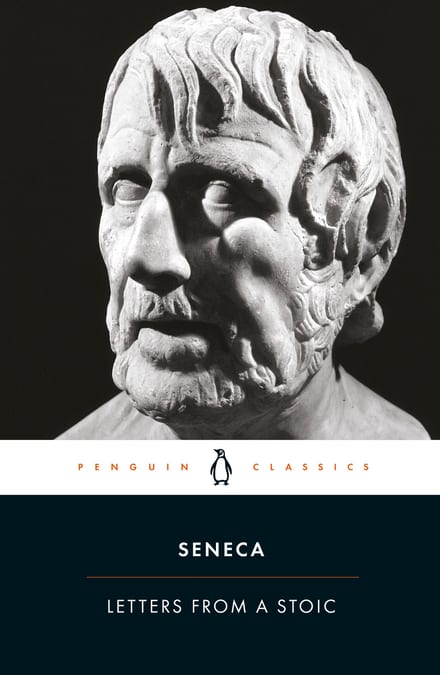
Letters from a Stoic
The full book runs ~222 pages — roughly 4 hours of reading. You get the key ideas here in 5 minutes.
The key ideas
- Guard your time: it is the one loan you can never repay.
- Rehearse poverty for days at a stretch, until hardship stops frightening you.
- Expect the worst that can happen, not the worst that usually does.
- Avoid crowds: you never bring home the character you took out.
- Judge a friend before you trust him, then hold nothing back.
- Own wealth dauntlessly: be as great with silver as with earthenware.
The summary
“Nothing, Lucilius, is ours, except time.” Everything else — your body, your money, your standing, the people you love — is on loan from Fortune, callable tonight. That claim organizes all 124 of these letters, and they are not a treatise. Seneca wrote them in his last years to a single man: Lucilius, a Roman knight serving as procurator in Sicily, a friend with Epicurean leanings he keeps trying to convert. He wanted them to sound like the two of them talking on a walk, “spontaneous and easy.” Most close with a maxim he calls the day’s profit, usually lifted from Epicurus: “I cross over even into the enemy’s camp — not as a deserter, but as a scout.”
Nothing is ours except time
Gather and save your time, he opens: it has been forced from you, filched away, or has merely slipped from your hands, and the most disgraceful loss is the careless kind. Look closely and you find that the largest portion of life passes while we are doing ill, a good share while doing nothing, and the whole of it while doing what is not to the purpose. Time is the one loan even a grateful recipient can never repay.
Death is not the appointment at the end of it. “We are mistaken when we look forward to death; the major portion of death has already passed.” Hence Cornelius Senecio, a knight who had climbed from nothing to the edge of real wealth. He spent a day at a dying friend’s bedside, ate a comfortable dinner, was seized in the night by quinsy, and was gone by daybreak. “How foolish it is to set out one’s life, when one is not even owner of the morrow!” Begin at once to live, and count each separate day as a separate life.
Rehearse the disaster, then stop dreading it
“There are more things, Lucilius, likely to frighten us than there are to crush us; we suffer more often in imagination than in reality.” We exaggerate sorrow, invent it, anticipate it, and spook cheaply, like soldiers abandoning camp over a dust cloud raised by stampeding cattle.
His answer to fear is not optimism, though. It’s rehearsal. Set aside a stretch of days on the cheapest food and roughest clothes and ask yourself: is this the condition that I feared? Let the pallet be real and the bread hard and grimy, three or four days at a stretch, so it’s a test and not a hobby. “If you would not have a man flinch when the crisis comes, train him before it comes.” Get on business terms with poverty and Fortune can’t ambush you with it.
When the colony of Lyons burned to the ground in one night — a city at its greatest, then a city non-existent — their steady friend Liberalis was knocked flat. Surprise does the damage, so rehearse not what usually happens but the very worst that can.
The crowd taints you; the right few make you
“I never bring back home the same character that I took abroad with me.” He drifted into a midday show at the arena expecting wit and relaxation, and found unarmed men shoved out to be killed during the interval, the crowd shouting kill him, lash him, burn him. He went home greedier, more ambitious, more cruel — and said so.
That isn’t misanthropy, it’s selection. Associate with those who will make a better man of you, welcome those you can improve; people learn while they teach. Friendship gets the same care: judge a man before you admit him, then trust him without reserve, speaking as boldly with him as with yourself. When one dies, weep but don’t wail. “I have had them as if I should one day lose them; I have lost them as if I have them still.” Then the blunt part: you have buried someone you loved, so go find someone to love. The logic runs down to the household: your slaves are comrades, fellow-slaves, since Fortune has equal rights over slave and free alike.
Own things without being owned by them
“It is not the man who has too little, but the man who craves more, that is poor.” The proper limit to wealth is to have what is necessary, then what is enough. He is not telling you to give it away — “I do not forbid you to possess it, but I would have you reach the point at which you possess it dauntlessly” — and he has no patience for theatrical simplicity, the unkempt hair and loud scorn for silver dishes. Philosophy calls for plain living, not penance.
Then he shows you the crack in his own practice. Travelling with his friend Maximus: a mattress on the ground, dried figs for bread, a farmer’s cart behind mules that only prove they’re alive by walking, the driver barefoot. When a smarter party passes on the road, Seneca blushes — and reports it against himself: the conduct he applauds “has not yet gained a firm and steadfast dwelling-place within me.” This from Nero’s former tutor, one of the richest men in Rome. The standard isn’t poverty but indifference: “He is a great man who uses earthenware dishes as if they were silver; but he is equally great who uses silver as if it were earthenware.”
The bottom line
All of it trains for one exam. Your arguments and gathered maxims prove nothing, since even the most timid man can deliver a bold speech — Seneca leaves it to death to decide what progress he made. Learn to die and you have unlearned slavery, because nobody holds a man whose way out is clear. Read this if Meditations left you wanting a teacher rather than a diary: Marcus argues with himself, Seneca talks to you, and he is honest enough to record that the very rich man preaching indifference to wealth still went red at the sight of his own cart.
Frequently asked questions
What is Letters from a Stoic about?
It is a set of 124 letters Seneca wrote in his final years to one friend, Lucilius, a Roman knight posted to Sicily. The argument running through all of them is that time is the only thing you actually own, and everything else — your body, your money, your standing, the people you love — is on loan from Fortune and can be called in tonight. So the work is to guard your time, practise losing everything else, and learn how to die.
What are the key takeaways from Letters from a Stoic?
Guard your time, since it is the one loan you can never repay, and count each day as a separate life. Rehearse hardship on purpose: spend three or four days at a stretch on the cheapest food and roughest clothes until poverty stops frightening you. Expect the worst that can happen rather than the worst that usually does, because surprise is what does the real damage. Avoid crowds, choose the few people who improve you, and judge a friend before you trust him rather than after. Keep wealth if you have it, but hold it loosely enough to put down.
Who should read Letters from a Stoic?
Anyone who wants Stoicism taught rather than overheard — Seneca is writing to a real person he is trying to persuade, so he explains, jokes and repeats himself. It suits readers who want practical exercises for anxiety, grief, money and mortality more than a system of philosophy.
Is Letters from a Stoic worth reading?
Yes, and it holds up as well as anything else on the shelf: the prose is warm, the examples are concrete, and Seneca admits where he falls short of his own advice, like blushing when a smarter party passes his farm cart on the road. The obvious objection is that one of the richest men in Rome, Nero's former tutor, is the one arguing for indifference to wealth. Read it with that tension in mind, and skip around — at 124 letters it repeats, and it was never meant to be read straight through.