Book summary
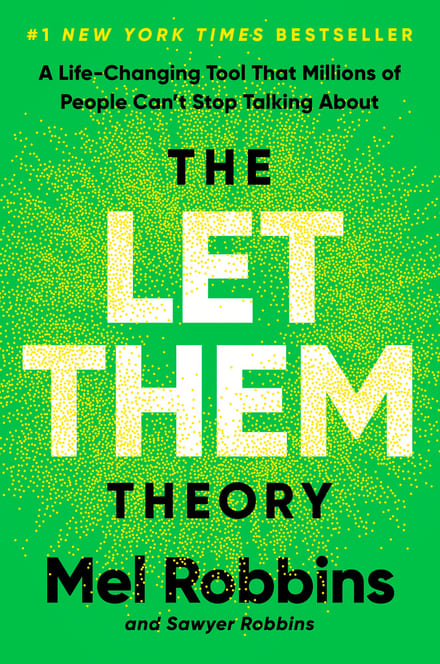
The Let Them Theory
The full book runs ~284 pages — roughly 5 hours of reading. You get the key ideas here in 7 minutes.
The key ideas
- Release control over others; reclaim power over yourself.
- Interrupt your hijacked stress response with 'Let Them, Let Me'.
- Stop performing for an imaginary audience of critics.
- Never manage another adult's emotions or reactions.
- Turn envy into a signal pointing to your next move.
- Stop chasing; actions reveal how people truly feel.
The summary
Two short phrases handle almost everything that drains you. Let Them releases your grip on what other people do. Let Me returns you to the only thing you actually control: what you do next. Mel Robbins found the idea while spinning out over her son’s prom, until her daughter told her to let the kids enjoy it their way. The stress vanished, and Robbins realized how much of her life she’d wasted forcing other people to match her expectations.
Let Them, then Let Me
Most daily misery comes from trying to control other adults’ behavior, thoughts, and feelings instead of focusing on yourself. If friends don’t invite you to brunch, let them. If the person you’re attracted to won’t commit, let them. If a family member or business partner won’t show up the way you need, let them be themselves, because they’re revealing exactly who they are. Their behavior is data about them, and once you accept it, you get to choose your response.
The same move defuses minor irritations. Modern life is full of small annoyances — slow walkers, a coughing passenger on a plane — that trip the amygdala’s stress response and shove your rational prefrontal cortex offline. Say “Let Them” to accept what you can’t control, then “Let Me” and take a breath to steady yourself: let them cough, let me put on headphones and a scarf. Without the second half, the theory collapses into isolation and neglect, so Let Me is where you take real responsibility — reaching out to people, fixing the deeper issue, or leaving a job that’s grinding you down rather than fuming about it.
Stop performing for an imaginary audience
Worrying about what people think breeds procrastination, self-doubt, and paralysis. Advised to promote her business on social media, Robbins didn’t post for two years because she feared friends and family would think she was arrogant or phony. The delay badly hurt her income and growth. She had put other people’s imagined opinions ahead of the action she needed to take.
Negative opinions are normal, even from people who love you, and you can’t control them, so grant others the freedom to think what they will. Family is the hardest place to apply this, because lifelong bonds and shared history run deep, and relatives often mistake control for care. Try to see their reactions through their frame of reference. When Robbins announced she was marrying Chris, her mother said she wouldn’t have chosen him, which stung for years — until Robbins understood the disapproval came from her mother’s fear of losing her daughter to distance, replaying her own painful experience of leaving home.
Never manage another adult’s emotions
Many grown people behave like emotionally immature children, and we wrongly take responsibility for managing their reactions, putting their feelings ahead of our own needs. It is never your job to manage another adult’s emotions. When someone gives you the silent treatment, plays the victim, or erupts, let them, and picture an eight-year-old trapped inside their body. Suddenly you don’t feel afraid; you feel compassion instead of contempt. A podcast listener wanted to call off his wedding but feared disappointing family and losing deposits. Robbins was blunt: his feelings were a clear sign to cancel. The logical choice was obvious; only the fear of causing others pain made it hard. Avoiding that hard conversation would just postpone and deepen the pain.
Comparison can trap you the same way. Obsessing over fixed traits you can’t change — looks, metabolism, family background — is torture. But comparison can also be a teacher. Molly, an interior designer, was jealous when a neighbor with no experience gained a big social media following, until she realized the neighbor was mirroring her own neglected need to build her website and online presence. The envy pointed straight to her next move.
You can’t force change, only influence it
People change when they feel like it, not when you pressure them. Change is hard and painful, pressure makes people dig in, and everyone believes they’re the exception to consequences, so threats and ultimatums get ignored. You can’t change anyone, but you can influence them by modeling the behavior yourself, because people learn by watching. For more active influence, use the ABC Loop:
- Apologize and Ask open questions that prompt self-reflection.
- Back off and give space while consistently modeling the behavior.
- Celebrate small progress with genuine reinforcement.
This doesn’t apply to emergencies, where you must intervene, and it isn’t a license to enable. Rescuing people from consequences hinders their healing. When Robbins’s daughter developed anxiety and started sleeping in her parents’ room, allowing it felt supportive but actually worsened her anxiety by teaching avoidance. Real support means offering space, tools, encouragement, and compassion without taking on the job of fixing them. Dating runs on the same principle: people’s actions reveal their true feelings, so stop chasing anyone who sends mixed signals. Be direct about wanting commitment, value your own time, and be ready to walk away if your needs aren’t met.
The bottom line
Stop pouring energy into controlling other people’s choices, emotions, and opinions, and pour it into the life you actually want. Accept what you can’t control, focus on what you can, and you reclaim the power that’s been leaking into dead ends. Read this if you’re exhausted from managing everyone else and ready to build something better.
Fact check
Popular books repeat findings that later research has complicated. Where The Let Them Theory makes a testable claim, here's what the evidence actually shows.
Small everyday irritations trip the amygdala's stress response and shove the rational prefrontal cortex offline.
The underlying mechanism is real: Arnsten's review documents that even mild, uncontrollable acute stress causes a rapid loss of prefrontal cognitive ability, and that prolonged stress alters the architecture of prefrontal dendrites. The amygdala-as-trigger framing is a simplification, though — three patients with bilateral amygdala damage still experienced full fear and panic attacks after inhaling 35% CO2, showing the amygdala is not required for the response. And the laboratory stressors that degrade prefrontal control are not slow walkers or a coughing passenger; "offline" describes weakened control, not a shutdown.
Letting an anxious child sleep in the parents' room feels supportive but deepens the anxiety by teaching avoidance.
Treating only the parents works as well as treating the child. In a randomized noninferiority trial of 124 children aged 7-14, Lebowitz's SPACE program — which coaches parents to stop accommodating and respond supportively instead — matched standard child CBT on every primary and secondary anxiety outcome, and reduced family accommodation significantly more than CBT did. A meta-analysis of accommodation and pediatric anxiety severity finds a moderate positive association on parent-reported measures, shrinking to small when accommodation and anxiety come from different informants. Letting a child sleep in the parents' bed is a textbook accommodation, so the example is squarely within what the research covers.
- Lebowitz ER, Marin C, Martino A, Shimshoni Y, Silverman WK. Parent-Based Treatment as Efficacious as Cognitive-Behavioral Therapy for Childhood Anxiety: A Randomized Noninferiority Study of Supportive Parenting for Anxious Childhood Emotions. J Am Acad Child Adolesc Psychiatry. 2020;59(3):362-372. PubMed
- Iniesta-Sepulveda M, Rodriguez-Jimenez T, Lebowitz ER, Goodman WK, Storch EA. The Relationship of Family Accommodation with Pediatric Anxiety Severity: Meta-analytic Findings and Child, Family and Methodological Moderators. Child Psychiatry Hum Dev. 2021;52(1):1-14. PubMed
Pressure, threats and ultimatums make people dig in; backing off and modelling the behaviour works better.
The effect is large but conditional on the person. Across 13 controlled studies covering 1,208 patients, highly reactant people did better when the therapist took a reflective, nondirective stance rather than a directive, authoritative one (d = 0.79) — but the relationship ran the other way for low-reactance patients, who did better with direction. Motivational interviewing, built on the same non-confrontational principle, produced a clinically relevant effect in roughly three of four of 72 randomized trials and outperformed traditional advice-giving. So backing off is the right move for people prone to digging in, not a universal law about everyone.
- Beutler LE, Edwards C, Someah K. Adapting psychotherapy to patient reactance level: A meta-analytic review. J Clin Psychol. 2018;74(11):1952-1963. PubMed
- Rubak S, Sandbaek A, Lauritzen T, Christensen B. Motivational interviewing: a systematic review and meta-analysis. Br J Gen Pract. 2005;55(513):305-12. PubMed
Frequently asked questions
What is The Let Them Theory about?
It's built on two short phrases. "Let Them" releases your grip on what other people do, and "Let Me" returns you to the only thing you control, what you do next. Robbins found the idea watching herself spin out over her son's prom, and realized how much of life she'd wasted forcing others to match her expectations. Most daily misery comes from trying to control other adults, and both halves are needed, since Let Them without Let Me collapses into neglect.
What are the key takeaways from The Let Them Theory?
The book applies the two phrases across life. Other people's behavior is data about who they are, so let them reveal it, then choose your response. Stop performing for an imaginary audience, since worrying what people think breeds procrastination, as when Robbins didn't promote her business for two years. Never manage another adult's emotions, and picture the eight-year-old inside someone throwing a tantrum to feel compassion instead of fear. And you can't force change, only influence it by modeling behavior yourself or using the ABC Loop: Apologize and Ask, Back off, Celebrate progress.
Who should read The Let Them Theory?
Anyone exhausted from managing everyone else and ready to build something better. It fits people who feel drained by other people's choices, moods, and opinions and want to reclaim that energy.
Is The Let Them Theory worth reading?
Yes, if you want a simple, repeatable mental tool for detaching from what you can't control, backed by relatable stories like the neighbor Molly's envy pointing straight to her own neglected goal. Its strength is the pairing of Let Them with Let Me, which keeps the idea from sliding into passivity or avoidance. Readers wanting deep psychological theory may find it light, and the two-phrase framing repetitive across chapters, but the practicality is the draw.