Book summary
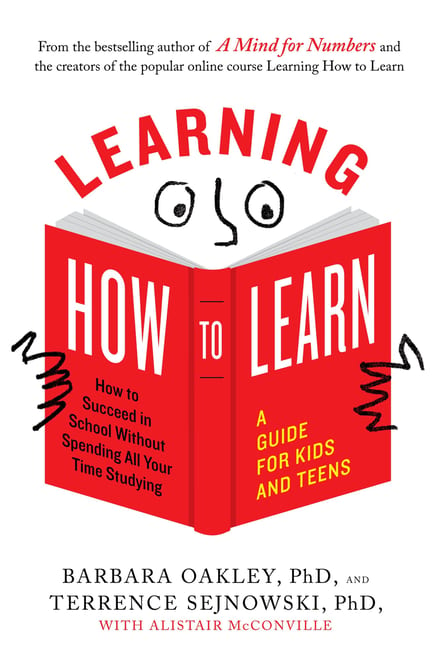
Learning How to Learn
How to Succeed in School Without Spending All Your Time Studying
The full book runs ~256 pages — roughly 5 hours of reading. You get the key ideas here in 6 minutes.
The key ideas
- Alternate focused concentration with diffuse, wandering thought to solve problems
- Retrieve ideas from memory instead of passively rereading them
- Space practice across days and sleep to consolidate memory
- Interleave problem types to learn which tool fits when
- Beat procrastination with 25-minute Pomodoro intervals and rewards
- Teach others, exercise, and use vivid metaphors to cement learning
The summary
You can’t learn well in one gear. Barbara Oakley and Terrence Sejnowski open from neuroscience: the brain runs in two modes, and you need both. Focused mode is tight, deliberate concentration on the thing in front of you. Diffuse mode is the loose, wandering state that takes over when you step away—in the shower, on a walk, half-asleep. Focused mode loads the material; diffuse mode quietly wires it into connections. That’s why, when you’re genuinely stuck, the smartest move is often to stop staring at the page and go do something else. Your brain keeps working the problem in the background.
Sleep is the third ingredient, and it isn’t negotiable. While you’re out, neurons grow new dendritic spines—the tiny branches that link one neuron to another—and the brain consolidates what you studied that day. Cramming the night before doesn’t just leave you groggy; it robs you of the sleep cycles that turn fragile new facts into durable structure. This single fact reshapes how you should study: not one heroic session, but shorter ones spread across days with sleep in between.
Pull it from memory, don’t reread it
The most powerful technique in the book is active recall: shut the book and force the key ideas back up from your own mind. Skim first—a “picture walk” over the headings, diagrams, and summaries to get oriented—then read closely, jot a few points, and look away to reconstruct the main ideas without peeking. That effort of retrieval is what builds strong brain-links, the well-worn thought patterns experts rely on to move fast through hard material. Rereading feels like progress and mostly isn’t; recognizing a sentence on the page is not the same as being able to produce it.
There’s a hard limit you’re working against. Working memory holds only about four items at once and tires within ten or fifteen seconds, so anything worth keeping has to move into long-term storage through repetition and retrieval. Nelson Dellis went from forgetful to memory champion using techniques anyone can borrow—focus, practice, vivid pictures, linking new facts to things you already know, and frequent recall. His signature trick is the memory palace: mentally stashing items around a familiar place. To remember milk, tomatoes, and bananas, you might picture a milk bottle blocking your front door, the sink full of tomatoes, a banana jammed in the blinds. The brain is far better at spatial and visual memory than at abstract lists, so give it images.
Space it out and mix it up
Two habits separate real learning from the illusion of it. The first is spacing: spread practice across several days rather than massing it into one marathon. Forgetting a little between sessions makes the next retrieval harder, and that difficulty is what strengthens the memory. The second is interleaving: mix different problem types in a session instead of drilling one until you’re numb. If chapter 4 of your algebra book teaches one method and chapter 5 another, don’t finish all of chapter 4 before starting chapter 5—alternate between them, so you learn not just how to solve each type but when to use which. Interleaving feels clumsier in the moment, which is exactly why it works.
Beat procrastination, then protect your attention
Procrastination seems harmless in small doses, but over a term it quietly wrecks you, because it denies your brain the spaced time it needs to build anything solid. The fix Oakley recommends is the Pomodoro Technique: work in focused 25-minute blocks, then take a short break and give yourself a small reward. The timer manufactures a little urgency; the reward trains the habit. Think of your habits as zombies that lurch toward their goals on autopilot—you can’t kill them, but you can redirect them by changing the cue. If notifications derail you, the phone goes in another room.
Distraction and task-switching drain your attention and stop brain-links from forming, so guard your study time. Music with lyrics tends to pull focus; silence or instrumental usually serves better, though the honest move is to treat yourself like a scientist watching from the ceiling and test what actually works for you rather than what you wish did.
Feed the brain and lean into difficulty
A few things make learning physically easier. Metaphors are a shortcut because they run new ideas over neural pathways you’ve already built—picture neurons as aliens trading tiny friendly electric shocks, and the more often they shock each other, the stronger the bond. Exercise helps directly: it grows new neurons in the hippocampus, the brain’s memory hub, and releases BDNF, a chemical that acts like fertilizer for neurons. And sleep, once more, does the consolidating.
Use tests as tools, not just verdicts—retrieving under exam conditions strengthens memory more than extra reading. On a test, try the hard-start technique: begin with a difficult problem, and the moment you stall, switch to an easy one so focused mode chews on the hard one while diffuse mode works underneath. Teaching someone else exposes the gaps you didn’t know you had. And don’t envy the fast learners; slower ones often build more creative, better-linked understanding because they’re forced to simplify.
The bottom line
Learning sticks when you retrieve instead of reread, space practice across days, mix problem types, and sleep enough for your brain to wire it all in. Read this if you’re a student or lifelong learner tired of pouring hours into studying that doesn’t hold.
Fact check
Popular books repeat findings that later research has complicated. Where Learning How to Learn makes a testable claim, here's what the evidence actually shows.
Retrieving material from memory and spreading practice across days beats rereading and cramming.
This is the book's central advice and it holds up better than almost anything else in the study-skills literature. A review of ten techniques for Psychological Science in the Public Interest gave the top "high utility" rating to exactly two — practice testing and distributed practice — because they work across ages, abilities, materials and test formats. Rereading and highlighting, the two things students actually do most, landed in the low-utility group. Interleaving, which the book pushes just as hard, got a moderate rating: promising, with thinner classroom evidence behind it.
- Dunlosky J, Rawson KA, Marsh EJ, Nathan MJ, Willingham DT. Improving Students' Learning With Effective Learning Techniques: Promising Directions From Cognitive and Educational Psychology. Psychol Sci Public Interest. 2013;14(1):4-58. PubMed
When you're stuck, stepping away lets a diffuse mode of thinking work the problem in the background and solve it.
A meta-analysis of the incubation literature found a positive overall effect, so the basic advice to take a break is sound. It is far more conditional than the two-gear metaphor implies: divergent-thinking tasks benefit most, a longer stretch of work on the problem beforehand produces a bigger effect, and filling the break with cognitively demanding work shrinks it. Awkwardly for a story about the mind idling productively, low-demand activity during the break outperformed pure rest on verbal insight problems. The focused/diffuse split is a teaching metaphor rather than a mapped pair of brain modes.
- Sio UN, Ormerod TC. Does incubation enhance problem solving? A meta-analytic review. Psychol Bull. 2009;135(1):94-120. PubMed
Sleep after studying grows new dendritic spines and consolidates what you learned that day.
Two-photon imaging of mouse motor cortex caught this happening directly: sleep after motor learning drove new postsynaptic dendritic spines on a specific subset of branches, and those spines were protected from elimination when a second task was learned. The mechanism is reactivation of the learning-active neurons during non-REM sleep — disrupt that reactivation and the branch-specific spine growth does not occur. The limit is species. This is mouse cortex watched directly, which cannot be done in people, so the human version of the claim rests on behavioural memory studies rather than on seeing the synapses form.
- Yang G, Lai CS, Cichon J, Ma L, Li W, Gan WB. Sleep promotes branch-specific formation of dendritic spines after learning. Science. 2014;344(6188):1173-8. PubMed
Exercise grows new neurons in the hippocampus and releases BDNF, which acts like fertilizer for them.
The benefit to the hippocampus is real in humans: a randomized trial of 120 older adults found a year of aerobic training increased anterior hippocampal volume by 2%, reversing one to two years of age-related loss, with the gains tracking rises in serum BDNF while the control group's hippocampus kept shrinking. Whether that means new neurons in adult humans is genuinely unsettled. A 2018 Nature study found no young neurons in the dentate gyrus of anyone aged 18 to 77; a 2019 Nature Medicine study using different tissue-handling methods reported thousands of immature neurons into the ninth decade. Neurogenesis is well established in exercising rodents and still contested in people, so the mechanism is an extrapolation.
- Erickson KI, Voss MW, Prakash RS, et al. Exercise training increases size of hippocampus and improves memory. Proc Natl Acad Sci U S A. 2011;108(7):3017-22. PubMed
- Sorrells SF, Paredes MF, Cebrian-Silla A, et al. Human hippocampal neurogenesis drops sharply in children to undetectable levels in adults. Nature. 2018;555(7696):377-381. PubMed
- Moreno-Jimenez EP, Flor-Garcia M, Terreros-Roncal J, et al. Adult hippocampal neurogenesis is abundant in neurologically healthy subjects and drops sharply in patients with Alzheimer's disease. Nat Med. 2019;25(4):554-560. PubMed
Frequently asked questions
What is Learning How to Learn about?
It uses neuroscience to explain how learning actually sticks. The brain runs in two modes, focused (tight, deliberate concentration) and diffuse (the loose, wandering state that takes over when you step away), and you need both, which is why stepping back from a stuck problem often solves it. Sleep is the non-negotiable third ingredient, when neurons grow the dendritic spines that turn fragile new facts into durable structure.
What are the key takeaways from Learning How to Learn?
The most powerful technique is active recall: shut the book and force ideas back from memory rather than rereading, which only feels like progress. Because working memory holds only about four items, real learning moves material into long-term storage through repetition and retrieval, aided by tricks like the memory palace. Two habits separate real learning from illusion: spacing practice across days and interleaving different problem types instead of drilling one. The book also counters procrastination with the Pomodoro Technique, and notes that exercise, metaphors, teaching others, and the hard-start technique all make learning easier.
Who should read Learning How to Learn?
Any student or lifelong learner tired of pouring hours into studying that doesn't hold. It's for people who want their effort to actually stick rather than evaporate before an exam.
Is Learning How to Learn worth reading?
Yes, if you want evidence-based study techniques explained simply, with the biology behind why rereading fails and retrieval works. Its strength is turning research on memory, sleep, and attention into concrete habits like Pomodoro blocks, spaced practice, and memory palaces. Readers already familiar with the science of learning may find some advice well-trodden, but the book packages it into an actionable system rather than abstract theory.