Book summary
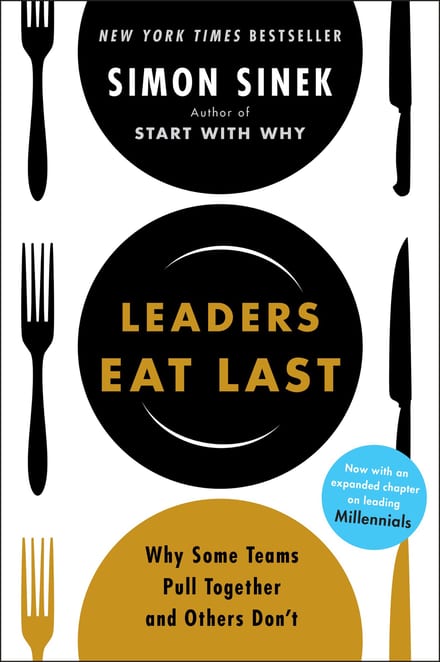
Leaders Eat Last
Why Some Teams Pull Together and Others Don't
The full book runs ~368 pages — roughly 7 hours of reading. You get the key ideas here in 5 minutes.
The key ideas
- Build a Circle of Safety against internal threats
- Balance selfish chemicals with trust-building serotonin and oxytocin
- Beware chronic cortisol—it breeds paranoia and hoarding
- Keep teams small enough to see human impact
- Choose costly integrity over profitable cover-ups
- Cure metric addiction through service and shared hardship
The summary
Leadership isn’t authority. It’s the willingness to absorb risk so the people you lead don’t have to feel it. Sinek’s title comes from a Marine mess hall, where the most junior are served first and the most senior eat last — no order given, they just do it. The ritual encodes the real price of leading: putting others’ needs above your own. When leaders run toward danger instead of away, and shield their people from internal threats, something changes. Employees stop spending energy protecting themselves and start cooperating, taking risks, and telling the truth — the things that actually move an organization.
Sinek calls the protected space a Circle of Safety. Inside it, people feel secure from the dangers that usually come from within a company: layoffs timed to quarterly targets, bosses who scapegoat their staff, cultures of blame and intimidation. Remove those and all that defensive energy turns outward, toward the real competition and real opportunities outside. It isn’t soft management; it’s strategic. When Bob Chapman took over a manufacturing company, he stripped the locks and fences off the tool room and let any worker check out what they needed — treating people like people rather than suspected thieves. Revenue climbed from $55 million to $95 million. Every employee, Sinek reminds leaders, is someone’s son or daughter, entrusted to your care.
The chemistry of trust
Underneath all of this is biology. Four chemicals shaped for survival drive much of how we behave. Endorphins and dopamine are the “selfish” ones that reward individual achievement: endorphins mask physical pain, which is the runner’s high, while dopamine delivers the hit of satisfaction when you finish a task or find what you were after. They kept our ancestors hunting, but they’re addictive — you can get hooked on hitting targets and lose sight of why the targets mattered.
Serotonin and oxytocin are the “selfless” chemicals that bind groups together. Serotonin produces pride and status when others respect you, which is why you can feel accountable to people but never to a number. Oxytocin is the feeling of love, trust, and safety, and without it nobody wants to be generous. Then there’s cortisol, the stress chemical that signals danger. A jolt keeps you alert, but it was never meant to linger. Chronic cortisol — the product of a fearful workplace — suppresses oxytocin, damages the immune system, and locks people into self-preservation. They stop trusting colleagues, hoard information, and cover themselves instead of taking smart risks.
Why trust breaks at scale
Trust is what lets people bend the rules when it matters. Sinek points to an experienced air traffic controller who knowingly broke strict airspace protocol to let a distressed pilot descend immediately, saving 126 lives. “To a social animal, trust is like lubrication,” he writes. But scale corrodes it. As organizations grow, leaders drift physically away from the workers and the customers, and the brain can’t empathize with people it can’t see. Stanley Milgram’s 1961 experiment showed the danger: 65% of participants would deliver what they thought were lethal shocks to a stranger in another room simply because an authority told them to. Distance makes harm easy.
The fixes are concrete. Bill Gore capped his factories at about 150 people to keep camaraderie intact. Wells Fargo saw employee motivation surge after inviting a customer in to describe how a loan had changed her life. When the dopamine of metrics starts outweighing the oxytocin of connection, you get what Sinek calls Destructive Abundance — cultures that chase the score and forget why they began playing. The Peanut Corporation of America knowingly shipped salmonella-contaminated products to protect short-term profit, and people died. Goldman Sachs went from Wall Street’s most trusted firm to a symbol of greed after the mortgage crisis, its CEO eventually apologizing for participating in “things that were clearly wrong.”
Integrity, service, and shared hardship
Real authority comes from honesty, even when it’s expensive. In 2009 Ralph Lauren discovered its Argentine subsidiary had paid nearly $600,000 in bribes; the executives reported themselves and paid over $1.6 million in penalties rather than bury it, proving integrity was worth more than the loss. Contrast that with leaders who put shareholders above their people. Jim Sinegal built Costco by rejecting retail’s low-wage orthodoxy and treating employees like family, and the company thrived because of it, not in spite of it. Sinek even reads congressional dysfunction this way: members who once lived in Washington together now commute in for a few days, and the social bonds that made cooperation possible have frayed.
The modern threat, he argues, is addiction to instant gratification — social media, notifications, performance metrics, all delivering dopamine hits that mimic alcoholism and crowd out deep relationships; the more time people spent on Facebook, one study found, the worse they felt. The antidote is service. Doing real things for real people releases oxytocin and pulls you out of self-interest. So does shared struggle: the Greatest Generation was forged by the Depression and the Second World War, united by a cause larger than themselves. Good leaders reframe hard challenges the same way, because years later people don’t remember the work — they remember the camaraderie, how the group pulled together to get it done.
The bottom line
Leadership is the willingness to make your people feel safe from the threats inside the organization so they can spend their energy on the ones outside it. Cooperation, candor, and real performance aren’t things you demand; they’re what you earn by putting others first. Read this if you lead a team you suspect has quietly gone into self-protection mode, or if you want to understand why some groups pull together and others just survive.
Fact check
Popular books repeat findings that later research has complicated. Where Leaders Eat Last makes a testable claim, here's what the evidence actually shows.
Oxytocin is the chemical of trust and safety, one of four chemicals whose balance explains why some teams cooperate and others do not.
The oxytocin-equals-trust link rests on a 2005 finding that has not held up. A double-blind, placebo-controlled replication powered above 95%, using the same minimal-social-contact setup as the original, found no effect of oxytocin on trusting behaviour in the trust game. A review of the full literature — intranasal dosing, blood and saliva levels, and genetic variants — concluded the cumulative evidence does not show human trust is reliably associated with oxytocin or caused by it, and that peripheral measurements of the hormone are themselves unreliable. The four-chemical scheme works as a metaphor for the difference between individual reward and group belonging; it is not an established mechanism.
Milgram's obedience experiment showed that 65% of ordinary people will deliver what they believe are lethal shocks when an authority tells them to, because distance makes harm easy.
The number is roughly right for one condition and misleading as a statement about people in general. Pooling all 21 conditions Milgram ran (740 participants), 43.6% went to the 450-volt maximum; the most-cited baseline condition produced 62.5%. Situation did most of the work — obedience rose with a directive experimenter and an indirect relation to the learner, and fell with group pressure to disobey and closer teacher-learner proximity — which broadly supports the distance argument, with one wrinkle: distance from the victim raised obedience, but distance from the experimenter lowered it. Burger's 2006 partial replication found rates only slightly below Milgram's 45 years earlier, so the effect is not a period piece.
Human groups have a cognitive ceiling of about 150 relationships, which is why Bill Gore capped his factories at that size.
Reanalysing the primate brain-size data the figure was derived from, using the same regression logic with modern statistics, produced a 95% confidence interval for human group size of 4 to 520 people (2 to 336 on a second specification). The authors' conclusion is not that a different number is correct but that the method cannot support any specific number. Small units may still be worth keeping for other reasons — coordination cost, and being able to see the effect of your work on a colleague — but 150 is not a measured cognitive limit.
- Lindenfors P, Wartel A, Lind J. 'Dunbar's number' deconstructed. Biol Lett. 2021;17(5):20210158. PubMed
Chronic workplace stress keeps cortisol elevated, which suppresses oxytocin and damages the immune system.
The immune half is well supported. A meta-analysis of more than 300 studies found that chronic stressors suppressed both cellular and humoral immune measures, while acute stressors lasting minutes were associated with adaptive upregulation of some parameters — close to Sinek's point that a jolt of stress is useful and a permanent one is corrosive. The cortisol-suppresses-oxytocin step is the weak link: oxytocin measured in blood or saliva is not a dependable readout of central activity, so the specific chemical trade-off described has not been demonstrated.
- Segerstrom SC, Miller GE. Psychological stress and the human immune system: a meta-analytic study of 30 years of inquiry. Psychol Bull. 2004;130(4):601-30. PubMed
- Nave G, Camerer C, McCullough M. Does oxytocin increase trust in humans? A critical review of research. Perspect Psychol Sci. 2015;10(6):772-89. PubMed
Frequently asked questions
What is Leaders Eat Last about?
It argues that leadership isn't authority but the willingness to absorb risk so the people you lead don't have to feel it. The title comes from a Marine mess hall where the most senior eat last, encoding the real price of leading. When leaders shield their people from internal threats, employees stop protecting themselves and start cooperating, taking risks, and telling the truth, the things that actually move an organization.
What are the key takeaways from Leaders Eat Last?
The central idea is the Circle of Safety: remove internal dangers like layoffs, scapegoating, and blame, and defensive energy turns outward toward real competition. Sinek grounds it in biology, contrasting the "selfish" chemicals endorphins and dopamine, which reward achievement and can become addictive, with the "selfless" ones serotonin and oxytocin, which build trust and belonging, while chronic cortisol from fear poisons the whole system. Trust breaks at scale as leaders drift from their people, producing what he calls Destructive Abundance, where chasing metrics crowds out why the work began. Real authority comes from honesty, service, and shared hardship.
Who should read Leaders Eat Last?
Anyone who leads a team they suspect has quietly gone into self-protection mode, or who wants to understand why some groups pull together and others just survive. It's aimed at managers and leaders rather than individual contributors.
Is Leaders Eat Last worth reading?
Yes, if you want a people-first case for leadership backed by memorable examples, from Bob Chapman removing tool-room locks and watching revenue climb to Costco thriving by treating employees like family. The biological framing of trust chemicals makes the argument stick. Readers wanting rigorous science or step-by-step tactics may find the chemistry simplified and the advice more inspirational than procedural, but the core message about earning cooperation rather than demanding it is clear.