Book summary
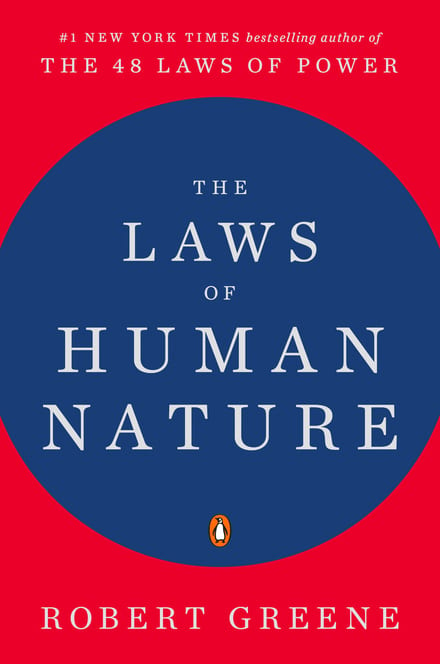
The Laws of Human Nature
The full book runs ~609 pages — roughly 11 hours of reading. You get the key ideas here in 5 minutes.
The key ideas
- Train rationality: Pericles never decided while a strong emotion still held him.
- Check superiority bias: you spot everyone's irrationality except your own.
- Spot deep narcissists: no self to love, so people become instruments.
- Watch the Shadow: out-of-character behavior is usually more of the character.
- Read envy early: effusive praise, gossip, then criticism unrelated to anything you did.
- Elevate your perspective: crowds shrink your time frame, as Newton learned at £20,000.
The summary
You believe you are rational, decent, and mostly in charge of what you do. Robert Greene’s answer is that you are not, and neither is anyone else. Under ordinary polite behavior run forces shaped by five million years of evolving as a social animal: hunger for attention, the compulsion to rank yourself against everyone nearby, tribal instinct, hidden aggression. You see the output and almost never the machinery. Greene treats each force as a law, because under its influence people react predictably. This is the mirror image of The 48 Laws of Power — the opponent to outmaneuver is your own wiring.
Rationality is a skill, not a starting condition
Pericles looked at Athenian politics and noticed that every leader believed himself rational. They had plans, factions, and excellent explanations for whatever went wrong, yet the city lurched from crisis to crisis. They were not rational, he concluded, only selfish and shrewd — driven by appetite for power, attention and money.
So he trained himself never to decide while a strong emotion held him. When the Assembly got heated he went home and stayed alone for days until he had calmed down, judging every policy by one standard: what actually served Athens. It cost him glory: fewer wars, and an imperial surplus spent on the Parthenon rather than political favors. Then a plague killed a third of the city, and him with it. Within a generation the Athenians launched the Sicilian expedition, lost an entire armada, sent a second, lost that too, and surrendered to Sparta in 405 BC.
The emotions doing this work are unglamorous. Confirmation bias sends you hunting the evidence you already wanted. Superiority bias lets you see everyone’s irrationality but your own — if you are certain you’re exempt, that is the bias operating. Crowds multiply it. When the South Sea Company sold England’s national debt as shares in 1720, Isaac Newton bought, doubled his money, sold, then watched others get richer, bought back near the top and lost £20,000. “I can calculate the motion of heavenly bodies,” he wrote, “but not the madness of people.”
We are all somewhere on the narcissism spectrum
Most of us build a self-image we can love, and it works like a thermostat: when nobody is paying attention you retreat into it and soothe yourself. Deep narcissists never built one, so the supply must come from outside, continuously, and everyone nearby becomes an instrument.
Stalin was, at first, charming. He had junior officials address him with the familiar you and put an arm around your shoulder on the way out. When regional leaders approached his closest friend Sergey Kirov about a coup, Kirov stayed loyal and told him — and Stalin went cold, because Kirov had accidentally revealed that somebody else was more popular. Kirov was shot outside his office in December 1934, and the purge of Stalin’s inner circle followed. Later he was making Khrushchev dance the gopak at all-night parties until it made him sick.
Hypersensitivity aimed outward imitates empathy: they listen closely in order to find the weakness. The tell is that nowhere in their past is a single relationship in which they exposed a vulnerability. Greene’s twist is that narcissism is not an excess of self-love — the worst cases have no coherent self to love. The way out is real empathy: shutting off your interior monologue long enough to occupy somebody else’s view.
What looks out of character is the character
Richard Nixon built a persona he called RN — resolute, compassionate, de Gaulle in an American suit — and installed a secret taping system so posterity could hear how rationally he decided things. The tapes caught the other man: paranoid, vindictive, ordering audits of his enemies, waffling over simple choices. His speechwriter described two Nixons at constant war, one “exceptionally considerate, exceptionally caring,” the other “angry, vindictive, ill-tempered, mean-spirited.” Kissinger got closer to the cause: “Can you imagine what this man would have been like if somebody had loved him?”
Jung called it the Shadow — everything a person denies and represses, which waits for stress to draw it out. Greene’s rule follows: read overt traits as cover for their opposite, and treat out-of-character behavior as more of the character, not less. Nixon knew he was being recorded and never edited himself; advised to burn the tapes, he could not.
Envy arrives dressed as friendship
Jane Williams turned up in Pisa in 1821, saturated Mary Shelley with attention, and made herself indispensable during the worst year of Mary’s life. She also went quietly to work on Mary’s husband, and after Percy Shelley drowned in 1822 she spent years telling their friends he had never really loved his wife and had wanted to die the day he sailed. Mary found out only when a third party repeated it back; by then old friends had gone cold for reasons she could not name. Her journal: “My friend has proved false & treacherous. Have I not been a fool?”
Nobody admits to envy, so you read the leakage. The Latin invidia means to probe with the eyes like a dagger: a hard look held a second too long, then a strained smile. Schopenhauer’s test is to mention good news of your own and watch the face before the congratulations arrive. Then come praise pitched to sting, habitual gossip, and the push and pull: effusive early warmth, criticism unrelated to anything you did, warmth again.
The bottom line
The most useful move here is refusing the exemption. Every law is aimed at you first — your biases, your shadow, your fragile ego — because the flaws you can name in yourself are the only ones you will catch in anybody else. Read it if the same type of person keeps blindsiding you, or if you want the psychology underneath Greene’s earlier work on power; skip it if you want tactics fast, because eighteen chapters of historical case study is a slow road there.
Fact check
Popular books repeat findings that later research has complicated. Where The Laws of Human Nature makes a testable claim, here's what the evidence actually shows.
Isaac Newton doubled his money in the South Sea Company, sold, bought back near the top, lost £20,000, and wrote that he could calculate the motion of heavenly bodies but not the madness of people.
The trading story survives scrutiny. Working from previously unknown ledger and transfer records, Odlyzko concludes Newton did realise large gains around a price of 350 in spring 1720 and then put the proceeds back into South Sea Stock near 700 in June, with losses that almost surely exceeded £10,000 and plausibly passed the £20,000 of family lore — perhaps £20 million in today's terms. The quotation is weaker. Its earliest form, in Joseph Spence's notebooks (recorded 1756, published 1820), has Newton saying only that he could not calculate "the madness of the people", apparently during the bubble rather than after the crash; the "motions of the heavenly bodies" half was added by later writers, and the £20,000 figure comes from his niece via an anecdote collector in 1797, not from anything Newton wrote.
- Odlyzko A. Newton's financial misadventures in the South Sea Bubble. Notes and Records: the Royal Society Journal of the History of Science. 2019;73(1):29-59. Source
Almost everyone sees other people's irrationality clearly while believing themselves comparatively unbiased.
This holds, and holds more strongly than the book claims. Across two studies covering the standard heuristics-and-biases list, West, Meserve and Stanovich found the blind spot on every bias tested, and none of it was reduced by cognitive ability or by thinking dispositions related to bias — higher cognitive ability actually went with a larger blind spot. They also found that being free of the blind spot does not help a person avoid the underlying biases. Earlier work locates the asymmetry in introspection: people search their own minds for felt bias and find none, and read a personal stake in an issue as a source of insight in themselves but of distortion in someone who disagrees.
- West RF, Meserve RJ, Stanovich KE. Cognitive sophistication does not attenuate the bias blind spot. J Pers Soc Psychol. 2012;103(3):506-19. PubMed
- Ehrlinger J, Gilovich T, Ross L. Peering into the bias blind spot: people's assessments of bias in themselves and others. Pers Soc Psychol Bull. 2005;31(5):680-92. PubMed
Deep narcissism is not excess self-love but the absence of a coherent self to love, with grandiosity acting as a mask over negative self-worth.
Tested directly in a clinical sample, the mask model failed: men diagnosed with narcissistic personality disorder, compared with psychiatric and healthy controls, showed no hidden negative self-worth on implicit measures, and the authors reported no evidence supporting the mask model in a clinical group. One partial exception cuts the other way. In a study of 232 people using a self-referential memory task, narcissism was unrelated to negative self-beliefs across the sample as a whole, but among the most narcissistic participants higher scores did track better recall of negative adjectives. Greene's picture may fit the extreme end while failing as a general account of narcissism.
- Marissen MAE, Brouwer ME, Hiemstra AMF, Deen ML, Franken IHA. A masked negative self-esteem? Implicit and explicit self-esteem in patients with Narcissistic Personality Disorder. Psychiatry Res. 2016;242:28-33. PubMed
- Thomas J, Hashmi AA, Chung MC, Morgan K, Lyons M. The narcissistic mask: an exploration of 'the defensive grandiosity hypothesis'. Personal Ment Health. 2013;7(2):160-7. PubMed
Frequently asked questions
What is The Laws of Human Nature about?
Robert Greene argues that you are far less rational and far less in control than you assume, and so is everyone around you. Underneath ordinary polite behavior run primal forces shaped by millions of years of evolving as a social animal — the hunger for attention, the urge to rank yourself against others, tribal instinct, repressed aggression. Greene treats each force as a law, because under its influence people react in predictable ways, and he illustrates each one with a long historical case study.
What are the key takeaways from The Laws of Human Nature?
Rationality is a trained skill, not a starting condition: Pericles ran Athens for decades by refusing to decide while a strong emotion held him. Watch for the biases that quietly steer you — confirmation bias hunting the evidence you already wanted, superiority bias letting you see everyone's irrationality but your own. Recognize deep narcissists like Stalin, whose apparent empathy is sensitivity aimed at finding your weakness. Expect the Shadow, the repressed side that leaks out under stress, as Nixon's tapes showed. And read the early signs of envy — effusive friendship, praise pitched to sting, criticism unrelated to anything you actually did.
Who should read The Laws of Human Nature?
It suits anyone who keeps getting blindsided by the same type of difficult boss, colleague or friend and wants to see it coming next time. It also rewards readers who like their psychology delivered through history — Pericles, Stalin, Nixon, Mary Shelley — rather than through studies and checklists.
Is The Laws of Human Nature worth reading?
The case studies do real work: you finish the Nixon chapter genuinely able to spot a persona covering its opposite, and the section on envy gives you specific things to watch for rather than vague advice. The catch is length. Eighteen chapters, each built around an extended historical narrative, is a slow road if what you want is tactics you can use on Monday.