Book summary
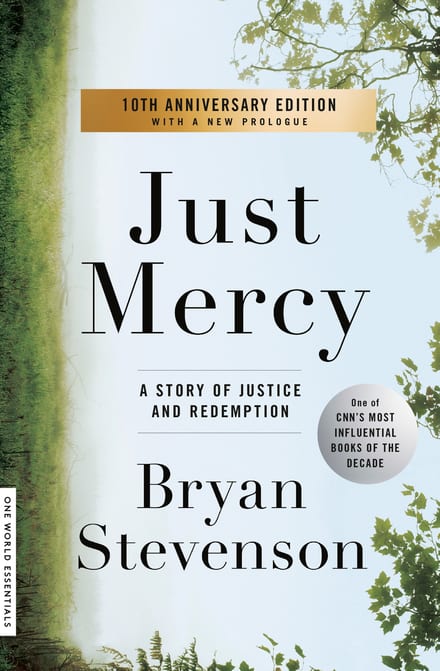
Just Mercy
A Story of Justice and Redemption
The full book runs ~352 pages — roughly 6 hours of reading. You get the key ideas here in 5 minutes.
The key ideas
- Justice punishes the poor and Black most harshly.
- Walter McMillian nearly executed on one liar's testimony.
- Death penalty runs on poverty, haste, and error.
- Children thrown into adult prisons for life.
- Mercy belongs to the undeserving, breaking retribution's cycle.
- Measure a society by how it treats the condemned.
The summary
A young lawyer walks into a maximum-security prison and comes out changed. Bryan Stevenson was twenty-three, a Harvard law student unsure he even wanted to practice, when an internship sent him to Georgia’s death row in 1983 to deliver one message to a condemned man: you will not be executed in the next year. He expected disappointment. Instead the prisoner, Henry, wept with relief, talked with him for three hours, and, as guards shoved him out in shackles, planted his feet and sang an old church hymn. His argument, built over three decades, is blunt and hard to shake: our justice system condemns people too easily, punishes the poor and the Black most harshly, and makes terrible, irreversible mistakes. Under it runs a single conviction. Each of us is more than the worst thing we’ve ever done.
Stevenson went back to the Deep South after graduation to represent the poor, the incarcerated, and the condemned, founding the Equal Justice Initiative in Montgomery, Alabama, in 1989 on almost no money and no local support. He lays out the scale of what he found. The prison population grew from 300,000 in the early 1970s to 2.3 million, the highest incarceration rate in the world. Nearly three thousand children have been sentenced to die in prison, a quarter million kids sent to adult jails, the number of women behind bars up 640 percent in thirty years. His work, he writes, taught him that the opposite of poverty is not wealth. The opposite of poverty is justice.
The case of Walter McMillian
The book’s spine is the story of Walter McMillian, a Black man from Monroeville, Alabama, the town that celebrates itself as the home of To Kill a Mockingbird. In November 1986 an eighteen-year-old white college student, Ronda Morrison, was found shot dead in the dry cleaners where she worked. Months passed with no arrest, and public fury mounted. The case that finally stuck was almost entirely the word of one man: Ralph Myers, a white career criminal with a badly disfigured face who was himself implicated in another killing. Myers changed his story again and again, first blaming a man who turned out to be in jail, then a sheriff, before finally naming Walter. When police staged a meeting to prove the two men knew each other, Myers couldn’t even pick Walter out of a group and had to ask which man he was.
None of it mattered. Walter had a rock-solid alibi: a fish fry at his house the day of the murder, with dozens of relatives and neighbors who could place him there. He was convicted anyway and sent to Alabama’s death row before he was ever tried, which is illegal. His case, Stevenson writes, exposed the system’s indifference to unreliable verdicts, its comfort with racial bias, its tolerance of unfair prosecutions. After years of appeals and suppressed evidence dragged into the light, Walter finally walked out of court a free man. The victory is real, and frightening, because it so nearly failed.
A death penalty defined by error
Walter’s case is not an outlier but a window. Stevenson documents a machinery of execution running on poverty and haste, where, as his early mentor put it, “capital punishment means them without the capital get the punishment.” Scores of innocent people have been sentenced to death and later exonerated. He sits with clients through the final hours before their executions, including a man named Jimmy Dill, and forces you to watch what the state does in your name. He does not pretend his clients are all innocent. Many committed terrible crimes. His point is harder: a system this quick to condemn, this shaped by fear and error, cannot be trusted with the power to kill.
Children sentenced to die in prison
Some of the book’s most wrenching chapters concern children. Stevenson represents Charlie, fourteen years old, under a hundred pounds, no prior record, who shot his mother’s abusive boyfriend and was thrown into an adult jail. He recalls George Stinney, a fourteen-year-old Black boy executed by South Carolina. He takes the cases of Joe Sullivan, thirteen at his crime, and others like Ian Manuel and Antonio Nunez, condemned to grow old and die in prison. For years the United States stood alone in sentencing children to life without parole. Stevenson carried that fight to the Supreme Court and won: on May 17, 2010, the Court barred such sentences for children convicted of non-homicide crimes, and in June 2012, after he argued the cases of Evan Miller and Kuntrell Jackson, it struck down mandatory life without parole for juvenile homicide.
Mercy and our shared brokenness
The book’s final turn is inward. Sitting with the condemned, Stevenson comes to see that the work has broken something in him too, and that this is the point. “We are all broken by something,” he writes, and that shared brokenness is the source of our common humanity. He calls himself a stonecatcher, after the story of the woman spared when Jesus asked that whoever was without sin throw the first stone. Mercy, he insists, belongs to the undeserving, and is most potent when least expected, because it alone can break the cycle of retribution that mass incarceration feeds. The true measure of a society is not how it treats the powerful and respected but how it treats the poor, the accused, the imprisoned, and the condemned.
The bottom line
This is one lawyer’s evidence that American justice reduces people to their worst act, punishes poverty and race, and gets it catastrophically wrong more often than we admit, and his case that mercy is not weakness but the truer form of justice. Walter McMillian’s near-execution and the children he fought for are the proof; the line that lingers is that each of us is more than the worst thing we’ve ever done. Read it if you care about race, punishment, or the moral cost of the system we all live inside.
Fact check
Popular books repeat findings that later research has complicated. Where Just Mercy makes a testable claim, here's what the evidence actually shows.
The US prison population grew from about 300,000 in the early 1970s to 2.3 million, giving the country the highest incarceration rate in the world.
The growth is as described. A National Academies review found state and federal prison populations rose from about 200,000 in 1973 to 1.5 million in 2009, with the total penal population reaching roughly 2.2 million adults — close to a quarter of the world's prisoners in a country holding about 5 percent of its people, at nearly 1 adult in 100 behind bars. The world ranking has since shifted: the World Prison Brief now places the US fourth at 542 per 100,000, behind El Salvador (1,659), Cuba (794) and Turkmenistan, with the US total down to roughly 1.83 million. Stevenson's figures were accurate for the period he was writing about.
- National Research Council. The Growth of Incarceration in the United States: Exploring Causes and Consequences. Washington, DC: National Academies Press; 2014. Source
- Institute for Crime & Justice Policy Research. World Prison Brief: Highest to Lowest — Prison Population Rate. London: Birkbeck, University of London. Source
The number of women behind bars in the US rose 640 percent in thirty years.
The Sentencing Project counts 26,326 incarcerated women in 1980 against 186,244 in 2023 — an increase of more than 600 percent, leaving the female incarcerated population over seven times its 1980 size. Stevenson's 640 percent across roughly three decades sits squarely inside that trajectory. This is one of the book's least contested numbers.
- The Sentencing Project. Incarcerated Women and Girls [fact sheet]. Washington, DC: The Sentencing Project. Source
Nearly three thousand children in the US have been sentenced to die in prison.
The practice was real and, for a time, close to unique to the United States, but the best available count puts the peak below Stevenson's figure. The Sentencing Project recorded roughly 2,500 people serving juvenile life without parole at the 2012 peak. That number has fallen steeply since — 1,465 by the start of 2020, a 44 percent drop from the peak — driven by the Supreme Court rulings Stevenson himself litigated and by states abolishing the sentence outright.
- The Sentencing Project. Juvenile Life Without Parole: An Overview [policy brief]. Washington, DC: The Sentencing Project. Source
Scores of innocent people have been sentenced to death in the US and later exonerated.
If anything the phrasing undercounts. The Death Penalty Information Center documents at least 202 people exonerated after a death sentence since 1973 — about one exoneration for every eight executions carried out. A peer-reviewed survival analysis in PNAS estimated that at least 4.1 percent of defendants sentenced to death in the US are innocent, and its authors called that a conservative floor, since most death sentences are converted to life terms where the intense legal scrutiny that surfaces wrongful convictions falls away.
Frequently asked questions
What is Just Mercy about?
It's lawyer Bryan Stevenson's account of representing the poor, the condemned, and the wrongly convicted through the Equal Justice Initiative he founded in Montgomery, Alabama. Built over three decades, his case is blunt: American justice condemns people too easily, punishes the poor and the Black most harshly, and makes terrible, irreversible mistakes. Underneath it runs one conviction, that each of us is more than the worst thing we've ever done.
What are the key takeaways from Just Mercy?
The book's spine is the wrongful conviction of Walter McMillian, sent to Alabama's death row on the shifting word of one criminal despite a rock-solid alibi, which exposes the system's tolerance of racial bias and unreliable verdicts. From there it widens: a death penalty defined by error, where "them without the capital get the punishment"; children sentenced to die in prison, a fight Stevenson carried to the Supreme Court and won in 2010 and 2012; and the idea that mercy belongs to the undeserving and alone can break the cycle of retribution. He calls himself a stonecatcher and insists the opposite of poverty is justice.
Who should read Just Mercy?
Anyone who cares about race, punishment, or the moral cost of the justice system we all live inside. It's for readers willing to sit with hard cases and reconsider what mercy and justice actually require.
Is Just Mercy worth reading?
Yes, if you want a moving, evidence-driven look at how the system reduces people to their worst act and gets it catastrophically wrong. Its strength is grounding sweeping claims in real people, from Walter McMillian's near-execution to children like Charlie and Joe Sullivan thrown into adult prisons. It doesn't pretend every client is innocent, which makes its harder argument, that a system this quick to condemn can't be trusted to kill, land with force. Readers wanting a detached legal treatise rather than a personal moral appeal may want something drier.