Book summary
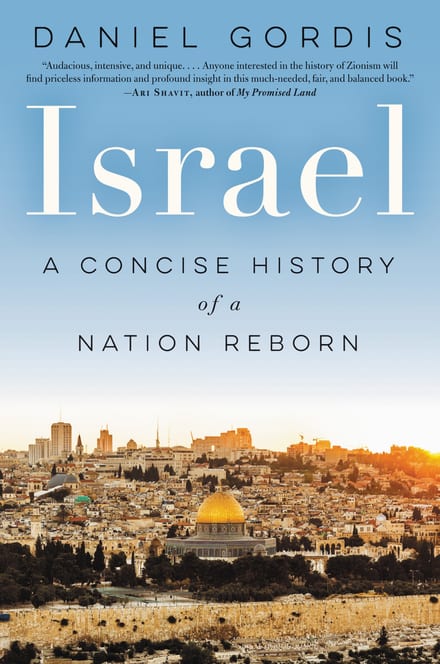
Israel: A Concise History of a Nation Reborn
The full book runs ~546 pages — roughly 10 hours of reading. You get the key ideas here in 4 minutes.
The key ideas
- Persecution and pogroms drove Jews to seek a homeland.
- Zionism turned biblical promise into a political movement.
- Settling inhabited Palestine displaced Arabs and bred lasting hostility.
- Repeated wars forged a nation defined by siege mentality.
- Peace deals eased some tensions but never ended violence.
- Israel thrives economically despite unending existential conflict.
The summary
Israel’s whole history turns on a single, painful double fact: the state exists because persecution in Europe had made Jewish safety impossible anywhere else, and it was built on land where other people already lived. Hold those two truths together and much of what followed stops looking like a puzzle. A nation founded to end Jewish vulnerability has been at war almost continuously since its birth, and it flourishes and is contested at the very same time. Daniel Gordis traces how that tension was baked in from the start.
Persecution made a homeland feel necessary
For centuries Jews across Europe lived under laws that stripped away basic freedoms, and under the constant threat of pogroms — organized massacres carried out with impunity. By the late 1800s, roughly 2.5 million Jews had fled Eastern Europe, abandoning places their families had called home for generations. The lesson many drew was stark: the old world offered no safe ground.
That conclusion gave rise to Zionism. Theodor Herzl, watching even democratic societies turn on their Jewish citizens, published The Jewish State in 1896 and set the movement for an independent homeland in motion. The idea divided Jewish opinion immediately — many American Jews thought it unnecessary, since the United States already gave them freedom enough. But atrocities kept making the case. The 1903 Kishinev pogrom, three days that left 49 Jews dead, dozens gravely wounded, women raped, and some 1,500 homes damaged, became a rallying point for early Zionists and grim proof that a refuge was needed.
Herzl proposed Palestine, invoking the biblical promise of a Jewish return. During World War I, the Zionist biochemist Chaim Weizmann helped Britain produce acetone for explosives, and his influence with British leaders fed into the 1917 Balfour Declaration, which backed a Jewish state there. The parallel Sykes-Picot Agreement carved up the Middle East and placed the future state under British control — with borders left vague and the Arabs already living in the region left entirely out of the conversation. That omission guaranteed hostility from the beginning.
A land already inhabited
Between 1880 and 1940, the Jewish population in the area surged from about 20,000 to roughly 450,000. Successive waves of Aliyah — immigration to the Land of Israel — brought people escaping violence, who drained swamps, built infrastructure, and turned hard terrain into functioning settlements despite disease and hardship. But the land was not empty. As Arab power and landholding shrank, resentment boiled over into repeated, deadly riots.
The 1930s brought a wave of Jews fleeing Nazi Germany, and Britain, squeezed between Jewish desperation and Arab anger, capped immigration. The Jewish Agency smuggled thousands in; thousands more were turned away to face death in Europe. In 1947 the United Nations voted to end the British Mandate and grant Israel independence — 33 countries in favor, including the US and the USSR, and 13 opposed, including Egypt, Iraq, Iran, and Saudi Arabia. War broke out at once, killing nearly 2,000 in the first six months. David Ben-Gurion’s Plan Dalet let peaceful Arabs remain under Jewish rule but removed those who resisted; critics read it not as defense but as a way to force a Jewish majority. By the war’s end, more than 700,000 Palestinians had been displaced, and Israel’s Arab population had fallen to about 20 percent.
A nation shaped by siege
In 1956, the military leader Moshe Dayan delivered a eulogy for Roi Rotberg, killed in an attack from Gaza, that became something like Israel’s Gettysburg Address. “We mustn’t flinch from the hatred that… fills the lives of hundreds of thousands of Arabs who live around us,” he warned. “That is the choice of our lives — to be willing and armed, strong and unyielding.” That worldview carried the country through the 1967 Six-Day War, when Israel seized new territory, cemented its military dominance, and began handing the prime minister’s office to former generals.
Fractures opened from within, too. The early Ashkenazi immigrants were joined by Sephardic, Haredi, and Mizrachi Jews whose cultures differed sharply, and as politicians courted the more religious Mizrachi vote, public life took on a more religious and militaristic cast, drifting from the secular Zionism of the founders. Then the 1973 Yom Kippur War, launched by an Egyptian- and Syrian-led coalition on the holiest day of the Jewish calendar, caught Israel off guard and shattered any sense of invincibility, even as the country survived.
Peace attempts, persistent threats
In 1977, Menachem Begin and Egypt’s Anwar Sadat signed the Camp David Accords, ending the state of war between their nations and earning both men the Nobel Peace Prize. But peace stayed partial. Israel’s 1982 intervention in Lebanon against the PLO went badly, and after the Phalangist leader Bashir Gemayel was assassinated, his followers massacred 700 to 800 Palestinians in the Sabra and Shatila refugee camps, setting off huge protests in Tel Aviv. The 1980s brought Hamas and its relentless attacks; the 1990s Oslo Accords aimed to hand Gaza and the West Bank to a Palestinian Authority, yet violence only rose under Yasser Arafat, with more Israelis killed by terror attacks in 1994–1996 than in any comparable span. Israel withdrew from Gaza in 2005, but the threats didn’t stop — Hamas now controls the Palestinian Authority, and Hezbollah looms from Lebanon.
The bottom line
Israel was born because persecution made Jewish survival elsewhere impossible, and it rose on land already inhabited — a double origin that explains why a state created to end vulnerability has been fighting ever since. And yet it endures, with one of the world’s fastest-growing economies and densest concentrations of startups and venture capital. Read this if you want to understand why the conflict runs so deep and why each side experiences its claim as a matter of survival.
Fact check
Popular books repeat findings that later research has complicated. Where Israel makes a testable claim, here's what the evidence actually shows.
More than 700,000 Palestinians were displaced by the end of the 1948 war.
The United Nations puts the number of Palestinian refugees produced by the hostilities at 726,000 — over half the indigenous population of Palestine. The summary's "more than 700,000" sits directly on that figure. The one wrinkle is timing: the UN counts to the end of 1949, not to the end of the fighting, and the total is an estimate rather than a census.
- United Nations. The Origins and Evolution of the Palestine Problem: Part II (1947-1977). Question of Palestine. New York, NY: United Nations. Source
The 1947 UN partition vote passed 33 in favour to 13 opposed, with the US and USSR voting yes and Egypt, Iraq, Iran and Saudi Arabia among the opponents.
The UN record of the 29 November 1947 vote gives exactly 33 in favour, 13 against and 10 abstentions. The United States and the Soviet Union both voted yes, and Egypt, Iraq, Iran and Saudi Arabia appear on the against list alongside Afghanistan, Cuba, Greece, India, Lebanon, Pakistan, Syria, Turkey and Yemen. One detail in the summary is loose: the Assembly voted to partition Palestine into an Arab state and a Jewish state with Jerusalem internationalized, not to grant Israel independence — Israel declared that itself in May 1948.
- United Nations. The Origins and Evolution of the Palestine Problem: Part II (1947-1977). Question of Palestine. New York, NY: United Nations. Source
Phalangist militiamen massacred 700 to 800 Palestinians in the Sabra and Shatila refugee camps in 1982.
The UN's account of the killings of 17 and 18 September 1982 says only that "several hundred men, women and children were brutally killed," and cites the Israeli commission of inquiry whose report was published on 8 February 1983. The 700 to 800 range comes from that Israeli inquiry; a parallel Lebanese government investigation had not reported its findings, and no agreed death toll was ever established. The figure is defensible as a floor, not as a settled number.
- United Nations. The Origins and Evolution of the Palestine Problem: Part III (1978-1983). Question of Palestine. New York, NY: United Nations. Source
The Jewish population of the area rose from about 20,000 in 1880 to roughly 450,000 by 1940.
The endpoint holds: UN records put the Jewish population of Palestine at over 445,000 in 1939 out of a total of about 1,500,000 — nearly 30 percent, against under 10 percent twenty years earlier. It stood at 84,000 in 1922 and reached 608,000 by 1946, an increase of roughly 725 percent over the Mandate period. The 1880 baseline predates any census and rests on Ottoman-era estimates, so the scale of the growth is documented even where the starting figure is approximate.
- United Nations. The Origins and Evolution of the Palestine Problem: Part I (1917-1947). Question of Palestine. New York, NY: United Nations. Source
Frequently asked questions
What is Israel about?
It traces Israel's history from a single painful double fact: the state exists because persecution in Europe made Jewish safety impossible anywhere else, and it was built on land where other people already lived. Gordis shows how that tension was baked in from the start, which is why a nation founded to end Jewish vulnerability has been at war almost continuously while flourishing at the same time. Hold both truths together, and much of the conflict stops looking like a puzzle.
What are the key takeaways from Israel?
The book walks through how the double origin played out. Pogroms and the 1903 Kishinev massacre made a homeland feel necessary, giving rise to Zionism and Herzl's The Jewish State. The Balfour Declaration and Sykes-Picot Agreement backed a Jewish state while leaving the Arabs already living there out of the conversation. Waves of Aliyah swelled the Jewish population, the 1947 UN vote triggered immediate war and displaced over 700,000 Palestinians, and a worldview of permanent siege, captured in Moshe Dayan's 1956 eulogy, shaped the country through the 1967 and 1973 wars and partial peace efforts like Camp David and Oslo.
Who should read Israel?
Anyone who wants to understand why the conflict runs so deep and why each side experiences its claim as a matter of survival. It's for readers seeking a concise narrative history rather than a polemic for one side.
Is Israel worth reading?
Yes, if you want a readable single-volume history that holds two hard truths together instead of picking a side. It moves briskly through Zionism's origins, the wars, the internal fractures between Ashkenazi, Sephardic, Haredi, and Mizrachi Jews, and the peace attempts, while noting Israel's rise to one of the world's fastest-growing economies. Readers wanting a deep defense of the Palestinian perspective or exhaustive detail on any single era may find its concise sweep leaves gaps.