Book summary
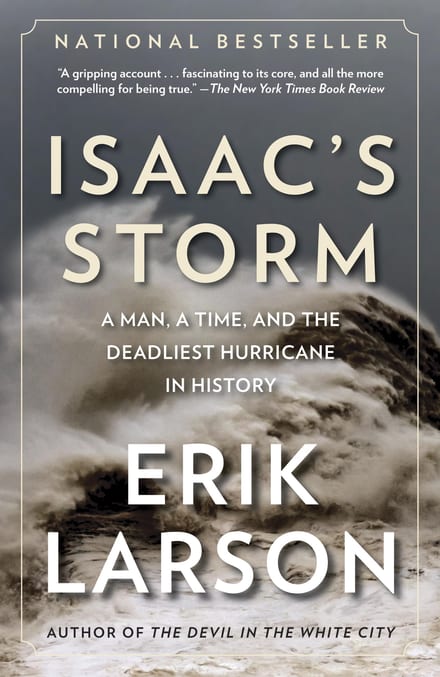
Isaac's Storm
A Man, a Time, and the Deadliest Hurricane in History
The key ideas
- Suppressed Cuban forecasts that correctly tracked the storm to Texas
- Dismissed catastrophic hurricanes as an 'absurd delusion' before disaster
- Mistook danger signs for spectacle in an age of tech optimism
- Falsified reports to protect the Weather Bureau's fragile authority
- Destroyed Galveston's future and shifted wealth to inland Houston
- Exposed how bureaucratic pride, not missing data, caused mass death
The summary
Galveston drowned on September 9, 1900, not because the information was missing but because an agency had staked its authority on certainty. The U.S. Weather Bureau dismissed the Cuban forecasters who correctly read the storm, banned the telegrams that might have carried their warning, and assured a confident city that no hurricane could ever seriously harm it. Roughly 8,000 people died in the deadliest natural disaster in American history. Erik Larson’s account makes the cause plain: they died of institutional pride, not of ignorance.
Isaac Cline’s absurd delusion
Isaac Cline ran the Weather Bureau’s Galveston office, a respected scientist who had revived the local station after arriving in 1889 and launched the Texas state weather service. He was also the man who, in an 1891 newspaper article, waved away the danger of a catastrophic hurricane. The Texas coast, he argued, was geographically shielded, and the fear of a devastating storm was an “absurd delusion.” He went further still: “It would be impossible for any cyclone to create a storm wave which could materially injure the city.”
That confidence wasn’t only personal — it was policy. Under its new chief, Willis Moore, the Bureau was centralizing power, chasing credibility, and cultivating a rigid culture that prized control over caution. Moore’s people banned non-official weather telegrams, partly out of disdain for outside expertise. So when seasoned Cuban meteorologists identified a strengthening cyclone and tracked it toward Texas, their warnings were suppressed. Against the Bureau’s confident prediction that the storm would curve safely into the Atlantic, it intensified over the Straits of Florida and pressed west on a path American forecasters had called impossible.
Danger mistaken for spectacle
In Galveston, the warning signs stacked up — deep ocean swells, unusually high tides running against the wind, immense waves — and the official response stayed reassuring. It was 1900, the height of American faith in technology, and the age believed science had tamed the weather. So the lack of urgency turned catastrophe into a show. People wandered to the beach to watch. Children splashed in the rising floodwaters.
The mood broke when Ritter’s Cafe, a popular downtown restaurant, collapsed and killed several men inside. Fear spread, but too late. On the Bolivar Peninsula a stranded train was destroyed, killing 85. Even with the water rising, Isaac told a neighbor to stay in his home, which later collapsed, while his brother Joseph urged people to flee. When the Cline house was knocked off its foundation and capsized, Joseph smashed through a window and pulled Isaac’s two oldest daughters onto a floating wall; nearly fifty others trapped inside did not get out. Isaac was knocked unconscious and nearly drowned before waking alone on drifting timber, and eventually found his daughters and Joseph again. At St. Mary’s Orphanage, 93 children and 10 nuns died. On a floating porch, Anthony Credo fought to hold his family together, at one point weighing whether to let go of his badly injured son to save the others; a piece of timber killed one daughter, and a flying spike of wood impaled another.
The lies that followed
The first word out reached Willis Moore by telegram at 11:25 that night: a train couldn’t get closer than six miles from the bay, the prairie was “strewn with debris and dead bodies,” about two hundred corpses counted from the train, a steamship stranded two miles inland, and “nothing could be seen of Galveston.” The reports sounded so extreme they were first dismissed as exaggeration. They weren’t. Overwhelmed by the dead, officials resorted to sea burials and mass cremations while the city sat in stunned silence and the stench of death.
Then came the cover-up. Isaac’s official report falsely claimed timely warnings, inflated his own role by asserting he’d saved thousands, and, breaking protocol, folded in his personal story. He could not describe the Bureau’s failures, Larson writes, because that would damage the agency’s fragile credibility. Moore launched a public-relations campaign to defend it, even as the Cuban press ridiculed the Bureau for insisting the storm was bound for the Atlantic while the Cubans had correctly called Texas. Moore’s forecasting kept failing in public — he predicted the hurricane would dissipate after Texas, and instead it regained strength, sank ships in the North Atlantic, and died over Siberia; in 1909 he promised “clear and colder” for Taft’s inauguration, and snow fell.
The private griefs outlasted the storm. Isaac searched for his wife Cora for weeks; on September 30, workers found a woman wearing a distinctive wedding and engagement ring, and he identified her, enlarged the rings, and wore them for the rest of his life. Galveston built a seventeen-foot seawall and raised the whole city, but the Spindletop oil strike shifted wealth and shipping to inland Houston, and the city’s future dimmed. Isaac and Joseph never reconciled. Isaac turned to art, opened a small shop, and died in 1955 at ninety-three, just as Hurricane Connie emerged from the Caribbean; Joseph died a week later.
The bottom line
Institutions fail catastrophically when they value control over truth and certainty over humility, and Galveston’s dead are the monument to it. Read this if you want to see how organizational pride turns a survivable warning into a mass grave — or if you’ve ever wondered why the people in charge ignore the ones who saw it coming.
Fact check
Popular books repeat findings that later research has complicated. Where Isaac's Storm makes a testable claim, here's what the evidence actually shows.
Roughly 8,000 people died in the 1900 Galveston hurricane, making it the deadliest natural disaster in American history.
NOAA puts the toll at about 8,000 and calls the storm the deadliest weather disaster in United States history, and the Handbook of Texas calls it the nation's worst natural disaster. The round number is less precise than it looks: NOAA's range runs from 6,000 to 12,000, and the Texas historical record gives 6,000 to 8,000 for the city itself and 10,000 to 12,000 for the island as a whole. No later American disaster comes close even at the low end, so the ranking holds.
The storm destroyed Galveston's future as Texas's leading port and shifted wealth and shipping inland to Houston.
Galveston did lose its lead — while Houston, Beaumont and Port Arthur took the profits of the early-twentieth-century oil discoveries, Galveston spent its energy on recovery. But Houston merchants had been trying to bypass Galveston since the 1850s: Charles Morgan bought the Bayou Ship Channel Company in 1874 and within two years had dredged a channel from Galveston Bay toward Houston, and the deep-water Houston Ship Channel that settled the question opened on September 7, 1914. The 1900 storm sped up a shift already decades in motion rather than creating it.
- McComb DG. Galveston, TX. Handbook of Texas Online. Austin, TX: Texas State Historical Association; published 1952, updated September 28, 2023. Source
- Sibley MM. Houston Ship Channel. Handbook of Texas Online. Austin, TX: Texas State Historical Association; published 1976, updated March 22, 2017. Source
Frequently asked questions
What is Isaac's Storm about?
It's the story of the 1900 Galveston hurricane, which killed roughly 8,000 people in the deadliest natural disaster in American history. The information to warn the city existed, but the U.S. Weather Bureau had staked its authority on certainty: it dismissed the Cuban forecasters who read the storm correctly, banned the telegrams that could have spread the warning, and assured the city no hurricane could seriously harm it. Larson's point is that they died of institutional pride, not ignorance.
What are the key takeaways from Isaac's Storm?
The core lesson is how organizational pride turns a survivable warning into a mass grave. Under chief Willis Moore, the Weather Bureau centralized power, banned non-official telegrams out of disdain for outside expertise, and suppressed the Cubans who correctly tracked the storm toward Texas. Isaac Cline had publicly called the fear of a devastating hurricane an "absurd delusion." When danger arrived, the era's faith in technology turned it into a spectacle, with people wandering to the beach to watch, and afterward the officials covered up their failures rather than admit them.
Who should read Isaac's Storm?
Anyone who wants to understand how institutions fail catastrophically when they value control over truth, or who has ever wondered why the people in charge ignore the ones who saw disaster coming. It suits readers drawn to narrative history that doubles as a study of organizational failure.
Is Isaac's Storm worth reading?
Yes, if you want a gripping true account that works as both a disaster narrative and a case study in institutional hubris. Larson braids the meteorology, the Bureau's politics, and wrenching personal stories like the Cline family's near-drowning and the 93 children lost at St. Mary's Orphanage. Readers who want a dry technical weather history or a tidy heroic ending should look elsewhere, since the book dwells on human error and grief.