
Book summary
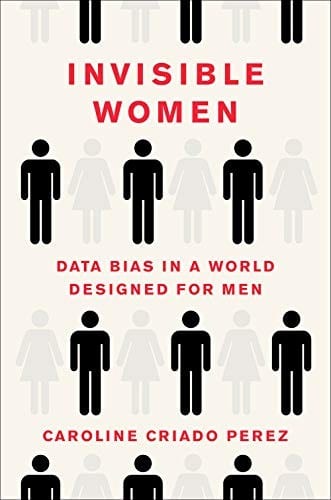
Invisible Women: Data Bias in a World Designed for Men
The full book runs ~432 pages — roughly 8 hours of reading. You get the key ideas here in 3 minutes.
The key ideas
- Recognize the gender data gap hides in plain sight everywhere
- Design flaws harm women in cars, phones, and workplaces
- Medical research tests on men, mis-dosing and misdiagnosing women
- Public spaces and transit ignore women's patterns and safety
- Unpaid care work, mostly women's, vanishes from GDP
- Male-dominated power keeps women's needs invisible and unaddressed
The summary
When crash-test dummies are built to male proportions, drug trials enroll mostly men, and smartphones are sized for male hands, women end up hurt — not because anyone set out to harm them, but because the data we design the world from quietly leaves female bodies and lives out. Caroline Criado Pérez calls this the gender data gap, and her central point is how ordinary it is. “One of the most important things to say about the gender data gap is that it is not generally malicious, or even deliberate.” It’s the residue of thousands of years of treating men as the default human: “when we say human, on the whole, we mean man.” The habit runs deep — Aristotle cast women as aberrations from the male norm, female organs were named centuries after their male counterparts, and even today the UK has more statues of men named John than of all non-royal women combined.
The built world is sized for men
Start with the objects and rooms you move through every day. Office thermostats still run on temperature standards set in the 1960s to suit men’s metabolic rate, which is why women are perpetually reaching for a sweater. Smartphones are built for the male hand, and female users pick up more musculoskeletal problems for it. The standard piano keyboard was scaled to a male handspan — one quiet reason so few women reach the top ranks of concert pianists, since a smaller hand can’t comfortably stretch an octave.
Cars are where the stakes turn deadly. The European Union has required crash-test dummies modeled on the “fiftieth percentile male,” even though women sit differently, are proportioned differently, and suffer higher injury rates in crashes. The male body is the engineering baseline, and everyone who doesn’t match it absorbs the difference.
Medicine treats the male body as universal
The same default shapes medicine, where the cost is measured in misdiagnosis and mis-dosing. Women made up only 18% of participants in trials of occlusion devices. The CRT-D pacemaker was tested on a group that was just 20% women, and the FDA later found its data inaccurate and harmful for female patients. Medical textbooks depict men three times as often as women, and research shows women are more affected by radiation than men — yet the standards are still calibrated on male bodies. When a drug is trialed mostly on men, its dose can be wrong for women; when a disease is studied in men, doctors miss how it shows up differently in women. Treating the male body as the universal template means women’s health is an afterthought built on someone else’s data.
Public space overlooks how women actually live
Infrastructure fails women in the same absent-minded way. Men and women are typically given the same amount of restroom space, which sounds fair until you account for the fact that women take longer and do more — managing periods, helping children, without the throughput of a wall of urinals. The predictable result is a long line for the women’s room and none for the men’s. In developing countries the same gap turns dangerous: without safe, private toilets, women face both health problems and sexual violence. Transit systems are tuned for the full-time commuter, historically a man, and penalize the more complex chains of trips women tend to make between work, school pickup, groceries, and eldercare. On that transit, women are harassed often but report it rarely, deterred by unclear procedures, taboo, and fear of retaliation — so the data never shows their greater vulnerability, and no protections get built. The pattern is captured neatly by Facebook, which had no priority parking for pregnant employees until it hired a woman CEO who became pregnant. The need was invisible until someone with power lived it.
Unpaid work, and the people in charge
The economy performs its own erasure. Unpaid domestic and care work — roughly 75% of it done by women — is left out of GDP entirely; count it in the US and the figure would rise by as much as 20%. “There is no such thing as a woman who doesn’t work. There is only a woman who isn’t paid for her work.” That invisible labor is also the main thing keeping women out of paid jobs, because workplaces are built around an “unencumbered” worker with no one to care for at home, and anyone needing flexibility or skipping overtime is quietly penalized. Tax policy compounds it: cuts aimed at top earners flow mostly to men, who out-earn women worldwide by 38%, and because governments rarely check policy for gender impact, the discrimination passes through inattention rather than intent.
Fixing any of this runs into who holds power. In 2017, only 23.5% of the world’s politicians were women, and male leaders are far less likely than female ones to take up gender issues — “it’s not always easy to convince someone a need exists, if they don’t have that need themselves.” Women who do reach these rooms are judged more harshly for saying exactly what men say; a 2016 report found 66% of female politicians faced misogynistic abuse, and an Australian study found 80% of women wouldn’t run for office for fear of harassment. At the far end of the same neglect, female refugees endure widespread sexual violence from male authorities, in facilities designed and staffed on a male-as-default mindset that never asked what women would need to be safe.
The bottom line
The world is built around male bodies, male schedules, and male experience — not by conspiracy, but by the compounding habit of treating men as the standard human — and women pay the difference in comfort, money, health, and safety. Read this if you design products, set policy, or make any decision on behalf of people who aren’t exactly like you.
Fact check
Popular books repeat findings that later research has complicated. Where Invisible Women makes a testable claim, here's what the evidence actually shows.
Because cars are designed and tested around a fiftieth-percentile male body, women suffer higher injury rates than men in comparable crashes.
The figure the book rests on holds: in US crash data from 1998 to 2008, a belt-restrained female driver had 47% higher odds (95% CI 28% to 70%) of severe injury than a belt-restrained male driver in a comparable crash. Later work with a much wider set of controls finds the disadvantage real but narrower than a blanket statement implies. NHTSA researchers fitting 300 models across crash types found women at significantly higher odds of injury in 36 of them and significantly lower odds in 43; the consistent female penalty was in moderate (AIS 2+) injuries overall and lower-extremity injuries in frontal crashes, while for several severe head, neck and thorax injuries women's odds were lower than men's.
- Bose D, Segui-Gomez M, Crandall JR. Vulnerability of female drivers involved in motor vehicle crashes: an analysis of US population at risk. Am J Public Health. 2011;101(12):2368-2373. PubMed
- Craig MJ, Liu C, Zhang F, Enriquez J. Sex-based differences in odds of motor vehicle crash injury outcomes. Accid Anal Prev. 2024;195:107100. PubMed
Office temperature standards were built in the 1960s around men's metabolic rate, which is why women are systematically too cold at work.
The premise checks out. Indoor climate regulation still rests on an empirical thermal comfort model developed in the 1960s whose standard value for metabolic rate is based on an average man, and that value may overestimate female metabolic rate by up to 35%. The consequence shows up in output, not just complaint: in a controlled experiment with 543 participants, women did better on maths and verbal tasks as the room got warmer while men did slightly worse, and the female gain was both larger and more precisely estimated than the male loss.
- Kingma B, van Marken Lichtenbelt W. Energy consumption in buildings and female thermal demand. Nature Climate Change. 2015;5:1054-1056. doi:10.1038/nclimate2741 Source
- Chang TY, Kajackaite A. Battle for the thermostat: gender and the effect of temperature on cognitive performance. PLoS One. 2019;14(5):e0216362. PubMed
Cardiac device trials enrolled so few women — around 20% for the CRT-D — that the resulting evidence turned out to be wrong and harmful for female patients.
The underrepresentation is confirmed and worse than the book's individual figures suggest: across 123 studies backing 78 high-risk cardiovascular devices approved by the FDA between 2000 and 2007, enrolled populations averaged 67% men, and 28% of the studies did not report the sex of enrollees at all. Cardiac resynchronization therapy trials were about 20% women, as the book says. But when the FDA pooled patient-level data from three CRT-defibrillator trials (4,076 patients), the finding was that women benefited more than men, not that the device harmed them — women with left bundle branch block and a QRS of 130-149 ms had a 76% reduction in heart failure or death, while men in that band showed no significant benefit. The cost of the data gap here was under-treatment, since guidelines drawn from the male-dominated results set the threshold at 150 ms.
- Dhruva SS, Bero LA, Redberg RF. Gender bias in studies for Food and Drug Administration premarket approval of cardiovascular devices. Circ Cardiovasc Qual Outcomes. 2011;4(2):165-171. PubMed
- Zusterzeel R, Selzman KA, Sanders WE, et al. Cardiac resynchronization therapy in women: US Food and Drug Administration meta-analysis of patient-level data. JAMA Intern Med. 2014;174(8):1340-1348. PubMed
Roughly 75% of unpaid domestic and care work is done by women, and counting it would raise US GDP by as much as 20%.
Both numbers hold, and the GDP one is conservative. The ILO puts women's share of total unpaid care hours worldwide at 76.2% — 3.2 times men's, with no country where the two sexes share it equally — amounting to 16.4 billion hours a day, or 9% of global GDP valued at minimum wage. The US Bureau of Economic Analysis's own satellite account finds that valuing household production raises nominal US GDP by 25.7% for 2010, and by 39% for 1965. One caveat: the American split is narrower than the global one, with women averaging 26 hours a week of home production in 2010 against men's 17.
Frequently asked questions
What is Invisible Women about?
It's about the gender data gap: because we treat men as the default human, the data we design the world from quietly leaves women out. Crash-test dummies built to male proportions, drugs trialed mostly on men, thermostats set to male metabolic rates, and phones sized for male hands all mean women pay the difference in comfort, money, health, and safety. The gap isn't malicious or even deliberate, which is exactly what makes it so pervasive.
What are the key takeaways from Invisible Women?
The book shows the same blind spot repeating across every domain. The built world is sized for men, from car crash dummies modeled on the "fiftieth percentile male" to piano keyboards scaled to a male handspan. Medicine treats the male body as universal, so drugs get mis-dosed and diseases missed in women. Public space ignores how women actually live, giving equal restroom space to people with unequal needs and tuning transit to the full-time commuter. And the economy erases the roughly 75% of unpaid care work done by women, leaving it out of GDP entirely.
Who should read Invisible Women?
Anyone who designs products, sets policy, or makes decisions on behalf of people who aren't exactly like themselves. If your choices affect users, patients, or citizens you don't personally resemble, this shows you the data you're missing.
Is Invisible Women worth reading?
Yes, if you want a concrete, example-packed case that the world is quietly built around male bodies and schedules. Its strength is the sheer accumulation of specifics, from CRT-D pacemakers tested on 20% women to Facebook only adding pregnancy parking once a woman CEO became pregnant. Readers who already accept the premise may find the drumbeat of statistics relentless, but that repetition is the point.