Book summary
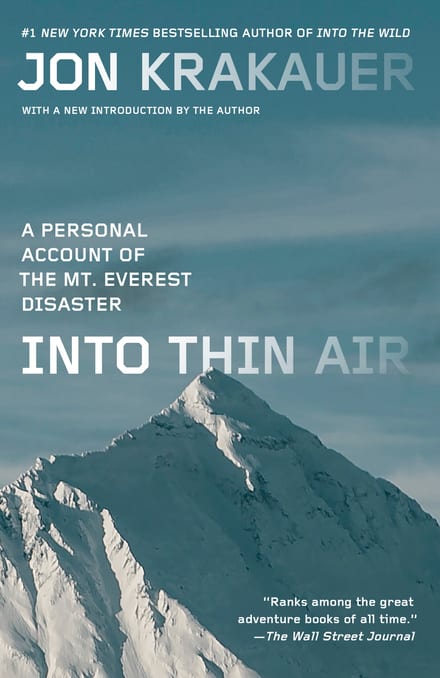
Into Thin Air: A Personal Account of the Mount Everest Disaster
A Personal Account of the Mount Everest Disaster
The full book runs ~335 pages — roughly 6 hours of reading. You get the key ideas here in 5 minutes.
The key ideas
- Clients paid Rob Hall $65,000 each; thirty expeditions crowded Everest in spring 1996.
- Hall preached a hard turn-around time, never named one, then ignored it entirely.
- Only six of thirty-four climbers reached the top before the agreed two o'clock deadline.
- Unfixed ropes and a queue at the Hillary Step cost hours nobody had.
- The storm was ordinary; the delay is what made it lethal.
- Krakauer's own error sent word home that a dead teammate was safe in camp.
The summary
At 1:17 P.M. on May 10, 1996, Jon Krakauer stood on the summit of Mount Everest and couldn’t summon the energy to care. He hadn’t slept in fifty-seven hours, had eaten only ramen and peanut M&Ms in three days, and had two ribs separated by weeks of coughing. He fired off four photographs and turned down. Cloud was filling the valleys below, but to his oxygen-starved brain it looked like the harmless afternoon convection that rose most days. By the time he reached Base Camp, nine climbers from four expeditions were dead, and three more died before the month ended.
The mountain had been turned into a product
By spring 1996 thirty expeditions were on Everest, at least ten of them commercial. Rob Hall charged $65,000 a head, the highest price on the mountain, and had no trouble filling his roster: between 1990 and 1995 he put thirty-nine people on top, three more ascents than were made in the twenty years after Hillary. His brochure guaranteed “to maximise the safety and success of your adventure.”
What clients gave up in exchange was every decision. Sherpas fixed the ropes, built the camps, hauled the loads; Krakauer, thirty-four years a climber, felt as though surrogates were doing it for him. One veteran American guide named the bind: “We think that people pay us to make good decisions, but what people really pay for is to get to the top.”
Everyone agreed on the rule; nobody used it
Hall had lectured his clients for a month about a hard turn-around time. “With enough determination, any bloody idiot can get up this hill,” he told them. “The trick is to get back down alive.” Then he never named the hour: at Base Camp he weighed 1:00 P.M. against 2:00 and left it open, planning to call it on the day.
Thirty-four climbers left the South Col that night; six reached the summit before two o’clock. Scott Fischer, leading the rival Mountain Madness team, got there at 3:40. Doug Hansen, the postal worker Hall had turned back 300 feet short the year before, arrived after four. Fischer’s third guide, Neal Beidleman, had told him he didn’t feel able to order down clients who’d paid sixty-five thousand dollars. “So Scott agreed that would be his responsibility. But for whatever reason, it didn’t happen.”
Four clients did the arithmetic themselves: Stuart Hutchison, John Taske and Lou Kasischke turned around at 11:30, Frank Fischbeck hours earlier. Krakauer calls them the few who chose right, and names the trap they escaped — to get that high you must be exceedingly driven, and if you’re too driven you die.
Small delays, stacked
The Sherpas were supposed to leave ninety minutes ahead to fix rope on the exposed ground. None did. So the merged teams stood shivering for an hour at 28,000 feet while Beidleman ran the line out himself, then another hour at the South Summit. Lopsang Jangbu, who should have been up front with that rope, instead spent five or six hours hauling the client Sandy Pittman on a three-foot tether, having already wrecked himself carrying her satellite phone to 26,000 feet, where it didn’t work. Krakauer’s verdict: “a slow accrual, compounding steadily and imperceptibly toward critical mass.”
Then hypoxia began editing the details. Asked to shut off Krakauer’s oxygen above the Hillary Step, the guide Andy Harris cranked the valve wide open and drained the tank. Hours later Harris told Hall by radio that the bottles cached at the South Summit were empty. They were full. Mike Groom heard the exchange and discovered his own radio could receive but not transmit.
What one ordinary storm did
Near dark the weather stopped being weather. Visibility dropped under twenty feet, the windchill went past a hundred below, and eleven climbers staggered around the South Col for two hours before huddling behind a boulder no bigger than a dishwasher — 1,000 feet of flat ground from the tents, fifteen minutes, had anyone known which way. Boukreev, who had descended hours ahead of his clients, went back out alone and brought three of them in one at a time. Yasuko Namba, by then the oldest woman to climb Everest, died on that ice. Beck Weathers, twice written off as dead, lay comatose more than twelve hours, then woke, reasoned that camp had to be upwind, and walked there — losing his right hand, the fingers of his left, and his nose.
Hall survived a night at 28,700 feet with no shelter and a mask iced shut. Asked how his client was doing, he said only, “Doug is gone.” Patched through to his wife in Christchurch the next evening: “I love you. Sleep well, my sweetheart. Please don’t worry too much.”
Krakauer’s own share of it
He had told his tentmate he saw Harris reach camp safely; that went to Base Camp and by satellite phone to Harris’s partner in New Zealand. Two months later, talking to the client Martin Adams, he realized the man he’d spoken to on the ice had been Adams — Harris never came down at all. He prints his critics’ angriest letters and doesn’t argue back.
He refuses the comfortable ending too. Twelve people died that season out of 398 who climbed above Base Camp — three percent, slightly below the historical rate. Cataloguing the blunders, he writes, is mostly denial: convince yourself Hall died of stupid errors you’re too clever to repeat, and you’ve made it easier to go yourself.
The bottom line
Four of Krakauer’s teammates died not because Hall’s systems were sloppy — nobody’s were better — but because at that altitude systems break down with a vengeance, leaving no margin for two hours of ordinary delay. The storm was unremarkable; had it come two hours later, likely nobody would have died. Read it to understand how careful people talk themselves past the line, or if you’ve ever been the one who couldn’t turn back.
Fact check
Popular books repeat findings that later research has complicated. Where Into Thin Air makes a testable claim, here's what the evidence actually shows.
The 1996 season's toll — twelve dead out of 398 people who climbed above Base Camp, about three percent — was slightly below Everest's historical death rate.
The arithmetic is right; whether it reads as ordinary depends entirely on the denominator. Measured the same way Krakauer measures 1996 — deaths among mountaineers who went above Base Camp — the rate across 14,138 climbers and sherpas from 1921 to 2006 was 1.3%, so that season ran at roughly double the long-run figure. The comparison works on the other common measure, deaths per summiter, which fell sharply once guided expeditions started putting large numbers of people on top. Both numbers are real, but only the second one makes 1996 look unremarkable.
- Firth PG, Zheng H, Windsor JS, et al. Mortality on Mount Everest, 1921-2006: descriptive study. BMJ. 2008;337:a2654. PubMed
It was the hours of delay — summiting late — rather than the severity of the storm that killed Hall's clients.
Summit time separates the survivors from the dead more cleanly than almost any other variable. On standard routes the median time of reaching the top was 0900-0959 for those who lived and 1300-1359 for those who did not. Of 94 mountaineers who died after climbing above 8,000 m, 53 (56%) died descending from the summit against 9 (10%) on the ascent, and across the spring seasons from 1982 to 2006, 82.3% of climber deaths occurred during a summit attempt. Profound fatigue and a late summit are the paper's two named early markers of subsequent death.
- Firth PG, Zheng H, Windsor JS, et al. Mortality on Mount Everest, 1921-2006: descriptive study. BMJ. 2008;337:a2654. PubMed
Oxygen starvation above 8,000 metres degrades judgement and memory badly enough to explain the errors climbers made — a guide draining a client's oxygen bottle, another reporting full canisters as empty.
Hypoxia damages the exact faculties involved. A review of the altitude literature reports impaired encoding and short-term memory as especially noticeable above 6,000 m, along with deficits in verbal fluency, cognitive flexibility and metamemory. Testing done on Everest itself found something more unsettling than plain forgetting: at extreme altitude climbers' retrieval of stored facts held up, but their feeling of knowing — their read on what they did and did not know — declined, so self-assessment fails before recall does. Cognitive change was among the commonest symptoms recorded in Everest fatalities (21 cases), consistent with high-altitude cerebral oedema.
- Virués-Ortega J, Buela-Casal G, Garrido E, Alcázar B. Neuropsychological functioning associated with high-altitude exposure. Neuropsychol Rev. 2004;14(4):197-224. PubMed
- Nelson TO, Dunlosky J, White DM, Steinberg J, Townes BD, Anderson D. Cognition and metacognition at extreme altitudes on Mount Everest. J Exp Psychol Gen. 1990;119(4):367-374. PubMed
- Firth PG, Zheng H, Windsor JS, et al. Mortality on Mount Everest, 1921-2006: descriptive study. BMJ. 2008;337:a2654. PubMed
Crowding on the mountain — thirty expeditions, a queue at the Hillary Step — is what produced the fatal delay.
Delay kills, but headcount by itself does not predict it. Among 3,620 Everest climbers after 2005, summit-day crowding was four times greater than in the 1990-2005 cohort and yet had no evident effect on either success or death; those later climbers were almost twice as likely to summit and slightly less likely to die than the earlier group. What the data supports is the narrower version of Krakauer's argument — unprepared bottlenecks, rope that should have been fixed hours earlier — rather than the number of people on the route.
- Huey RB, Carroll C, Salisbury R, Wang JL. Mountaineers on Mount Everest: effects of age, sex, experience, and crowding on rates of success and death. PLoS One. 2020;15(8):e0236919. PubMed
Frequently asked questions
What is Into Thin Air about?
On May 10, 1996, Jon Krakauer summitted Mount Everest as a paying client on a guided expedition, and by the time he got back to Base Camp nine climbers from four expeditions were dead. The book reconstructs how it happened: a mountain sold as a $65,000 product, a turn-around deadline everyone agreed on and nobody enforced, and hours of small, ordinary delays that a routine storm turned lethal. Krakauer includes his own share of the blame, including an error that sent word home that a dead teammate was safe in camp.
What are the key takeaways from Into Thin Air?
The clearest one is that a rule nobody enforces is not a rule. Rob Hall preached a hard turn-around time for a month, never named the hour, and then ignored it; only six of the thirty-four climbers who set out reached the top before two o'clock. The book also shows how disasters accrue rather than strike: unfixed ropes, a queue at the Hillary Step, a sirdar towing a client instead of leading, a guide reporting full oxygen bottles as empty. And it names the trap in ambition itself, because the drive required to get that high is the same drive that ignores the signs telling you to stop.
Who should read Into Thin Air?
Anyone interested in how competent, careful people make catastrophic decisions under pressure, and anyone who has felt the pull of finishing something they should have abandoned. It also rewards readers who want a first-rate piece of reporting about risk, commercial guiding, and what altitude does to judgment.
Is Into Thin Air worth reading?
Yes. The reporting is meticulous, the pacing is relentless, and Krakauer refuses the tidy verdict that would make readers feel safe, arguing that cataloguing other people's blunders is mostly a way of convincing yourself you'd be smarter. It is also grim and personally raw, written months after the event by a man who prints his critics' angriest letters without arguing back, so readers wanting an uplifting adventure story or a clean assignment of blame should look elsewhere.