Book summary
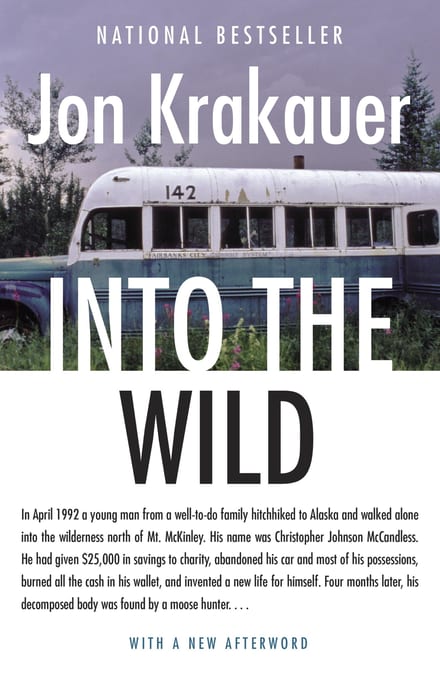
Into the Wild
The full book runs ~284 pages — roughly 5 hours of reading. You get the key ideas here in 5 minutes.
The key ideas
- He gave his $24,000 college fund to charity, burned the cash in his wallet, and walked north with ten pounds of rice.
- The meagerness was deliberate: he wanted Tolstoyan renunciation, and turned down the gear his last driver offered to buy him.
- He fed himself for sixteen weeks, then found the Teklanika — knee-deep in April — at impassable flood in July.
- A cable basket half a mile downstream would have carried him across, but he carried no topographic map.
- Krakauer argues mold on his stored wild potato seeds poisoned him, not a carelessly misidentified plant.
The summary
On September 6, 1992, moose hunters reached an abandoned bus on the Stampede Trail, twenty-five miles west of Healy, Alaska, and found a note taped to the door: “S.O.S. I NEED YOUR HELP. I AM INJURED, NEAR DEATH, AND TOO WEAK TO HIKE OUT OF HERE.” Inside lay a body weighing sixty-seven pounds. Christopher Johnson McCandless had graduated from Emory with honors in 1990, given the $24,000 left in his college fund to OXFAM, and spent two years crossing North America as Alexander Supertramp. Krakauer retraced that route for more than a year, and what he built is neither a canonization nor a coroner’s verdict.
The unpreparedness was deliberate
Jim Gallien, who gave him his last ride, catalogued what the kid carried: ten pounds of rice, a .22 Remington far too small for moose or grizzly, cheap boots, no ax, no compass, no snowshoes, a gas-station road map. Gallien offered to drive him to Anchorage and buy proper gear; Alex refused, handed over his watch and his last eighty-five cents, and said: “I don’t want to know what time it is. I don’t want to know what day it is or where I am.”
This wasn’t innocence about what Alaska costs: he had read Tolstoy hard enough to want the renunciation, not just admire it. Two years earlier, after a flash flood stranded his beloved Datsun in the Mojave, he abandoned it and burned the $123 left in his wallet. He wanted a blank spot on the map, and since none was left in 1992, he made one by refusing to carry a real map.
He collected people, then slipped away from them
McCandless was no recluse. Wayne Westerberg, who put him to work at the grain elevator in Carthage, South Dakota, called him the hardest worker he’d ever seen. Ronald Franz, eighty, who had lost his wife and only son to a drunk driver in 1957, taught him leatherwork and asked to adopt him as a grandson. McCandless dodged it — “We’ll talk about it when I get back from Alaska, Ron” — and sent him instead the closest thing to a creed he left: “Nothing is more damaging to the adventurous spirit within a man than a secure future…. Just get out and do it.”
The old man obeyed: furniture into storage, a van bought, camp pitched where Alex had slept. He waited eight months. On December 26, 1992, a hitchhiker told him the boy was dead; Franz renounced God and drank a bottle of whiskey in the desert hoping it would finish him.
The quarrel underneath the journey
Krakauer finds the engine of all this motion in 1986, when McCandless pieced together his father’s past from old neighbors. Walt McCandless, a NASA radar engineer, had kept two households for years, fathering another son with his first wife two years after Chris was born. Chris told his sister Carine the concealment made his “entire childhood seem like a fiction.” He never confronted his parents; he kept score in silence, graduated, gave the money away, and disappeared.
Then Krakauer inserts his own story. At twenty-three he quit a carpentry job and went alone to climb the unclimbed north face of the Devils Thumb, convinced it would repair his life. He nearly burned his father’s borrowed tent down, retreated off the wall in terror, summited by an easier line, and came home to find nothing changed. His father had mapped out medicine for him; he chose mountains. “The Devils Thumb was the same as medical school, only different.” He survived and McCandless didn’t, and he argues the difference was mostly chance: what he had was hubris and innocence about death, not a wish to die.
Two mistakes, not a verdict
For most of sixteen weeks he did well — squirrel, ptarmigan, porcupine, goose, berries, wild potato roots. He shot a moose on June 9, botched the smoking of the meat, watched it rot, and called it “one of the greatest tragedies of my life.” By early July he decided to walk out. The Teklanika he had strolled across in April was now a hundred feet of glacial floodwater, and he turned back, correctly. Half a mile downstream, a decommissioned gauging station spanned the gorge with a steel cable and a hand-hauled basket. Without a topographic map, he had no way of knowing salvation was that close.
The second mistake was smaller. On July 30 he wrote: “EXTREMLY WEAK. FAULT OF POT. SEED…. STARVING. GREAT JEOPARDY.” Krakauer’s magazine piece blamed a poisonous look-alike plant; he later argued instead that the wild potato seeds were harmless and that mold growing on them in damp Ziploc bags produced swainsonine, an alkaloid that stops the body turning food into energy. He calls this probable, not proven — the same care he takes correcting his own earlier report that the skeleton by the bus was a caribou. It was a moose; some of the legend of the incompetent kid came from Krakauer’s own errors.
The last book he read was Doctor Zhivago; beside a passage on unshared happiness he wrote, “HAPPINESS ONLY REAL WHEN SHARED.” His final note: “I HAVE HAD A HAPPY LIFE AND THANK THE LORD.” In the self-portrait he took holding it up, skeletal and grinning, he looks at peace.
The bottom line
McCandless wasn’t mentally ill, wasn’t suicidal, and wasn’t the usual bush casualty who assumed rescue would come; he lasted longer on less than most of the people who call him a fool ever have. A missing map and a bag of moldy seeds killed him, which is why the argument about him won’t settle: the mistakes were trivial and the ambition wasn’t. Read it if you’ve ever felt the pull of walking away from everything, or want to understand someone who did.
Fact check
Popular books repeat findings that later research has complicated. Where Into the Wild makes a testable claim, here's what the evidence actually shows.
Mold growing on McCandless's stored wild potato seeds produced swainsonine, an alkaloid that stopped his body converting food into energy.
No swainsonine has ever been found in Hedysarum alpinum seeds, and Krakauer dropped the mold explanation himself. The chemical analysis he later co-authored identified a different compound entirely — L-canavanine, at 1.2% by weight, roughly half the concentration found in jack bean. Canavanine's documented effect in primates is a slow lupus-like autoimmune syndrome, seen in macaques fed alfalfa sprouts, not a block on energy metabolism. The mold was an inference from the damp Ziploc bags, never a laboratory finding.
- Krakauer J, Long Y, Kolbert A, Thanedar S, Southard J. Presence of L-canavanine in Hedysarum alpinum seeds and its potential role in the death of Chris McCandless. Wilderness Environ Med. 2015;26(1):36-42. PubMed
- Malinow MR, Bardana EJ Jr, Pirofsky B, Craig S, McLaughlin P. Systemic lupus erythematosus-like syndrome in monkeys fed alfalfa sprouts: role of a nonprotein amino acid. Science. 1982;216(4544):415-7. PubMed
A toxin in the wild potato seeds, rather than plain starvation, is what killed McCandless.
The only hard evidence concerns the plant, not the man: mass-spectrometry analysis put L-canavanine in H. alpinum seeds at 1.2% weight for weight and its authors concluded seed consumption was "highly likely" to have contributed. Nobody has shown canavanine poisoning in McCandless, and the syndrome the compound is known to cause is a gradual autoimmune reaction in animals fed alfalfa over weeks, not the fast wasting his journal records. His sixty-seven-pound body is consistent with starvation on its own, so the seed hypothesis stays plausible and unproven — which is close to how the book itself frames it.
- Krakauer J, Long Y, Kolbert A, Thanedar S, Southard J. Presence of L-canavanine in Hedysarum alpinum seeds and its potential role in the death of Chris McCandless. Wilderness Environ Med. 2015;26(1):36-42. PubMed
- Malinow MR, Bardana EJ Jr, Pirofsky B, Craig S, McLaughlin P. Systemic lupus erythematosus-like syndrome in monkeys fed alfalfa sprouts: role of a nonprotein amino acid. Science. 1982;216(4544):415-7. PubMed
Frequently asked questions
What is Into the Wild about?
Jon Krakauer's reconstruction of Chris McCandless, who graduated from Emory with honors, gave the $24,000 left in his college fund to OXFAM, spent two years crossing North America as Alexander Supertramp, and walked into the Alaska bush in April 1992 with ten pounds of rice and a gas-station road map. Moose hunters found his body in an abandoned bus four months later. Krakauer spent more than a year retracing the route, and what he produced is neither a canonization nor a coroner's verdict.
What are the key takeaways from Into the Wild?
The book mostly dismantles the easy readings of McCandless. His unpreparedness was chosen, not naive — he wanted a blank spot on the map and made one by refusing to carry a real one. The fury driving him traces to discovering his father's secret second household, which made his "entire childhood seem like a fiction." He fed himself for sixteen weeks and was killed by two trivial things: a flooded Teklanika with a cable basket half a mile downstream he had no map to know about, and probably mold on wild potato seeds in damp plastic bags.
Who should read Into the Wild?
Read it if you've ever felt the pull of walking away from everything, or want to understand someone who did. It's also the book to read before joining the long argument about whether McCandless was a fool.
Is Into the Wild worth reading?
Yes, partly because Krakauer is honest about his own stake in it — he interrupts the story to describe his near-fatal solo climb of the Devils Thumb at twenty-three and admits the difference between them was mostly chance. He also corrects his own reporting, including the skeleton by the bus that was a moose, not a caribou. If you want a settled verdict, the book withholds one on purpose.