Book summary
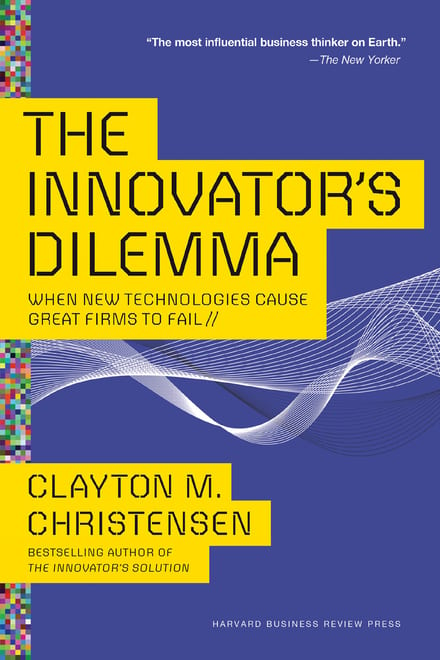
The Innovator's Dilemma: When New Technologies Cause Great Firms to Fail
When New Technologies Cause Great Firms to Fail
The full book runs ~286 pages — roughly 5 hours of reading. You get the key ideas here in 5 minutes.
The key ideas
- Established firms lead sustaining innovations and lose disruptive ones, every time.
- Disruptive products arrive worse, cheaper, and useful only in markets you ignore.
- Chasing margin pulls you upmarket until the low end is gone.
- Forecasts about markets that don't exist yet are reliably wrong.
- Conserve resources for the second strategy — your first one will fail.
- Hand the disruptive bet to an organization small enough to care.
The summary
Good management is what destroys great companies. Not complacency or arrogance — the exact practices taught as excellence. Listen closely to your best customers, invest where the margins are, kill projects that don’t pencil out, and you will walk your company off a cliff when the wrong kind of technology arrives. Fortune praised Sears in 1964 — “everybody simply did the right thing, easily and naturally” — at the moment it was ignoring discount retailing. Digital Equipment starred in the study behind In Search of Excellence while missing the desktop computer.
Two kinds of change, and only one of them kills you
Christensen tested this on disk drives, an industry a friend called the closest thing business has to fruit flies. He catalogued every model introduced worldwide between 1975 and 1994.
Most innovation is sustaining — it improves the product along dimensions existing customers already measure — and established firms led every sustaining change in that history, including radical ones that made their own factories obsolete. Disruptive innovations are the opposite: technically straightforward, often off-the-shelf parts in a plainer architecture, and worse on everything the mainstream values. The 8-inch drives of 1978 to 1980 held 10 to 40 MB when mainframe makers demanded 300 to 400, so entrants sold them to minicomputer makers instead. Then the lines crossed. Eight-inch capacity grew over 40 percent a year while minicomputer buyers needed 25, and the small drives were soon good enough for low-end mainframes. Two-thirds of the 14-inch makers never shipped an 8-inch model, and every one of them was eventually driven from the industry.
Listening to your best customers is the trap
Seagate had working 3.5-inch prototypes in early 1985, two years before Conner Peripherals shipped one. Marketing took them to Seagate’s own customers — desktop makers like IBM, who wanted 40 and 60 MB and were offered 20 at a higher cost per megabyte. The response was lukewarm, so executives cancelled the project for 5.25-inch drives, where the revenue obviously was. They read their market accurately. Seagate shipped its first 3.5-inch drive in 1988, by which point the industry had cumulatively sold $750 million of them.
Bucyrus Erie made the same move in dirt, buying a hydraulic backhoe company in 1950 and pitching the Hydrohoe to its own customers, who wanted buckets holding 1 to 4 cubic yards. Early hydraulics managed a quarter of a yard. What they were good for was cutting narrow trenches from sewer lines to house foundations — work previously done by hand, for contractors Bucyrus had never met. Of some thirty makers of cable-actuated shovels, four survived the switch.
Christensen calls this resource dependence: managers believe they allocate the money, but customers and investors actually do. The best-run companies have the most efficient systems for killing ideas their customers don’t want, which is exactly why they can’t fund a disruption in time.
The march upmarket looks like good strategy right to the end
Resources flow toward margin. A drive maker serving minicomputers needed 40 percent gross margins: moving down meant fighting rivals honed to profit at 25, moving up meant selling into a market used to paying 60. Each decision is right on its own; together they vacate the low end.
Minimills melt scrap at a fraction of an integrated mill’s scale, and their early steel was fit only for concrete reinforcing bar — the lowest-margin product in the industry, which the integrated mills were almost relieved to lose. Then went bars, rods and angle irons, then structural beams; Bethlehem closed its last beam plant in 1995. Retreating into premium sheet steel made those mills look brilliant: Bethlehem’s market value rose from $175 million in 1986 to $2.4 billion in 1989. By 1995 no integrated steelmaker anywhere had built a minimill.
You cannot research a market that doesn’t exist
Honda entered America in 1959 selling big highway bikes, because research said Americans valued size, power and speed. The engines leaked oil, the clutches wore out, and air-freighting warranty replacements nearly sank the venture. Kihachiro Kawashima, running the Los Angeles office, worked off his frustration riding his 50cc Supercub in the hills east of the city, and neighbors began asking where to buy one. Eventually the team saw it had stumbled into off-road recreational riding, and talked sporting goods dealers into stocking the line. Honda’s plan had been 10 percent of a 550,000-unit market growing 5 percent a year. By 1975 the market was five million units.
Forecasts about markets that don’t exist yet are wrong, and so is your first strategy. What separates survivors is having resources left for the second attempt, and the humility to plan for learning rather than for execution.
The fix is organizational, not motivational
You can’t exhort a big company into caring about a small market. A $4 billion firm growing 20 percent needs $800 million in new revenue, and no emerging market is that size — yet drive makers entering markets less than two years old hit $100 million in revenue 37 percent of the time, versus 6 percent for those entering established ones. Hand the disruptive business to an organization small enough to be excited by small orders. Quantum did that with Plus Development, an 80-percent-owned spinout; when the old 8-inch business evaporated, Quantum bought in the rest and installed Plus’s executives at the top. Capability lives in processes and values, not people: DEC’s engineers could have designed personal computers, but its two-to-three-year design cycles and 50-percent-margin rule could not.
The bottom line
Disruption doesn’t beat you with better technology. It beats you with a worse product, sold to customers you don’t want, in a market too small to matter — until it isn’t, and by then your cost structure can’t follow it down. The defense is giving the small, unpromising bet its own organization that must live or die by it. Read this if you run, fund, or set strategy for anything that could be undercut from below.
Fact check
Popular books repeat findings that later research has complicated. Where The Innovator's Dilemma makes a testable claim, here's what the evidence actually shows.
Established firms lead sustaining innovations but systematically lose to disruptive entrants from below.
The pattern is real in specific industries; the "systematically" is where it strains. King and Baatartogtokh went back through all 77 cases Christensen and his coauthor had offered as disruption and asked experts on each one whether the theory's four elements actually held. Seven of the 77 — 9 percent — matched both the premises and the prediction. A separate study of 93 radical innovations in consumer durables and office products found the incumbent's-curse assumption unreliable too: what predicted whether a firm produced radical innovation was its willingness to cannibalize its own business, not its size or incumbency.
Minimills, which began by melting scrap into the cheapest product in the industry, went on to take American steelmaking from the integrated mills.
The takeover Christensen described in 1997 as still in progress ran to completion. In 2024 electric arc furnaces — the minimill technology — accounted for 72 percent of US raw steel production, made by 49 companies across 104 minimills, while integrated steelmaking was down to two companies operating in 12 locations. The share has held above 70 percent every year since at least 2020. Of Christensen's three anchor industries, this is the one where the low-end path he traced is easiest to check against public production data.
- Tuck CC. Iron and Steel. In: Mineral Commodity Summaries 2025. Reston, VA: U.S. Geological Survey; January 2025:94-95. Source
Frequently asked questions
What is The Innovator's Dilemma about?
Great companies don't fail from complacency — they fail by doing exactly what's taught as excellence: listening to their best customers, investing where the margins are, and killing projects that don't pencil out. Christensen tested this on disk drives, cataloguing every model shipped worldwide between 1975 and 1994, and found established firms led every sustaining innovation and lost nearly every disruptive one. Disruptive products show up worse, cheaper and useful only in markets the leaders don't want, right up until they're good enough to take everything.
What are the key takeaways from The Innovator's Dilemma?
Separate sustaining innovation, which improves what customers already measure, from disruption, which arrives worse on every mainstream dimension — 8-inch drives held 10 to 40 MB when mainframe buyers wanted 300 to 400, and two-thirds of 14-inch makers never shipped one. Understand resource dependence: customers and investors allocate your money more than managers do, which is why Seagate cancelled working 3.5-inch prototypes in 1985 after its own desktop customers shrugged. Expect the march upmarket to feel like good strategy the whole way down, as it did for integrated steelmakers who happily gave up rebar to minimills. Don't trust forecasts about markets that don't exist — Honda planned for 10 percent of a 550,000-unit motorcycle market and stumbled into off-road riding instead — and hand the disruptive bet to an organization small enough to be excited by small orders.
Who should read The Innovator's Dilemma?
Read it if you run, fund, or set strategy for anything that could be undercut from below — an incumbent business, a portfolio, or a product line with comfortable margins.
Is The Innovator's Dilemma worth reading?
The evidence is what makes it hold up: disk drives, mechanical excavators, steel minimills and discount retailing all producing the same pattern, with the failure traced to good decisions rather than bad managers. The fix it offers is organizational rather than motivational, which is a harder sell than a pep talk but far more honest — Quantum survived by spinning out Plus Development and then installing its executives at the top. If you already know the disruption story secondhand, the detailed industry histories are where the real value sits, and skimming them defeats the point.