Book summary
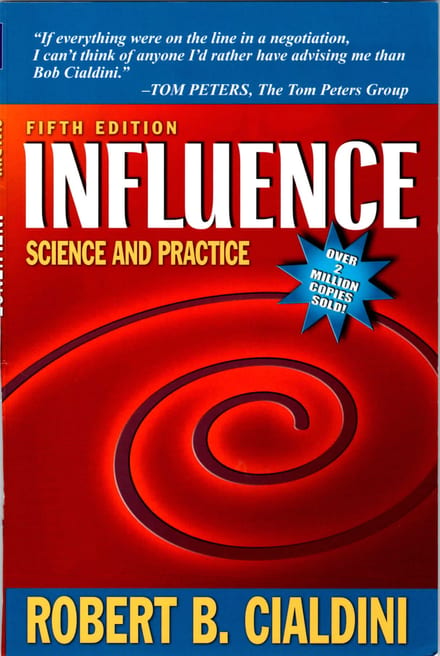
Influence: The Psychology of Persuasion
The full book runs ~287 pages — roughly 5 hours of reading. You get the key ideas here in 4 minutes.
The key ideas
- Reciprocity: unsolicited favors create debts you never agreed to
- Consistency: small commitments trap you into bigger ones
- Social proof: uncertainty makes you copy the crowd
- Liking: attractiveness and flattery quietly buy your yes
- Authority: uniforms and titles override your own judgment
- Scarcity: losing an opportunity makes you crave it irrationally
The summary
A mother turkey will mother almost anything that makes the cheep-cheep sound of a chick, and predators have learned to imitate that sound to get close. It’s a reflex, a shortcut that usually works and occasionally gets exploited. You run on the same kind of shortcuts, because you can’t reason every decision through from scratch. Consider the copy-machine study: a researcher asking to cut the line got 60% compliance with no reason, but 94% when she added “because I’m in a rush,” and 93% even when the reason was nonsense (“because I have to make copies”). The word “because” was enough to flip the switch. Cialdini’s point is that six of these switches, reciprocity, consistency, social proof, liking, authority, and scarcity, run most of your yeses, and professional persuaders have learned to trigger them on purpose. The defense isn’t to kill the reflex. It’s to notice when someone has counterfeited it.
Reciprocity creates debts you never agreed to
We feel obligated to return favors. The rule of reciprocation is so deeply wired, with roots in how societies share resources, that people will often repay a small favor with a much larger one just to shed the discomfort of feeling indebted. Manipulators exploit this by handing you an unsolicited favor and then cashing it in.
The same instinct powers the rejection-then-retreat tactic, also called door-in-the-face: open with an outrageous request, then “concede” to the smaller thing you wanted all along, and your target feels compelled to reciprocate the concession. It also rides the contrast principle, since the second request looks reasonable next to the first. G. Gordon Liddy used it on the Nixon campaign. His first schemes, kidnapping protest organizers and luring Democrats with prostitutes, were so extreme that when he scaled down to merely burglarizing the Democratic National Committee, it seemed almost sensible. That burglary became Watergate and brought down a president. The counter-move is simple: ask whether the favor was genuine, because a real favor deserves reciprocation and a setup does not.
Consistency traps you with your own words
Once you take a stand, however small, you feel pressure to act in line with it. The foot-in-the-door technique exploits this: agree to a tiny request and you’re far likelier to grant a big one later. In one beach study, people who had agreed to watch a stranger’s belongings tried to stop a staged theft 95% of the time, versus 20% who hadn’t been asked. That small yes had quietly turned them from bystanders into participants. The lowball technique works the same way. You agree to a good price, the terms then worsen, but by now you’ve justified the purchase to yourself and grown attached, so backing out feels like breaking your own word. It’s also why grueling initiation rituals bind people so tightly, since the harder you work for something, the more you inflate its value to justify the effort.
Social proof: we copy the crowd
When you’re unsure what to do, you look at what everyone else is doing. That’s why sitcoms use laugh tracks and why books boast of being bestsellers, since popularity reads as proof of quality. The dark version is the bystander effect: in an emergency, the more witnesses there are, the less likely anyone helps, because responsibility diffuses across the crowd. The fix is to destroy the ambiguity, singling out one person, meeting their eyes, and making a direct request so the job lands on them specifically. Social proof reaches even into the grimmest behavior. After Goethe published The Sorrows of Young Werther, whose hero kills himself, copycat suicides spiked, the “Werther effect.” We imitate people we see as similar to us, which is exactly why advertisers fill their ads with faces that resemble their intended buyers.
Liking and authority
You say yes more readily to people you like, and liking is easy to manufacture through flattery, shared interests, humor, or the sense of being on the same team. Physical attractiveness adds a halo effect: we assume good-looking people are also more trustworthy and competent, which is part of why voters lean toward more attractive candidates without realizing it.
Authority is stronger still. Stanley Milgram’s experiments showed ordinary people willing to deliver what they believed were dangerous electric shocks simply because a figure of authority told them to. The symbols do much of the work, since titles, uniforms, and props don’t have to be legitimate, only to look it. The safeguard is to pause and ask two questions: is this authority real, and do their interests actually line up with mine?
Scarcity and forbidden fruit
Make something scarce and we want it more, not because it improved but because the prospect of losing the chance feels unbearable. Advertisers lean on “limited time” and “only a few left” for exactly this reason, and scarcity bites hardest when availability has recently dropped and there’s competition in the mix. A close cousin is the Romeo and Juliet effect, where forbidding, banning, or censoring something makes it more desirable. Restricted information gets treated as more valuable and more worth defending, so censoring an idea often wins it sympathy. The question to ask yourself is whether you want the thing itself, or just want to win the race for it.
The bottom line
These six shortcuts, reciprocity, consistency, social proof, liking, authority, and scarcity, usually serve you well, which is precisely why they can be faked to steer you toward a yes you’d otherwise refuse. The remedy isn’t to override your instincts but to catch the moment someone is pulling the trigger artificially. Read this if you’d rather not be an easy mark.
Fact check
Popular books repeat findings that later research has complicated. Where Influence makes a testable claim, here's what the evidence actually shows.
Adding the word "because" to a request triggers automatic compliance even when the reason that follows is empty — 60% agreed with no reason, 93% with a meaningless one.
The figures come from the small-favor version of Langer's copy-machine experiment, and the paper's own conclusion is narrower than the retelling: the mindless pattern held only when the request did not "occasion an effortful response" or break the expected structure. Ask for a big favor and people read the reason rather than the format. Folkes ran four studies on the same paradigm in 1985 and reported that neither of her two direct attempts replicated Langer's result; compliance instead tracked whether the reason described something the asker could control ("I don't want to wait") or could not ("I feel really sick"), which points to processing rather than reflex.
- Langer EJ, Blank A, Chanowitz B. The mindlessness of ostensibly thoughtful action: the role of "placebic" information in interpersonal interaction. J Pers Soc Psychol. 1978;36(6):635-642. Source
- Folkes VS. Mindlessness or mindfulness: a partial replication and extension of Langer, Blank, and Chanowitz. J Pers Soc Psychol. 1985;48(3):600-604. Source
In an emergency, the more witnesses are present, the less likely it is that anyone helps.
The bystander effect is real but moderate, and it shrinks in exactly the situations the book has in mind. A meta-analysis of 105 independent effect sizes and more than 7,700 participants put the overall effect at g = -0.35, and found it attenuated when the emergency was perceived as dangerous rather than ambiguous. Surveillance footage of 219 real public conflicts in the UK, the Netherlands and South Africa went further: at least one bystander intervened in 9 of 10 incidents, and a larger crowd raised the odds that someone would step in rather than lowering them. Cialdini's practical advice — single someone out and make the request specific — still targets the ambiguity that does the damage.
- Fischer P, Krueger JI, Greitemeyer T, et al. The bystander-effect: a meta-analytic review on bystander intervention in dangerous and non-dangerous emergencies. Psychol Bull. 2011;137(4):517-537. PubMed
- Philpot R, Liebst LS, Levine M, Bernasco W, Lindegaard MR. Would I be helped? Cross-national CCTV footage shows that intervention is the norm in public conflicts. Am Psychol. 2020;75(1):66-75. PubMed
Milgram's experiments show that ordinary people will deliver apparently dangerous shocks simply because an authority figure tells them to.
The behaviour holds up. Burger's 2006 partial replication of Milgram's Experiment 5, run with 70 adults and stopped at the 150-volt protest, found obedience rates only slightly lower than Milgram's 45 years earlier, with no difference between men and women. What has not held up is the mechanism Cialdini's shortcut implies. In a virtual-reality version of the paradigm, participants who identified more strongly with the study's scientific purpose helped the learner more, were less stressed and hesitated more before shocking — results the authors read as a refutation of the passive "agentic state" account in favour of "engaged followership", where people go along because they have bought into the cause, not because a title switched off their judgement.
- Burger JM. Replicating Milgram: Would people still obey today? Am Psychol. 2009;64(1):1-11. PubMed
- Gonzalez-Franco M, Slater M, Birney ME, Swapp D, Haslam SA, Reicher SD. Participant concerns for the Learner in a Virtual Reality replication of the Milgram obedience study. PLoS One. 2018;13(12):e0209704. PubMed
Frequently asked questions
What is Influence about?
Cialdini shows that because you can't reason every decision through from scratch, you run on mental shortcuts — and six of them drive most of your yeses: reciprocity, consistency, social proof, liking, authority, and scarcity. Professional persuaders have learned to trigger these switches on purpose. The defense isn't to kill the reflex but to notice when someone has counterfeited it.
What are the key takeaways from Influence?
Reciprocity makes us repay favors, and powers the door-in-the-face tactic. Consistency traps us with our own words through foot-in-the-door and lowball techniques. Social proof makes us copy the crowd, which is why the bystander effect leaves no one helping. Liking rides flattery, similarity, and physical attractiveness, while authority — as in Milgram's experiments — bends people to titles and uniforms. Scarcity makes us want what we might lose. For each, Cialdini offers a counter-move: ask whether the trigger is genuine or artificial.
Who should read Influence?
Read it if you'd rather not be an easy mark. It's for anyone who wants to recognize when persuasion is being used on them — and to persuade more honestly themselves.
Is Influence worth reading?
It's a clear, evidence-driven tour of six persuasion principles, memorably illustrated — the copy-machine 'because' study, G. Gordon Liddy's escalating schemes, the Werther effect on copycat suicides. Each principle comes with a practical defense, so it works as both explanation and shield. Readers already steeped in behavioral psychology may find some examples familiar, but as a foundational, well-organized guide to influence it holds up.