Book summary
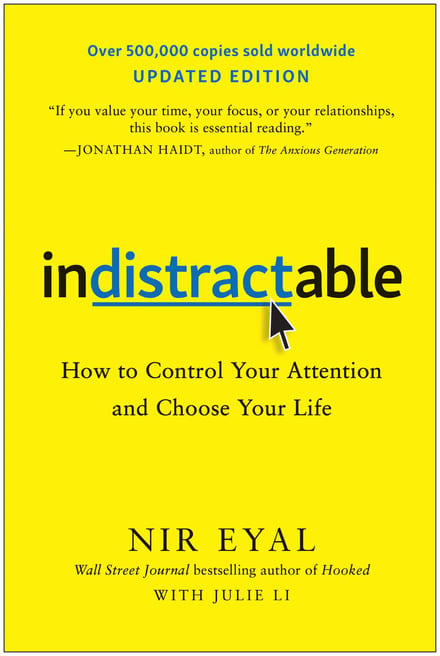
Indistractable: How to Control Your Attention and Choose Your Life
How to Control Your Attention and Choose Your Life
The full book runs ~336 pages — roughly 6 hours of reading. You get the key ideas here in 5 minutes.
The key ideas
- Separate traction from distraction by intent — the same hour can be either.
- Time management is pain management; sit with the trigger before you act.
- Surf the urge with the ten-minute rule and the craving usually fades.
- Timebox your values across self, relationships and work — planned leisure counts as traction.
- Ask of every ping: is it serving you, or are you serving it?
- Bind your future self with effort, price and identity pacts.
The summary
Your phone is not the reason you’re distracted. Nir Eyal’s argument is that the pull starts inside you, in a feeling you’d rather not sit with, and the screen is simply the nearest exit. He tested the alternatives on himself — digital detoxes, minimalism, even drafting on a disconnected word processor from the 1990s — and kept finding ways to squirm away from the work anyway. When the device is gone and the escaping continues, the device was never the cause.
So he rebuilds the vocabulary. Traction, from the Latin trahere, to draw or pull, is any action that moves you toward what you actually want. Distraction is any action that pulls you away from it. Notice what that definition does: the same hour of scrolling can be either one. You can’t call something a distraction unless you know what it’s distracting you from. The word separating the two isn’t screen time, it’s intent. Four steps follow, and the order matters: master internal triggers, make time for traction, hack back external triggers, prevent distraction with pacts.
All behavior is an escape from discomfort
Boredom, loneliness, uncertainty, the low dread of a task you’ve been putting off — these are internal triggers, and they arrive before you touch anything. Eyal’s compressed version: time management is pain management. You can’t govern your hours until you can sit with the feeling that makes you flee them.
The technique he borrows from acceptance and commitment therapy is deliberately unheroic. Notice the sensation. Write it down. Examine it with curiosity rather than contempt. Then apply the ten-minute rule — you may give in to the distraction, but not for ten more minutes. Set a timer and explore the urge while it runs. Usually the craving has faded before it goes off. Behavioral psychologists call this surfing the urge: you don’t fight the wave, you ride it until it flattens. The vulnerable moments are the seams between activities, when nothing has your attention yet.
Eyal also takes away a favorite excuse. Ego depletion — the theory that willpower is a tank you run dry — doesn’t survive scrutiny. Carol Dweck’s Stanford team, publishing in the Proceedings of the National Academy of Sciences, found signs of depletion only in subjects who already believed willpower was a limited resource. Michael Inzlicht at the University of Toronto proposes willpower behaves more like an emotion than a fuel gauge: it rises and falls with circumstance, and you no more run out of it than you run out of anger.
Schedule your values, not your tasks
A to-do list is a wish list. Eyal wants a calendar built from your values across three domains — yourself, your relationships, your work — with the hours boxed out in advance. That’s timeboxing, and it works because it’s an implementation intention, Gollwitzer’s well-tested finding that deciding what you’ll do and when dramatically improves follow-through. It also fences off Parkinson’s law, work swelling to fill the time available.
The counterintuitive part is that leisure gets scheduled too. The time you plan to waste is not wasted time. An hour of celebrity headlines you deliberately blocked out is traction; ten minutes of it stolen from a meeting is not.
Then sync the calendar with the people in it. A short weekly review with a partner keeps home commitments honest; the same conversation with a manager stops your week filling with someone else’s priorities. Colleagues who can’t see how you spend your time will keep handing you work that doesn’t matter.
Ask whether the trigger is serving you
Only now — after the inner work and the schedule — do you touch the notifications. The test for every external trigger is one question: is it serving you, or are you serving it? Pings, meetings, group chats, the colleague at your desk. Some earn the interruption; the rest get cut, muted, or moved.
When distraction at work is constant, Eyal reads it as a symptom: though we like to blame technology, distraction at work is a sign of dysfunction. What fixes it is psychological safety — knowing you won’t be punished for raising a concern — plus leaders who model focused work instead of firing off midnight messages. Slack, of all companies, greets employees with the words “Work Hard and Go Home.”
Pacts do what willpower can’t
A precommitment is a pledge that removes a future choice, made while you’re still clear-headed. Three kinds:
- Effort pacts make the unwanted thing harder. The Kitchen Safe is a container with a timer built into the lid. The Forest app grows a virtual tree that dies if you switch away before the timer ends. Site blockers do the same for the browser.
- Price pacts put your own money on the line. Eyal’s evidence is a New England Journal of Medicine smoking trial in which, among people who accepted the program offered them, a refundable $150 deposit produced far more quitters than an $800 reward. The catch he passes over is that almost nobody accepted the deposit, so counted across everyone enrolled the rewards won — a price pact bites hard on the rare person willing to post one.
- Identity pacts change who you believe you are. Vegetarians don’t deliberate over bacon. In a Journal of Consumer Research study, nearly twice as many people who said “I don’t” rather than “I can’t” chose the healthier option. Call yourself indistractable, out loud and to other people, and the behavior follows the label.
The bottom line
Distraction is a coping strategy, not a technology problem, and the fix is a chain rather than a trick: tolerate the discomfort, put your values on a calendar so you know what you’re being pulled away from, strip out the triggers that don’t serve you, then bind your future self with pacts. Eyal wrote Hooked to teach companies how to build habit-forming products; this is the same psychology aimed back at your own life. Read it if you’ve tried deleting apps and detoxing and the restlessness followed you anyway.
Fact check
Popular books repeat findings that later research has complicated. Where Indistractable makes a testable claim, here's what the evidence actually shows.
Ego depletion doesn't survive scrutiny, and willpower only runs down in people who already believe it is a limited resource.
The first half is on firm ground; the replacement Eyal reaches for is not. A preregistered test run across 36 labs with 3,531 participants found no ego-depletion effect in its planned analysis, so dropping the fuel-tank model is the right call. But the belief-moderator finding has had a rough decade of its own: a 2023 review located 13 independent studies testing whether willpower mindset moderates depletion and found only five reporting a moderation — two of those in the direction opposite to the original — while the 36-lab study found none. The Stanford work is real, and a PNAS experiment did find that glucose aided self-control only among people holding a limited-willpower theory, but it is a small original result that the larger tests have not reproduced.
- Vohs KD, Schmeichel BJ, Lohmann S, et al. A Multisite Preregistered Paradigmatic Test of the Ego-Depletion Effect. Psychol Sci. 2021;32(10):1566-1581. PubMed
- Miyake A, Carruth NP. On the robustness and replicability of the moderating influence of willpower mindset on the ego-depletion effect: existing evidence is weak at best. Front Psychol. 2023;14:1208299. PubMed
- Job V, Walton GM, Bernecker K, Dweck CS. Beliefs about willpower determine the impact of glucose on self-control. Proc Natl Acad Sci U S A. 2013;110(37):14837-42. PubMed
In a smoking-cessation trial, free patches and education got 6 percent to quit, an $800 reward got 17 percent, and a refundable $150 deposit got 52 percent — proof that risking your own money beats winning someone else's.
All three numbers appear in the trial, but the 17 and the 52 come from a per-protocol analysis restricted to people who accepted the program they were assigned, and acceptance is the whole story: 90.0 percent took up the reward program against 13.7 percent for the deposit. Counted across everyone randomized, which is the trial's primary analysis, rewards beat deposits — 15.7 percent sustained abstinence at six months against 10.2 percent, with usual care at 6.0 percent across 2,538 participants. The authors' conclusion runs opposite to the price-pact argument: deposits work better on the rare person willing to post one, and that unwillingness is why reward programs produced more quitters overall.
- Halpern SD, French B, Small DS, et al. Randomized trial of four financial-incentive programs for smoking cessation. N Engl J Med. 2015;372(22):2108-17. PubMed
Blocking your values into the calendar in advance works because it is an implementation intention — deciding what you'll do and when dramatically improves follow-through.
Both pieces hold, at a modest size rather than a dramatic one. Gollwitzer and Sheeran's review of 94 independent tests found if-then plans had a medium-to-large effect on goal attainment (d = .65). Time management as a broader practice is moderately related to job performance, academic achievement and wellbeing across the meta-analytic literature, and the wellbeing link is the stronger of the two — which fits Eyal's argument that the calendar exists to protect what you value rather than to squeeze out more work. The one part with no evidence behind it is the comparison itself: nobody appears to have tested a timeboxed calendar against a to-do list.
The device is not what's making you distracted — the cause is internal discomfort, and the tech-addiction framing gets the problem backwards.
The epidemiology is friendlier to Eyal than the headlines are. A specification-curve analysis across three large datasets totalling 355,358 adolescents found the association between digital technology use and wellbeing negative but tiny, explaining at most 0.4 percent of the variation — not the profile of a substance acting on a population. What the deflation understates is the tail. A meta-analysis of 41 studies covering 41,871 children and young people put the median prevalence of problematic smartphone use at 23.3 percent, with raised odds of depression (OR 3.17), anxiety (OR 3.05) and poor sleep (OR 2.60), though the authors graded the evidence low quality and noted the boundary between helpful and harmful use is still undefined. For most people the phone is the exit rather than the cause; for a minority the compulsion looks real enough to need more than a ten-minute timer.
- Orben A, Przybylski AK. The association between adolescent well-being and digital technology use. Nat Hum Behav. 2019;3(2):173-182. PubMed
- Sohn S, Rees P, Wildridge B, Kalk NJ, Carter B. Prevalence of problematic smartphone usage and associated mental health outcomes amongst children and young people: a systematic review, meta-analysis and GRADE of the evidence. BMC Psychiatry. 2019;19(1):356. PubMed
Frequently asked questions
What is Indistractable about?
Nir Eyal's argument is that your phone isn't the reason you're distracted. The pull starts inside you, in a feeling you'd rather not sit with, and the screen is simply the nearest exit, which he proved on himself by trying detoxes, minimalism and a 1990s disconnected word processor and still finding ways to squirm away from the work. He rebuilds the vocabulary around traction, any action that moves you toward what you want, and distraction, any action that pulls you away, so the same hour of scrolling can be either one depending on intent.
What are the key takeaways from Indistractable?
Four steps in order: master internal triggers, make time for traction, hack back external triggers, and prevent distraction with pacts. Time management is pain management, so you handle boredom or dread by noticing the sensation, writing it down, and applying the ten-minute rule, giving in only after ten more minutes while you surf the urge. Then timebox your values across yourself, your relationships and your work, since scheduled leisure counts as traction and a to-do list is only a wish list. Every external trigger gets one test: is it serving you, or are you serving it? Pacts come last, in three kinds, effort pacts that make the unwanted thing harder, price pacts that put your own money on the line, and identity pacts where calling yourself indistractable makes the behavior follow the label.
Who should read Indistractable?
It's for anyone who has tried deleting apps and doing detoxes only to find the restlessness followed them anyway, and who wants to understand what the escaping is actually about.
Is Indistractable worth reading?
It's unusually honest about mechanism rather than tricks, and it clears away some received wisdom along the way, including the idea that willpower is a tank you run dry. It's also worth reading with one eye open: the smoking study behind its price-pact advice is weaker evidence than the book makes it sound, since almost nobody was willing to post the deposit that worked. Eyal wrote Hooked to teach companies how to build habit-forming products, so readers who want an indictment of tech companies will find the blame pointed inward instead.