Book summary
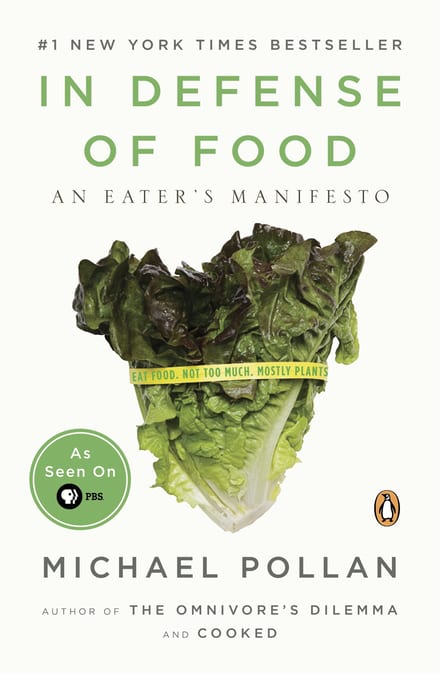
In Defense of Food: An Eater’s Manifesto
The full book runs ~244 pages — roughly 4 hours of reading. You get the key ideas here in 3 minutes.
The key ideas
- Reject nutritionism: eat real foods, not isolated nutrients
- Distrust health claims stamped on processed products
- Blame the Western Diet of refined sugar and flour
- Skip anything your great-grandmother wouldn't recognize
- Choose fewer, higher-quality foods grown in healthy soil
- Recover food culture with real meals at the table
The summary
Sometime in the twentieth century, we stopped eating food and started eating nutrients. People who once thought in terms of bread, apples, and fish began thinking in terms of carbohydrates, vitamins, and saturated fat. Michael Pollan calls this shift nutritionism, and his charge is blunt: it made us sicker. Once eating became about isolated nutrients rather than whole foods, manufacturers could stamp a health claim on almost anything, and Americans dutifully followed the advice into obesity and diabetes. His remedy fits on a bumper sticker — eat food, not too much, mostly plants — but the story of how we lost the plot is worth understanding first.
How eating food became eating nutrients
The shift has a specific origin. In the 1950s, scientists floated the lipid hypothesis, linking the fat and cholesterol in meat and dairy to heart disease. By 1977 it hardened into “The Dietary Goals for the United States,” a document that reshaped how a nation ate — despite resting on weak studies and a tenuous link between dietary cholesterol and heart disease. Politics finished the job. Senator George McGovern, who chaired the committee, had cattle-ranching interests, and to satisfy both those interests and the food lobby, the wording was softened. “Eat less meat and dairy” became “choose meats, poultry, and fish low in saturated fat.” That small edit changed everything: it invited the industry to reformulate products instead of prompting people to eat less processed food. From then on we needed nutritionists to interpret the mysterious commands of nutrition for us, a kind of priesthood for a new secular religion.
The regulations bent the same way. Manufacturers won the right to sell imitation foods without the “imitation” label as long as the products weren’t judged nutritionally inferior, which let processed concoctions pass as real food. Labels multiplied — low-fat, no-cholesterol, high-fiber — and a box of cookies could look virtuous by having a few approved nutrients added back in.
More science, worse health
For all the scientific framing, the health results were dismal. The boom in low-fat products tracked an alarming rise in obesity and diabetes. People cut saturated fat but replaced it with refined carbohydrates, and swapping fat for carbs interferes with metabolism and encourages overeating. Deaths from heart disease did fall, but hospital admissions for heart attacks didn’t, which suggests better medical care, not better diets, saved those lives.
Two cases puncture the whole approach. The French eat plenty of what American nutritionists call toxic and still have lower rates of heart disease than Americans on engineered low-fat diets — the French paradox, powered by a genuine love of food and a more natural way of eating. And long before any of this, Justus von Liebig built an early baby formula by isolating and concentrating the “essential” nutrients; babies raised on it were less healthy than breastfed ones. Real food keeps outperforming its reduction to parts.
The Western Diet and the whole food chain
The true culprit isn’t fat or carbohydrate in isolation; it’s the Western Diet itself — processed foods heavy in refined sugar and flour, stripped of nutrients and engineered for shelf life, right down to the heavily processed meat on the plate. Studies around the world show that populations who avoid this diet avoid its diseases. In one, ten Aboriginal people who had adopted a Western diet showed rising weight, blood pressure, and diabetes risk; when they returned to their traditional hunter-gatherer foods, those problems eased markedly.
Quality traces all the way back to the soil. Industrial production simplifies and chemically treats food to make it last and travel, removing nutrients and adding back only the few that food science prizes. The nutritional content of refined foods has fallen over time — an apple in 1940 supplied as much iron as three of today’s apples. White flour stores easily and converts fast to energy but lacks the value of whole wheat, feeding overeating, vitamin deficiencies, and chronic disease. The health of each link in the chain shapes the next, which is why you can’t separate your own health from the health of the whole food ecosystem. Even in animal products it matters: choose sources that ate more leaves and fewer seeds, because you are what you eat eats.
Eat food, not too much, mostly plants
Before nutritionism, people trusted food cultures handed down through generations, and Pollan wants us to recover that with a handful of plain rules. Don’t eat anything your great-grandmother wouldn’t recognize as food. Avoid products with long, complicated ingredient lists — a sign of heavy processing. Be skeptical of health claims, since you never see “lowers cholesterol” on a head of broccoli, and the claims usually rest on shaky science. Lean on plants, especially leaves, which are dense in nutrients and antioxidants; favor organic produce grown in good soil. Keep the diet diverse across many plants and animals. Then focus on quality over quantity: spend more per meal and eat less. And change how you eat, not just what — a fifth of American food is eaten in the car, so make the effort to sit down for real, home-cooked meals with people you care about.
The bottom line
The move from eating food to eating nutrients was a costly mistake, built on thin science and industry interests, and it left us chasing labels while getting sicker. Health comes from whole foods, mostly plants, grown in healthy soil — not from the next nutritional fad. Read this if you’re worn out by contradictory diet advice and want to eat well without a degree in biochemistry.
Fact check
Popular books repeat findings that later research has complicated. Where In Defense of Food makes a testable claim, here's what the evidence actually shows.
The lipid hypothesis behind the 1977 Dietary Goals rested on weak studies, and the link between dietary cholesterol and heart disease is tenuous.
Cutting saturated fat does help, though less sweepingly than 1977 promised. A Cochrane review of 15 randomised trials in 56,675 adults found a 17% reduction in combined cardiovascular events (RR 0.83), with larger cuts in saturated fat producing larger reductions — but little or no effect on all-cause mortality (RR 0.96) or cardiovascular mortality (RR 0.95), which is close to Pollan's scepticism. Dietary cholesterol, the link he treats as thinnest, still tracks risk: pooling six US cohorts of 29,615 people over a median 17.5 years, each additional 300 mg a day came with a 17% higher rate of incident cardiovascular disease and 18% higher all-cause mortality.
- Hooper L, Martin N, Jimoh OF, Kirk C, Foster E, Abdelhamid AS. Reduction in saturated fat intake for cardiovascular disease. Cochrane Database Syst Rev. 2020;8(8):CD011737. PubMed
- Zhong VW, Van Horn L, Cornelis MC, et al. Associations of Dietary Cholesterol or Egg Consumption With Incident Cardiovascular Disease and Mortality. JAMA. 2019;321(11):1081-1095. PubMed
The French eat plenty of what American nutritionists call toxic and still have less heart disease, which shows the fat-and-heart-disease story is wrong.
The gap is real but largely a matter of timing rather than a refutation. Across 20 countries, heart-disease mortality tracks animal-fat consumption from about 30 years earlier far more closely than current consumption — r² of 0.54 for 1965 intake against 0.07 for 1988 intake. France only caught up with Britain's saturated-fat intake between 1970 and 1980; before that it ran 21% of energy against Britain's 31%, and its serum cholesterol, 0.6 mmol/L lower in 1970, accounts for most of the mortality difference. Under-recording of coronary deaths on French death certificates explains roughly another 19%.
- Law M, Wald N. Why heart disease mortality is low in France: the time lag explanation. BMJ. 1999;318(7196):1471-1476. PubMed
Produce has been drained of nutrients — an apple in 1940 supplied as much iron as three of today's apples.
Declines are measurable but nowhere near a two-thirds drop. Comparing USDA composition data for 43 garden crops between 1950 and 1999, Davis and colleagues found statistically reliable median declines in six of 13 nutrients — ranging from 6% for protein to 38% for riboflavin, with iron among the six — and no reliable change in the other seven. They attributed the declines mainly to a yield-versus-nutrient trade-off in newer cultivars rather than exhausted soil, and noted that about 28% of the changes that were statistically reliable went up rather than down.
- Davis DR, Epp MD, Riordan HD. Changes in USDA food composition data for 43 garden crops, 1950 to 1999. J Am Coll Nutr. 2004;23(6):669-682. PubMed
Ten Aboriginal Australians who left the Western diet and returned to traditional hunter-gatherer food saw weight, blood pressure and diabetes markers ease markedly.
The metabolic reversal is real and the numbers are striking. Over seven weeks living as hunter-gatherers, ten middle-aged diabetic participants each lost about 8 kg; fasting glucose fell from 11.6 to 6.6 mmol/L, fasting insulin from 23 to 12 mU/L, and fasting triglycerides from 4.0 to 1.2 mmol/L. What the study cannot show is that traditional food as such did the work — intake ran about 1,200 kcal a day, so severe energy restriction and rapid weight loss are tangled up with the change in food type. With ten participants, no control group and a seven-week window, it points a direction rather than settling the question.
- O'Dea K. Marked improvement in carbohydrate and lipid metabolism in diabetic Australian aborigines after temporary reversion to traditional lifestyle. Diabetes. 1984;33(6):596-603. PubMed
Frequently asked questions
What is In Defense of Food about?
Pollan argues that sometime in the twentieth century we stopped eating food and started eating nutrients — thinking in carbohydrates and saturated fat instead of bread and fish — a shift he calls nutritionism that made us sicker. His remedy fits on a bumper sticker: eat food, not too much, mostly plants. But the story of how we lost the plot is what the book sets out to explain.
What are the key takeaways from In Defense of Food?
Nutritionism took hold through the 1950s lipid hypothesis and the 1977 Dietary Goals, whose wording was softened by politics so industry could reformulate products rather than have people eat less. More science tracked worse health as low-fat foods rose alongside obesity and diabetes. The real culprit is the Western Diet itself — processed foods heavy in refined sugar and flour — and food quality traces back to the soil. Pollan's plain rules: don't eat what your great-grandmother wouldn't recognize, avoid long ingredient lists, be skeptical of health claims, favor plants and quality, and sit down for real meals.
Who should read In Defense of Food?
Read it if you're worn out by contradictory diet advice and want to eat well without a degree in biochemistry. It suits anyone tired of chasing labels and nutritional fads.
Is In Defense of Food worth reading?
It's persuasive and well-told, tracing how thin science and industry interests reshaped how a nation eats, with sharp examples like the French paradox and Aboriginal people whose health improved on returning to traditional foods. Its practical rules are simple and memorable. The critique of nutrition science is pointed and takes a firm stance, so readers wanting a balanced survey of the research may find it one-sided — but as a manifesto for eating whole foods it's clear and convincing.