
Book summary
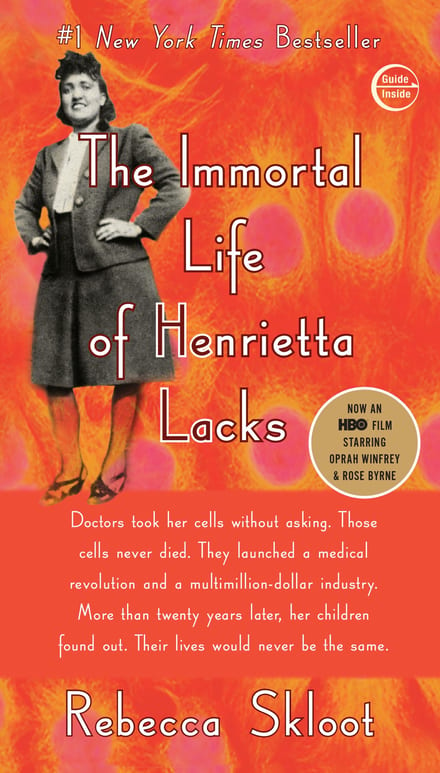
The Immortal Life of Henrietta Lacks
The full book runs ~381 pages — roughly 7 hours of reading. You get the key ideas here in 3 minutes.
The key ideas
- Stolen: Henrietta's HeLa cells were taken without consent in 1951
- Immortal: her cells reproduced endlessly, powering polio vaccines and cancer research
- Profited: a multibillion-dollar industry grew while her family stayed poor
- Silenced: the Lacks family learned nothing for decades
- Systemic: medical racism from Tuskegee shaped Black patients' distrust
- Contested: courts ruled patients own no rights to discarded cells
The summary
Some of medicine’s greatest gifts were extracted from people who were never asked. Henrietta Lacks is the clearest case. A Black tobacco farmer and mother of five, she died of cervical cancer at Johns Hopkins on October 4, 1951, after radium treatments failed. During those treatments, the biologist George Gey took a sample of her tumor without telling her or her family. Those cells — labeled HeLa — became the first human cells to survive and reproduce indefinitely outside the body, doubling every 24 hours. They seeded the polio vaccine, chemotherapy, cloning, gene mapping, and in vitro fertilization, and even rode the first space missions to test human cells in zero gravity. Trillions more of her cells now grow in labs than ever lived in her body. Her family had no idea.
Medicine took without asking
Gey cultivated the cells with a roller-tube technique that mimicked blood flow, and his assistant, Mary Kubicek, shipped the breakthrough “immortal” cells to researchers around the world. What made HeLa revolutionary wasn’t only its immortality. The cells were economical, cheaper to test on than animals; sustainable, thriving in culture medium rather than being limited by surface area like other cells; and transportable, surviving long journeys. Scientists built a cell factory to mass-produce them for polio research, then turned them loose on nearly every disease imaginable. They were the first cells cloned and the first commercially cultured for profit.
This was extraction, not consent — and at the time, it was perfectly legal. No law required doctors to ask. Henrietta’s family stayed in the dark for decades, learning the truth only when researchers needed blood from her surviving children to identify HeLa contamination in other cell lines. Even then, the doctors didn’t fully explain what they were doing. Her daughter Deborah, frightened, wondered whether the blood draw meant she too might have cancer.
The long shadow of medical racism
The family’s wariness wasn’t paranoia; it was pattern recognition. Black Americans have been used as research material for generations. The Tuskegee study, run from 1932 to 1972, observed the progression of untreated syphilis in 600 Black men without their informed consent and withheld treatment even after it existed. In the 1800s, white slave owners invented tales of “night doctors” in white sheets who kidnapped Black people, a scare tactic to deter escape that later shaped the Ku Klux Klan’s white cloaks. Johns Hopkins itself sat beside a poor Black neighborhood, which made patients easy to recruit.
The irony cuts deep: Black scientists and technicians, many of them women, used a Black woman’s cells to help save millions of lives, most of them white, on the very same campus and at the very same time that Tuskegee was underway. When Rebecca Skloot, a white writer, first tried to reach the Lacks family in 1999, she met deep mistrust and got stood up, which sent her to Henrietta’s hometown of Clover, Virginia, to learn the family’s story. After Henrietta’s death, that story was one of hardship — her husband Day worked two jobs, their son Lawrence left school to care for his siblings, and Deborah endured abuse as a child and later married an abusive husband.
Who owns your cells once they leave your body?
HeLa exposed a legal void that still isn’t fully closed. In the 1960s, a Sloan-Kettering researcher injected patients with HeLa cells without proper explanation or consent, drawing objections and press attention. The geneticist Stanley Gartler then discovered that HeLa’s aggressive survivability had contaminated cell lines across the world, throwing years of research into doubt. The question of ownership came to a head with John Moore, an Alaskan pipeline worker whose doctor marketed his cells without telling him. Moore sued, and the California Supreme Court ruled that a patient’s discarded samples aren’t his property and that he has no rights to the profits derived from them.
Contrast that with Ted Slavin, a hemophiliac whose blood produced valuable hepatitis B antibodies. Because someone told him his cells had commercial value, he was able to profit from them. The difference was simply that he was informed. Many argue patients have a fundamental right to know how their cells might be used, whether for profit or for controversial ends. The Lacks family learned their mother’s cells were being sold while they couldn’t afford health insurance. As Deborah put it, “She’s the most important person in the world and her family living in poverty. If our mother so important to science, why can’t we get health insurance?” Skloot and Deborah eventually became close friends; Deborah, still struggling with her health and money, died in her sleep in 2009.
The bottom line
Henrietta Lacks’s cells built modern medicine, yet she never consented and her family never shared in the reward — proof that scientific progress has often been extracted from people who were never asked. Read this if you care about medical ethics, racial justice, or the hidden human cost of innovation.
Frequently asked questions
What is The Immortal Life of Henrietta Lacks about?
It's the story of Henrietta Lacks, a Black tobacco farmer whose cancer cells were taken without her knowledge at Johns Hopkins in 1951 and became HeLa — the first human cells to survive and reproduce indefinitely. Those cells seeded the polio vaccine, chemotherapy, cloning, and gene mapping, yet her family had no idea for decades. The book shows how some of medicine's greatest gifts were extracted from people who were never asked.
What are the key takeaways from The Immortal Life of Henrietta Lacks?
Medicine took Henrietta's cells without consent, which at the time was perfectly legal. Her family's wariness was pattern recognition, not paranoia — the book connects it to the Tuskegee syphilis study and a long history of medical racism against Black Americans. It also exposes a legal void over who owns your cells once they leave your body, contrasting the John Moore ruling with Ted Slavin, who profited from his blood simply because he was informed. Running through it is the question of consent, ownership, and a family living in poverty while HeLa was sold.
Who should read The Immortal Life of Henrietta Lacks?
Read it if you care about medical ethics, racial justice, or the hidden human cost of innovation. It's for readers who want the human story behind a scientific breakthrough.
Is The Immortal Life of Henrietta Lacks worth reading?
It braids three strands well — the science of why HeLa was revolutionary, the Lacks family's decades of hardship and mistrust, and the ethical questions of consent and ownership — anchored by Skloot's close friendship with Henrietta's daughter Deborah. The emotional weight is real, including Deborah's struggles and death in 2009. Readers wanting a purely scientific account may find the family narrative expansive, but that human dimension is exactly what makes the book land.