Book summary
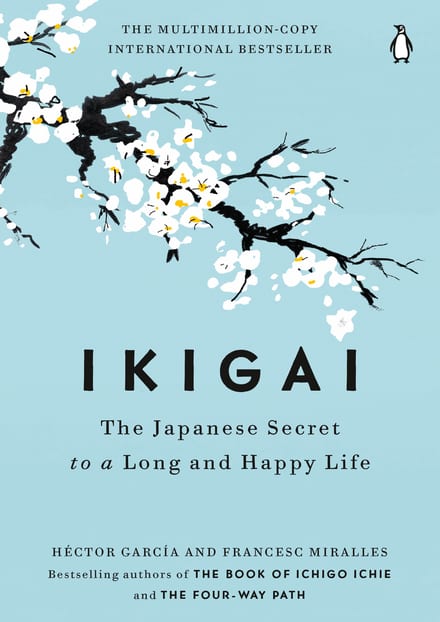
Ikigai: The Japanese Secret to a Long and Happy Life
The full book runs ~208 pages — roughly 4 hours of reading. You get the key ideas here in 4 minutes.
The key ideas
- Find your ikigai—the reason that gets you out of bed
- Never fully retire; weave meaningful work into daily life
- Eat until 80 percent full with varied, plant-rich foods
- Move gently all day rather than exercising in bursts
- Nurture lifelong social groups through moai and friendship
- Build resilience and antifragility by embracing challenge and impermanence
The summary
The people of Okinawa mostly don’t retire. In villages like Ogimi they keep tending gardens, meeting friends, and doing the work that gives them joy well past a hundred. What holds it all together is ikigai—your reason for being, loosely translated as “the happiness of always being busy.” García and Miralles set out to learn why these Blue Zone elders outlive nearly everyone, and the answer has less to do with medicine than with four humble habits: purposeful work you never fully quit, gentle movement all day, friendships that last a lifetime, and stopping before your stomach is full.
A reason to get up
Ikigai is the thing that pulls you out of bed in the morning, and finding it takes patient reflection. In Okinawa it isn’t a hobby set apart from life; it’s braided into the gardening, the craft, the grandchildren. That’s why so few people there retire in the Western sense—stepping away from your purpose removes the very thing keeping you vital. The same pattern shows up in artists who do their best work in their eighties and nineties. Walter Breuning, who reached 114, said it flatly: “If you keep your mind and body busy, you’ll be around a long time.”
Viktor Frankl built a whole therapy on this instinct. Logotherapy, shaped partly by his years in concentration camps, helps people find meaning as the engine that carries them through hardship. Unlike psychoanalysis, which mines the past, it faces forward—you may not control your circumstances, but you always choose your response to them. Japan has a kindred practice in Morita therapy, which teaches you to accept difficult emotions rather than wrestle them: “If we try to get rid of one wave with another, we end up with an infinite sea.”
Stop at eighty percent
Okinawans practice hara hachi bu—eat until you’re about four-fifths full, then put the chopsticks down. They take in roughly 1,800 to 1,900 calories a day against the American 2,200 to 3,300, and carry a body mass index between 18 and 22. The food itself is built for longevity: vegetables, fruit, whole grains, tofu, miso, bitter melon, seaweed, and jasmine tea, all dense with antioxidants. Local centenarians eat an average of eighteen different foods a day. You don’t have to copy the exact menu; the transferable rules are simply more plants, more variety, and less on the plate.
Move gently, all day
The longest-lived people aren’t the ones grinding through intense workouts—Blue Zone research finds they’re the ones who move constantly, in small ways, from morning to night. Okinawans walk, garden, and practice mind-body disciplines like tai chi, qigong, and yoga. Many join radio taiso, a group morning warm-up that gets a whole community stretching together and knits movement into the day. These gentle habits improve circulation and flexibility, ease stress, and slow the progress of disease, while long stretches of sitting do the opposite. Walk more, cut screen time, and sleep seven to nine hours, and the needle moves.
Friends, flow, and a supple mind
Central to Okinawan life is the moai—a tight circle of friends with shared interests who offer each other emotional and even financial support across decades. Set inside that web of belonging, the village ethic is easy to state: don’t worry, nurture your friendships, live unhurried, stay grateful, celebrate often. That steady social ground also makes room for flow, the state of full immersion where time vanishes and effort feels satisfying. You reach it by picking tasks that are challenging but doable, setting clear goals, and shutting out distraction—and fulfilled people, from artists to scientists, arrange their lives to spend as much time there as they can, aligned with their ikigai.
The mindset that ties it together is a durable calm. Both Buddhism and Stoicism teach the same disciplines the centenarians seem to live by: stay in the present, picture the worst to disarm it, and accept that everything passes. The Japanese ideas of wabi-sabi and ichi-go ichi-e train you to find beauty in imperfection and to treat each moment as unrepeatable. Better still than bouncing back is what the authors call antifragility—growing stronger through adversity—which you build by keeping redundancies like several income streams and strong relationships, taking small risks, and cutting out sources of fragility such as junk food and toxic people. As Epictetus said, it’s not what happens to you but how you react that matters.
The bottom line
Longevity in places like Okinawa comes down to having a reason to get up, moving gently all day, eating to about eighty percent full, and staying wrapped in people who love you. Read this if you want to add years and meaning to your life through daily habits and purpose rather than quick fixes.
Fact check
Popular books repeat findings that later research has complicated. Where Ikigai makes a testable claim, here's what the evidence actually shows.
Okinawa is a Blue Zone where an extraordinary share of people reach and pass 100, and its elders outlive nearly everyone.
Okinawa's older cohort really did outlive its peers: at age 65, remaining life expectancy was 24.1 years for women and 18.5 for men, against 22.5 and 17.6 on mainland Japan and 19.3 and 16.2 in the United States. The extreme-age end of the story is shakier. Newman's analysis of age records found US supercentenarian counts fell 69-82% once individual states introduced birth certificates, that only 18% of exhaustively validated supercentenarians hold one, and that Okinawa, Sardinia and Ikaria all sit below their national averages on income, literacy and life expectancy. That paper is still a preprint, but his peer-reviewed work showed birth- and death-registration errors at rates below 1 in 10,000 are enough on their own to produce the apparent late-life slowdown in mortality.
- Willcox BJ, Willcox DC. Caloric restriction, caloric restriction mimetics, and healthy aging in Okinawa: controversies and clinical implications. Curr Opin Clin Nutr Metab Care. 2014;17(1):51-58. PubMed
- Newman SJ. Errors as a primary cause of late-life mortality deceleration and plateaus. PLoS Biol. 2018;16(12):e2006776. PubMed
- Newman SJ. Supercentenarian and remarkable age records exhibit patterns indicative of clerical errors and pension fraud. bioRxiv. Preprint posted March 14, 2024. doi:10.1101/704080 Source
Okinawans take in roughly 1,800 to 1,900 calories a day against the American 2,200 to 3,300 and carry a BMI of 18 to 22, and that lifelong calorie deficit is what stretches their lives.
The figures are close for the cohort the book describes. Six decades of Okinawan population data put the elderly cohort's intake at about 1,785 kcal a day, roughly 11% below what they needed to hold their weight, with an adult BMI near 21. But the restriction was mild — on the order of 10-15% — not the 30-45% shortfall the American comparison implies, and it has not survived. Younger Okinawans now show higher BMI across every age band, more type 2 diabetes and worse cardiovascular risk factors than other Japanese, and the island's life-expectancy advantage is now confined to its oldest residents.
- Willcox BJ, Willcox DC. Caloric restriction, caloric restriction mimetics, and healthy aging in Okinawa: controversies and clinical implications. Curr Opin Clin Nutr Metab Care. 2014;17(1):51-58. PubMed
- Willcox BJ, Willcox DC, Todoriki H, et al. Caloric restriction, the traditional Okinawan diet, and healthy aging: the diet of the world's longest-lived people and its potential impact on morbidity and life span. Ann N Y Acad Sci. 2007;1114:434-455. PubMed
Having an ikigai — a clear reason to get out of bed — is associated with living longer.
This is the best-evidenced claim in the book. The Ohsaki cohort followed 43,391 Japanese adults for seven years and recorded 3,048 deaths; those who said they had no ikigai carried a 1.5-fold higher hazard of death from any cause (95% CI 1.3-1.7), concentrated in cardiovascular and external causes rather than cancer. A meta-analysis of ten prospective studies covering 136,265 people found a high sense of purpose associated with a 17% lower risk of all-cause mortality and the same reduction in cardiovascular events (pooled RR 0.83 for both). Both are observational, so purpose is partly a marker of already being well, not purely a cause of staying well.
- Sone T, Nakaya N, Ohmori K, et al. Sense of life worth living (ikigai) and mortality in Japan: Ohsaki Study. Psychosom Med. 2008;70(6):709-715. PubMed
- Cohen R, Bavishi C, Rozanski A. Purpose in Life and Its Relationship to All-Cause Mortality and Cardiovascular Events: A Meta-Analysis. Psychosom Med. 2016;78(2):122-133. PubMed
Longevity comes from constant gentle movement spread through the day rather than from concentrated bouts of exercise.
Any activity beats none, but concentrated exercise is not the weaker option the book implies. Pooling 11 English and Scottish cohorts — 63,591 adults, 8,802 deaths over 561,159 person-years — people who packed all their weekly activity into one or two sessions had an all-cause mortality hazard of 0.70 against inactive peers, statistically indistinguishable from the 0.65 of those who spread the same activity over three or more sessions. For cardiovascular death the two patterns were effectively identical, at 0.60 and 0.59. Total activity is what tracks with survival; how finely it is sliced across the day does not appear to matter much.
- O'Donovan G, Lee IM, Hamer M, Stamatakis E. Association of "Weekend Warrior" and Other Leisure Time Physical Activity Patterns With Risks for All-Cause, Cardiovascular Disease, and Cancer Mortality. JAMA Intern Med. 2017;177(3):335-342. PubMed
Frequently asked questions
What is Ikigai about?
It explores why elders in Okinawa's Blue Zone villages outlive nearly everyone, and finds the answer less in medicine than in ikigai — your reason for being, loosely 'the happiness of always being busy.' The long lives there rest on four humble habits: purposeful work you never fully quit, gentle movement all day, lifelong friendships, and stopping before your stomach is full.
What are the key takeaways from Ikigai?
Keep a reason to get up — Okinawans rarely retire, and Viktor Frankl's logotherapy and Japan's Morita therapy both make meaning the engine that carries people through hardship. Eat with hara hachi bu, stopping at about eighty percent full, with plenty of plants and variety. Move gently and constantly through walking, gardening, tai chi, and group radio taiso. Stay wrapped in a moai, a lifelong circle of friends, make room for flow, and build a durable calm — drawing on wabi-sabi, Stoicism, and what the authors call antifragility.
Who should read Ikigai?
Read it if you want to add years and meaning to your life through daily habits and purpose rather than quick fixes. It suits anyone drawn to a slower, more connected way of living.
Is Ikigai worth reading?
Its strength is weaving longevity research from the Blue Zones into a small set of livable habits — purpose, gentle movement, mindful eating, and strong friendships — illustrated with Okinawan centenarians and figures like Walter Breuning at 114. It ranges widely across ideas from Frankl to flow to Stoicism, which makes it inspiring but sometimes light on depth. If you want a gentle, big-picture guide rather than a rigorous health manual, it fits well.