Book summary
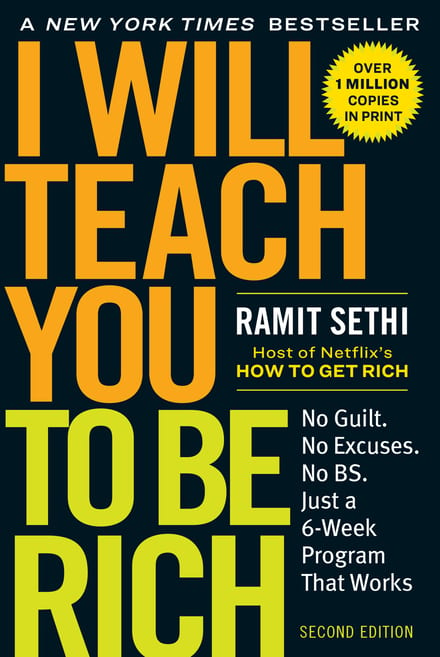
I Will Teach You to Be Rich
No Guilt. No Excuses. No BS. Just a 6-Week Program That Works
The full book runs ~272 pages — roughly 5 hours of reading. You get the key ideas here in 4 minutes.
The key ideas
- Start now: an 85% solution beats waiting for expertise.
- Treat credit cards as tools to build your score.
- Automate contributions, then actually invest them in target-date funds.
- Harness compound interest early to multiply money effortlessly.
- Spend lavishly on what you love, cut everything else.
- Negotiate salary and big purchases when leverage peaks.
The summary
Getting rich is boring. It’s not stock-picking or a secret—it’s automatic transfers and payments that run whether you think about them or not, started early enough that compound interest does the heavy lifting. Ramit Sethi’s core message is that your finances are in your own hands, and that the reason most people never build wealth isn’t lack of knowledge but paralysis. They wait to become experts. Don’t. Launch what he calls the 85 percent solution—a plan that’s roughly right and running today beats a perfect one you never build. Getting started matters more than getting it perfect, and if you’re young, time is the one advantage you can’t buy back.
Fix your credit, then kill your debt
Your credit score quietly decides what you pay for the biggest purchases of your life. On a $200,000 mortgage over 30 years, someone with excellent credit pays about $359,867; someone with poor credit pays $430,427—a $70,560 penalty for a low number. Credit cards are the main tool for building that score, so use them deliberately: pay on time (automate it so you never miss), pay down balances, chase the best rewards, and call to negotiate a lower rate or waive a fee, which lenders often do if you just ask.
If you’re carrying debt, work it in five steps. Total everything you owe. Attack one card first—either the highest APR or the smallest balance, whichever keeps you going. Negotiate a lower APR to stop the interest bleed. Cut spending elsewhere to throw more at the payments. And then simply start, because an imperfect payoff plan in motion beats a flawless one on paper.
Let compounding do the heavy lifting
Set up at least one checking account for daily spending and one savings account for goals, and keep roughly $1,000 in checking as a buffer against overdrafts and surprises. Use an online bank if you can—with no branches to fund, they pay far more. Park $50,000 at 4 percent and you earn $2,000 a year; the same balance at a traditional bank’s 0.5 percent earns $250. Over time that gap widens.
But saving alone won’t make you wealthy—investing will, because of compounding: you earn returns on your principal, then earn returns on those returns, and the snowball accelerates. The stock market has averaged about 8 percent a year after inflation, enough to turn a single $1,000 investment into roughly $46,901 over 50 years without adding a dollar. Start with your employer’s 401(k), which takes pretax money straight from your paycheck and often comes with a match—free money you forfeit if you don’t contribute enough to capture it. Just know the money is locked for retirement; pull it before 59.5 and you eat a 10 percent penalty plus tax. Once you’ve grabbed the full match, open a Roth IRA at a brokerage like Vanguard, Schwab, or Fidelity; you fund it with after-tax dollars, but your earnings come out tax-free in retirement, and you can withdraw your contributions anytime.
Then avoid the costly rookie mistake: funding an account is not the same as investing what’s in it. If the cash just sits there, it earns nothing. Don’t try to pick individual stocks—even the pros can’t do it reliably. Instead, buy a target-date (or lifecycle) fund matched to your retirement year. It automatically holds more stocks while you’re young and shifts toward bonds as you age, rebalancing for you at minimal cost.
Spend on what you love, cut everything else
Sethi’s philosophy is a conscious spending plan that ends the guilt by matching your money to your values, much like the Japanese budgeting ritual of kakeibo. Split your income on autopilot: roughly 50 to 60 percent to fixed costs like rent, food, utilities, and debt; 10 percent to long-term investments; 5 to 10 percent to savings goals; and 20 to 35 percent to guilt-free spending on whatever you actually enjoy. His rule is to “spend extravagantly on the things you love, and cut costs mercilessly on the things you don’t.” One of his friends got a raise and moved into a smaller apartment the same day—he doesn’t care where he lives, but he loves camping and biking, so that’s where the money goes.
The engine underneath all of it is automation. Schedule automatic payments for fixed bills and credit cards, and automatic transfers from checking into savings and investments the moment you’re paid. A mid-month calendar reminder to glance at your spending is enough to keep you on track. Set it up once and the system runs without you.
Win the big decisions
A few large choices move the needle more than years of penny-pinching. You have the most bargaining power to negotiate salary the moment you’re hired, so research comparable pay, let them name a number first, keep your target quiet, and sell the value you’ll add rather than what you need—while negotiating total compensation, from vacation to stock, and staying friendly, since you both want a deal. For cars, budget the true monthly cost (insurance, gas, parking, maintenance), buy something reliable, and drive it for as long as possible; get quotes at month’s end when salespeople chase quotas and let them bid against each other. A house is usually the biggest buy of your life: keep total housing costs under 30 percent of your income, and expect a 20 percent down payment plus 2 to 5 percent in closing costs. Weddings, which average about $35,000 and are routinely underestimated, deserve the same treatment—start saving before you’re even engaged by dividing the expected cost by the months until the date.
The bottom line
Wealth on an ordinary salary comes from one unglamorous formula: automate a roughly-right plan today and let compound interest work over decades. Stop waiting until you know everything. Read this if you earn a normal income and want to turn it into real money without agonizing over every dollar.
Fact check
Popular books repeat findings that later research has complicated. Where I Will Teach You to Be Rich makes a testable claim, here's what the evidence actually shows.
The stock market has averaged about 8% a year after inflation, enough to turn $1,000 into roughly $46,901 over 50 years.
The 8% headline is defensible for the US: real equity returns averaged 8.39% a year from 1870 to 2015, and 6.89% averaged across 16 advanced economies. The $46,901 is where it breaks, because a simple average cannot be used as a compounding rate — volatility pulls the compound return below it, to 4.64% a year for those same global equities against the 6.89% average. Compounded at rates in that range, a single $1,000 stake grows to something in the region of $10,000 to $30,000 over 50 years.
- Jordà Ò, Knoll K, Kuvshinov D, Schularick M, Taylor AM. The Rate of Return on Everything, 1870-2015. Federal Reserve Bank of San Francisco Working Paper 2017-25. December 2017. Source
Don't try to pick individual stocks, because even professional fund managers can't do it reliably.
Separating skill from luck across US equity mutual funds, Barras, Scaillet and Wermers found 75% produced zero alpha net of expenses, and that the share of genuinely skilled funds fell from a meaningful minority before 1996 to almost none by 2006. Fama and French arrived at the same place independently: the aggregate portfolio of active US equity funds tracks the market closely, so the cost of active management passes through intact as lower returns to investors, and few funds beat their benchmark by enough to cover their fees. Real skill shows up only in the extreme tails, and only once fees are added back — which is to say investors do not receive it.
Frequently asked questions
What is I Will Teach You to Be Rich about?
Sethi's message is that getting rich is boring: it's automatic transfers and payments that run whether you think about them or not, started early enough that compound interest does the heavy lifting. Most people never build wealth not from lack of knowledge but from paralysis — waiting to become experts. His fix is the '85 percent solution,' a plan that's roughly right and running today beating a perfect one you never build.
What are the key takeaways from I Will Teach You to Be Rich?
Fix your credit and attack debt in steps, since your credit score quietly decides what you pay on big purchases. Let compounding work by investing, not just saving — grab your 401(k) match, open a Roth IRA, and buy a target-date fund instead of picking stocks. Run a conscious spending plan: split income on autopilot into fixed costs, investments, savings, and guilt-free spending, and 'spend extravagantly on the things you love, cut mercilessly on the things you don't.' Automate everything, and win the big decisions on salary, cars, houses, and weddings.
Who should read I Will Teach You to Be Rich?
Read it if you earn a normal income and want to turn it into real money without agonizing over every dollar. It's aimed especially at younger people who still have time on their side.
Is I Will Teach You to Be Rich worth reading?
It's practical and specific — concrete numbers on credit-score costs, account setup, target-date funds, and how to negotiate salary — built around automation so the system runs without willpower. The guilt-free spending framework makes it feel livable rather than punishing. Readers looking for advanced investing strategy or stock-picking will find it deliberately basic, which is the point: it favors getting started over getting it perfect.