Book summary
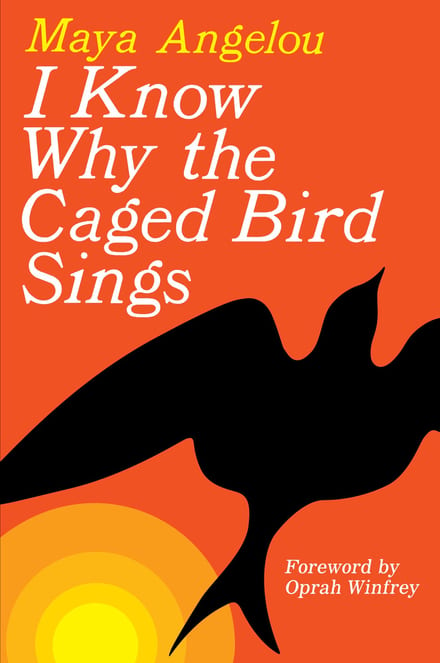
I Know Why the Caged Bird Sings
The full book runs ~304 pages — roughly 6 hours of reading. You get the key ideas here in 5 minutes.
The key ideas
- Take the title seriously: Dunbar's bird beats its wings against the bars.
- Count the moves — Stamps, St. Louis, California — each resetting who she is.
- Understand the silence: a child decides her words killed a man, and stops.
- Watch language come back at twelve and a half, through poetry and a neighbour.
- Notice what a segregated town teaches before she has words to argue with it.
- Register the irony — the passage that gets it banned is the one it is about.
The summary
Paul Laurence Dunbar’s “Sympathy” ends by insisting on something easy to miss: the bird in the cage is not singing because it is happy. The song is a plea flung upward from a bruised body beating against the bars. Maya Angelou took her title from that final line, and the borrowing is the argument. Her account of a Black girlhood in the segregated South is not a story about a voice being found. It is a story about what the singing is for.
The Library of Congress keeps the record of where Dunbar got the image. From September 1897 to the last day of 1898 he worked as an attendant in the stacks of what was then the Congressional Library, fetching medical and scientific volumes out of hot closed stacks — punishing work for a tubercular man. His wife, Alice, wrote in 1914 that the iron grating of those stacks was what put the bars of a cage in his head. The poem appeared in Lyrics of the Hearthside in 1899. Angelou, seventy years later, took the figure and gave it a childhood to hold.
Arriving everywhere as freight
She was born Marguerite Johnson in St. Louis in 1928. The book opens when she is three, and she and her brother Bailey are sent to their paternal grandmother in Stamps, Arkansas — sent, not brought. Angelou’s segregation is domestic rather than legislative: a devout, self-sufficient grandmother, the ache of having been handed off, the local poor whites the children are expected to defer to. What she keeps circling is the ordinary machinery by which a place informs a child what she is worth, and how completely that arithmetic gets absorbed before she has any words to argue with it.
Displacement is the book’s constant, not its crisis. Stamps, then St. Louis, then California. Each move resets who she is supposed to be, and none of the adults doing the moving explains why.
The years of not talking
At eight, back at her mother’s side in St. Louis, she was raped by her mother’s boyfriend. The man was murdered shortly afterward — by her uncles, in the Poetry Foundation’s account of her life. The child concluded that her own speech had killed him, and stopped talking. She stayed mute for years. It was not until she was twelve and a half, by the same account, that an educated woman she calls Mrs. Flowers drew her back out, insisting on the importance of the spoken word and instilling in her a love of poetry.
That sequence, not the assault, is what the book is built on. Angelou’s claim is that literature did the repair work — Shakespeare, Dickens and Poe alongside Dunbar, Langston Hughes and W.E.B. Du Bois — and that she came back into language as something chosen rather than something restored to her. The book closes with the birth of her son, Guy, to whom it is dedicated.
It exists because an editor said it couldn’t be done
Angelou never intended to write an autobiography. By 1968 she was a poet, playwright, performer and educator active in the civil rights movement, living in California, where she had written, produced and hosted a ten-part series for the San Francisco public station KQED. At a dinner party at Jules and Judy Feiffer’s house, Judy Feiffer heard her tell stories from her childhood and telephoned the Random House editor Robert Loomis to say he ought to get a book out of her. She turned him down, repeatedly. Loomis, in his own account, says he then decided to challenge her, telling her that writing autobiography as art is about the hardest thing a writer can attempt. She said she would do it.
The famous version of that story credits James Baldwin with supplying the reverse psychology. Loomis, asked directly, said he never discussed it with Baldwin at all. Either way, she took the dare. The method she described to George Plimpton in 1990 was monastic: a hotel room rented in whatever town she was living in, everything stripped off the walls, in by six-thirty in the morning, writing longhand on yellow pads across a bed she never slept in, home by early afternoon. Of nine pages written in a morning, she reckoned she might save two and a half or three. The critics who called her a natural writer were the ones she said she wanted to wrestle to the floor; getting the language to sing took her forever.
The most challenged memoir in American schools
Random House published it in 1969. It sold, and it has not gone out of print since. It also became one of the most attacked books in the country. The American Library Association’s Office for Intellectual Freedom ranked it third among the hundred most challenged books of 1990–1999, sixth for 2000–2009, and still at number 88 for 2010–2019. ALA’s Banned Books Resource Guide counts thirty-nine public challenges or bans since 1983 — the year four members of the Alabama State Textbook Committee moved to reject it, on the grounds that it preached bitterness and hatred toward white people and encouraged deviant behavior.
Most of the complaints, OIF reports, came from parents objecting to the book’s sexually explicit scenes — chiefly the rape. So the objection that keeps pulling the book off shelves is, almost precisely, the thing the book is about: a child made unspeakable, and then made silent.
The bottom line
Angelou’s premise is that a voice is not a gift but a recovery, and that what sounds like resilience from outside the cage is, from inside, a demand. Her own summary of the thesis, given to Plimpton: “We may encounter many defeats, but we must not be defeated.” The book earns it by showing how much has to be survived first.
Read it if you want to understand what displacement does to a child, or if you have only ever met this book through its reputation. Pair it with The Warmth of Other Suns, which maps the migration Angelou’s own family was carried by.
Fact check
Popular books repeat findings that later research has complicated. Where I Know Why the Caged Bird Sings makes a testable claim, here's what the evidence actually shows.
A child can stop speaking for years as a response to sexual assault.
A child who stops speaking for years is a recognised clinical picture: selective mutism, first described in the medical literature 140 years ago, was moved into the anxiety disorders in DSM-5, and its reported course runs from sudden and complete recovery to persistence into adulthood. What has changed is the explanation. A traumatic origin was formerly assumed; a multifactorial aetiology combining genetic, psychological and language-associated factors is now the standard account, which makes trauma one route in rather than the mechanism. Abuse does turn up more often than chance among these children — a British case-control study found definite or probable abuse in 8 of 18 children who were mute at school, against 1 of the speech-and-language controls and none of the classroom controls — but that is a single series of 18.
Literature did the repair work — being read to, and being made to recite it aloud, is what brought her speech back.
The ingredient that has actually been tested is narrower than literature. What the trials support is graduated exposure to situations that require speaking: a 2023 systematic review of nonpharmacological treatments for selective mutism found only five randomised trials in the whole literature, three of which — a combined behavioural and systems approach against waitlist — produced a large effect on speaking behaviour (Hedges g = 1.06, 95% CI 0.57 to 1.56). The two trials that measured full remission returned a risk ratio of 4.25 that did not reach statistical significance. Reading, or being read to, has no separate evidence base; the part with trial support is the requirement to speak the words aloud, which is what the book describes Mrs. Flowers demanding.
- Hipolito G, Pagnamenta E, Stacey H, Wright E, Joffe V, Murayama K, Creswell C. A systematic review and meta-analysis of nonpharmacological interventions for children and adolescents with selective mutism. JCPP Adv. 2023;3(3):e12166. PubMed
- Hua A, Major N. Selective mutism. Curr Opin Pediatr. 2016;28(1):114-20. PubMed
Frequently asked questions
What is I Know Why the Caged Bird Sings about?
Maya Angelou's account of her own childhood — sent at three with her brother Bailey to their grandmother in Stamps, Arkansas, then back to her mother in St. Louis, then on to California. Its centre is what happened at eight, when she was raped by her mother's boyfriend, and the years of silence that followed. The title comes from the last line of Paul Laurence Dunbar's poem "Sympathy," where the caged bird's song is a plea rather than a happy noise.
What are the key takeaways from I Know Why the Caged Bird Sings?
Displacement is the book's constant rather than its crisis — each move resets who she is expected to be, and no adult explains why. The silence is the hinge: a child concludes her own speech caused a death and stops speaking, and coming back into language is presented as something chosen rather than handed back. Literature does the repair work, from Shakespeare and Dickens to Dunbar, Hughes and Du Bois. And the ordinary machinery of a segregated town teaches a child what she is worth long before she has words to argue with it.
Who should read I Know Why the Caged Bird Sings?
Anyone who wants to understand what displacement does to a child, and anyone who has only met this book through its reputation as a banned book. It is short, and the prose is the reason it lasted.
Is I Know Why the Caged Bird Sings worth reading?
Yes — it has never gone out of print since 1969, and the writing earns that. Be aware going in that the account of the assault is direct, which is exactly what has kept the book on challenge lists for decades: the American Library Association's Office for Intellectual Freedom has it third among the most challenged books of the 1990s and still on the list for 2010–2019. The objection that keeps pulling it off shelves is close to the thing the book is about.