Book summary
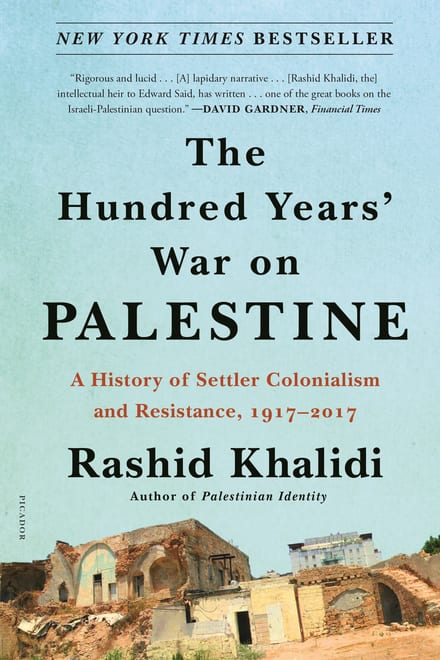
The Hundred Years' War on Palestine
A History of Settler-Colonial Conquest and Resistance, 1917-2017
The full book runs ~352 pages — roughly 6 hours of reading. You get the key ideas here in 4 minutes.
The key ideas
- Prophesied: al-Khalidi warned of Zionist displacement back in 1899
- Balfour Declaration granted Jews a homeland, denying Arabs political rights
- Nakba destroyed 500 villages, displaced 700,000, seized 80% of land
- 1967 war multiplied conquests as US cemented Israel alliance
- Oslo Accords delivered limited autonomy but deepened Palestinian suffering
- Gaza became an open-air prison under repeated bombardment
The summary
In 1899, Yusuf Diya al-Khalidi, the mayor of Jerusalem, sent a letter warning that the Zionist movement’s plan for a Jewish national home in Palestine would meet resistance from the people already living there. He closed with a plea: “in the name of God, let Palestine be left alone.” The author of this book is his great-great-nephew, and he uses that unheeded warning to open a century-long history. Rashid Khalidi’s central claim is that what followed was not a symmetrical clash of two national movements but a settler-colonial project — sponsored first by Britain and later by the United States, in which Palestinians were denied political recognition at every turn. Under Ottoman rule, Arabs made up 94% of Palestine’s population; Khalidi traces how that majority lost its standing, drawing throughout on his own family’s documents and experience.
The architecture of dispossession
The turning point came after World War I, when Britain took control of Palestine and issued the 1917 Balfour Declaration backing a Jewish national home there. The wording is where Khalidi locates the pattern: the declaration promised to protect the “civil and religious” rights of the non-Jewish communities but said nothing of their political rights or self-determination. The 1922 Mandate then built a framework for Jewish self-governance while never mentioning the Arab majority, and Palestinian petitions for independence from 1919 to 1928 went nowhere as the Jewish share of the population rose toward 20%.
Outside observers saw where this led. The King-Crane Commission, sent by President Woodrow Wilson in 1919 to gauge local opinion, warned that supporting a Jewish state would commit America “to the use of force in that area, since only by force can a Jewish state in Palestine be established or maintained” — a line Khalidi calls an accurate prediction of the century to follow. When Britain’s 1937 Peel Commission proposed a Jewish state on 17% of the land, a Palestinian revolt broke out and was crushed; by its end, 10% of adult Palestinian men had been killed, wounded, or imprisoned.
The Nakba and the 1967 war
After World War II, UN Resolution 181 partitioned the land in 1947, granting 56% to a Jewish state. The US and USSR, sympathetic after the Holocaust, backed it despite what Khalidi describes as a breach of the Palestinians’ right to self-determination under the UN Charter. In 1948 came the Nakba, “the catastrophe”: Zionist forces assaulted Arab villages, destroyed more than 500 of them, and displaced over 700,000 Palestinians, whose abandoned land was seized and repurposed for the Jewish community. Neighboring Arab states resisted but were too divided to be effective. When Israel declared statehood on May 15, 1948, it held 80% of former Palestinian territory.
The 1967 Six-Day War hardened the map. Amid lingering tensions and Egypt’s blockade of the Straits of Tiran, Israel struck Egyptian, Jordanian, and Syrian forces and captured the West Bank, the Gaza Strip, and the Sinai Peninsula. The war also drew Israel and the United States closer, as Washington came to see it as a strategic ally against the Soviet Union. UN Resolution 242, passed unanimously afterward, effectively ratified Israel’s 1948 borders and its new conquests while, again, passing over the Palestinians. Out of that defeat, resistance regrouped around organizations like the PLO.
Beirut, massacre, and the Oslo trap
In June 1982 Israel attacked Beirut, with US support, aiming to destroy the PLO and Palestinian nationalism; Khalidi and his family lived through the siege. By August the PLO agreed to withdraw, leaving a wrecked city and thousands of Palestinian and Lebanese civilians dead. That September, after the assassination of Israel’s ally Bachir Gemayel, the newly elected Lebanese president, Phalangist militants backed by Israel massacred between 460 and 3,500 people, mostly Palestinians and Lebanese Shias, in refugee camps.
The First Intifada, set off when an Israeli army vehicle killed Palestinians, brought a new kind of resistance built on civil disobedience — still met with force. It pushed Israel into talks with the PLO, brokered by an Israel-friendly US and negotiated by inexperienced Palestinian diplomats. The resulting Oslo Accords of 1993 and 1995 let the PLO return under a limited Palestinian National Authority, but required recognition of Israel and left it in control of security and residency. Life under the “martial regime,” Khalidi writes, gave the Israeli military near-unlimited power over the smallest details of Palestinian life, and as conditions worsened, faith in the PLO drained toward the more militant Hamas.
The Gaza years
Ariel Sharon’s visit to an Islamic holy site in Jerusalem in September 2000 triggered the far bloodier Second Intifada; Israel’s years-long crackdown killed thousands, and Palestinians answered with suicide bombings. When Hamas won the 2006 legislative election, Israel laid siege to Gaza — what Khalidi calls an open-air prison — and Hamas began firing rockets across the border. In 2014, after rockets killed five Israelis, Israel bombarded Gaza for 51 days, flattening neighborhoods and killing thousands, with American weapons magnifying the destruction. The Trump administration’s recognition of Jerusalem as Israel’s capital, and Israel’s 2018 law reserving self-determination for Jews alone, are for Khalidi the same logic that began with Balfour.
The bottom line
A century after al-Khalidi’s letter, Khalidi argues, the pattern holds: outside powers underwrite Israeli expansion while Palestinians are refused political recognition, and the arrangement rests on force rather than consent. He ends by insisting that any real progress must start from the fact that both peoples have deep ties to the land. Read it to understand the conflict’s roots beneath the headlines, from one of its most prominent Palestinian historians.
Fact check
Popular books repeat findings that later research has complicated. Where The Hundred Years' War on Palestine makes a testable claim, here's what the evidence actually shows.
Arabs made up about 94% of Palestine's population under late Ottoman rule, before Zionist immigration changed the balance.
The UN's own history of the period puts Arabs at over 90% of Palestine's population at the time of the 1917 Balfour Declaration, owning roughly 97% of the land, with Jews under 10%. That balance shifted fast under the Mandate: about 232,000 legal Jewish immigrants arrived during the 1930s, and by 1939 the Jewish population stood at over 445,000 out of roughly 1,500,000 — close to 30%. A figure near 94% for the years before the Mandate fits that record.
- United Nations. The Origins and Evolution of the Palestine Problem: Part I (1917-1947). The Question of Palestine. Accessed July 30, 2026. Source
When Israel declared statehood on 15 May 1948 it held 80% of former Palestinian territory, against the 56% that UN Resolution 181 had allotted to a Jewish state.
The partition figure is right and the territorial figure is close, but the timing is not. The UN records that Resolution 181 awarded 56% of Palestine to 32% of its population, and that Israel expanded to occupy 77% of the territory — reached over the course of the 1948 war, not on the day the state was declared. Formal armistice lines were only signed between February and July 1949, and the US State Department's account likewise dates Israel's gains beyond the partition allotment to that fighting, with Egypt and Jordan left holding Gaza and the West Bank.
- United Nations. The Origins and Evolution of the Palestine Problem: Part II (1947-1977). The Question of Palestine. Accessed July 30, 2026. Source
- Office of the Historian, US Department of State. The Arab-Israeli War of 1948. Milestones in the History of US Foreign Relations, 1945-1952. Accessed July 30, 2026. Source
The 1948 Nakba displaced more than 700,000 Palestinians.
The UN puts the number of Palestinian refugees at 726,000 by the end of 1949 — over half the indigenous population of Palestine. The same study cites a UN report finding that "almost the whole of the Arab population fled or was expelled from the area under Jewish occupation," which cuts against the long-running counter-claim that the flight was ordered by Arab leaders.
- United Nations. The Origins and Evolution of the Palestine Problem: Part II (1947-1977). The Question of Palestine. Accessed July 30, 2026. Source
Frequently asked questions
What is The Hundred Years' War on Palestine about?
Khalidi tells a century of Palestinian history not as a symmetrical clash of two national movements but as a settler-colonial project — sponsored first by Britain and later by the United States — in which Palestinians were denied political recognition at every turn. He opens with his great-great-uncle's 1899 warning to leave Palestine alone and draws throughout on his own family's documents and experience.
What are the key takeaways from The Hundred Years' War on Palestine?
The 1917 Balfour Declaration protected the 'civil and religious' rights of the Arab majority but said nothing of their political rights, a pattern Khalidi traces forward. Key turning points include the 1937 Peel Commission and the crushed Palestinian revolt, the 1947 UN partition and the 1948 Nakba that displaced over 700,000 people, the 1967 Six-Day War, the 1982 siege of Beirut and Sabra and Shatila massacre, and the Oslo Accords, which he reads as a trap that left Israel in control. Outside powers underwrite expansion while Palestinians are refused consent.
Who should read The Hundred Years' War on Palestine?
Read it to understand the conflict's roots beneath the headlines, told by one of its most prominent Palestinian historians. It's for readers who want the long historical arc rather than a snapshot of the latest crisis.
Is The Hundred Years' War on Palestine worth reading?
It's a clearly argued, century-spanning history that anchors big events in primary sources and family experience, from the King-Crane Commission's warning to the siege of Beirut the author lived through. It writes openly from a Palestinian perspective and frames the story as settler colonialism, so readers seeking a neutral both-sides survey should know its point of view up front — though Khalidi ends by insisting both peoples have deep ties to the land.