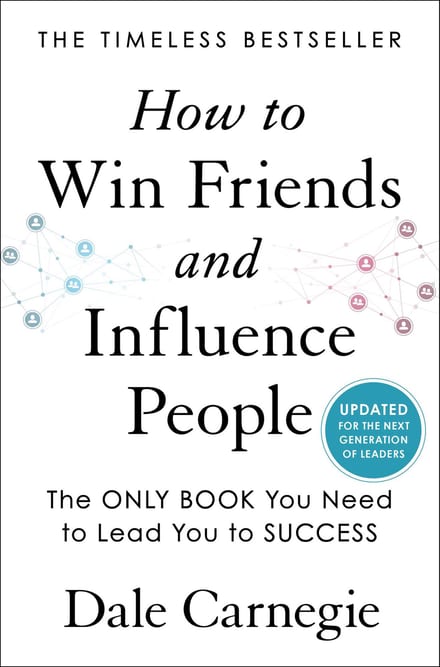
Book summary
How to Win Friends and Influence People
The full book runs ~276 pages — roughly 5 hours of reading. You get the key ideas here in 4 minutes.
The key ideas
- Skip criticism—it triggers defensiveness and makes enemies.
- Praise genuinely, smile, and remember everyone's name.
- Listen more than you talk; let others discuss themselves.
- See situations from the other person's perspective first.
- Avoid arguments; admit mistakes fast and never wound pride.
- Ask yes-building questions and praise before you criticize.
The summary
People don’t decide with logic. They decide with ego and emotion, then reach for reasons afterward. Dale Carnegie built his entire system on that fact. If you want someone’s cooperation, the move is never to prove them wrong or win the argument — it’s to make them feel important. Wound a person’s pride and they resist you no matter how right you are; feed it honestly and they’ll go out of their way for you.
Criticism almost always backfires
The psychologist B.F. Skinner found that animals rewarded for good behavior learn faster than animals punished for bad, and people are no different. Criticize someone and they don’t absorb the lesson; they feel attacked and start defending themselves. You may vent your own frustration, but you’ve lowered how much they like you and taught them nothing. Benjamin Franklin credited his success to “speaking no ill of man.” Abraham Lincoln learned the same the hard way — he stopped mocking opponents after one he’d insulted challenged him to a duel — and by the Civil War he could say of the South, “Don’t criticize them; they are just what we would be under similar circumstances.” The instinct to correct people is usually the instinct to alienate them.
Make the other person feel important
The flip side is that genuine appreciation opens almost anyone. Emerson said every man he met was his superior in some way, which means you can always find something real to admire; Carnegie once brightened a bored postal clerk’s whole day just by praising his hair. A simple smile does similar work. When a gloomy stockbroker asked Carnegie for advice and got only “smile more,” he came back astonished — people smiled back, complaints got easier to handle, and he found more happiness in two months than in the previous year. Smiling doesn’t merely follow good feeling; it can produce it.
Names matter enormously, because people love the sound of their own. Jim Farley, who rose to Postmaster General and chairman of his party, could recall fifty thousand people by their first names and credited that habit for his career. Remembering a name — or a birthday — quietly tells someone they count.
Get genuinely interested in the other person
Being interesting is far less useful than being interested. At a dinner party Carnegie spent hours drawing out a botanist with questions and close attention, barely speaking himself, and the botanist left calling him a brilliant conversationalist. People love to talk about themselves — “I” is the most common word in our phone calls — so the fastest way to be liked is to give them your full attention and let them. As Disraeli put it, “Talk to people about themselves, and they will listen for hours.”
The same empathy works when you need something. When a hotel abruptly tripled the price on a ballroom Carnegie used for lectures, he didn’t argue his own case; he explained, from the hotel’s point of view, how much free advertising it would lose if the popular lectures moved elsewhere. The hotel settled for a 50% increase. Ask not what you want, but how to make the other person want to give it.
Never puncture a person’s pride
Arguments are unwinnable in the way that counts: even if you’re proven right, the other person resents you for the bruise. So sidestep them. Look for the ground you already share, stay open to the chance you’re wrong, and admit your own mistakes fast. A truck salesman named Patrick kept losing deals by snapping back whenever a customer knocked his product; once he learned to agree first and then steer the conversation to his trucks’ strengths, he became his company’s star. Drop words like “obviously” and “certainly,” which announce that you think you’re smarter, and reach instead for “I could be wrong — let’s look at the facts.” When you’ve erred, own it immediately; people are generous with forgiveness because granting it makes them feel important too.
Two more levers follow from the same principle. Ask questions that earn a string of small “yeses” to build agreement before you ask for the big one — the way a shop clerk turned a customer who only wanted to rent a bow into one who bought it, walking him yes by yes to the realization that buying cost barely more than renting. And when you must criticize, lead with sincere praise: John D. Rockefeller Jr. defused miners who had been striking for over two years not by asserting authority but by presenting himself, sincerely, as a friend who shared their interests, and won their trust.
The bottom line
Cooperation doesn’t come from being right; it comes from making other people feel important through honest appreciation, real listening, and a refusal to bruise their pride. None of it works as manipulation — the appreciation has to be genuine — but practiced sincerely, it changes how people respond to you. Read this if you’ve ever won an argument and lost the person, and want to stop making that trade.
Fact check
Popular books repeat findings that later research has complicated. Where How to Win Friends and Influence People makes a testable claim, here's what the evidence actually shows.
B.F. Skinner showed that animals rewarded for good behaviour learn faster than animals punished for bad, and people work the same way.
Reward and punishment drive different parts of learning rather than one simply outperforming the other. In a motor-adaptation study, negative feedback accelerated learning while positive feedback did nothing for speed but improved retention once feedback was withdrawn. An earlier implicit motor-learning experiment found the complementary split: reward enhanced learning itself, while punishment produced only a short-term improvement in performance. Reward's genuine advantage is in making a behaviour stick, not in teaching it faster.
- Galea JM, Mallia E, Rothwell J, Diedrichsen J. The dissociable effects of punishment and reward on motor learning. Nat Neurosci. 2015;18(4):597-602. PubMed
- Wächter T, Lungu OV, Liu T, Willingham DT, Ashe J. Differential effect of reward and punishment on procedural learning. J Neurosci. 2009;29(2):436-443. PubMed
Criticism backfires: it makes people defensive instead of better at the thing you criticised.
Kluger and DeNisi pooled 607 effect sizes across 23,663 observations and found feedback raised performance on average (d = 0.41) — but more than a third of feedback interventions actually lowered it. The pattern that predicted harm is the one Carnegie describes: the further feedback pulled attention toward the self and away from the task, the less well it worked. Criticism is not reliably counterproductive, but the personal kind, aimed at who someone is rather than what they did, often is.
- Kluger AN, DeNisi A. The effects of feedback interventions on performance: a historical review, a meta-analysis, and a preliminary feedback intervention theory. Psychol Bull. 1996;119(2):254-284. Source
Smiling doesn't merely follow good feeling — the act of smiling helps produce it.
The most famous demonstration did not survive replication: 17 labs running a vetted protocol found the pen-in-mouth smile shifted cartoon funniness ratings by 0.03 points on a 10-point scale, against the original study's 0.82. The broader effect holds up, though it is small — a meta-analysis of 286 effect sizes from 138 studies found facial feedback does influence emotional experience — and a preregistered 19-country study of 3,878 people found that deliberately posing a smile both amplified and initiated feelings of happiness. Smiling nudges mood in the direction Carnegie claimed; it just does less of the work than the anecdote suggests.
- Acosta A, Adams RB Jr, Albohn DN, et al. Registered Replication Report: Strack, Martin, & Stepper (1988). Perspect Psychol Sci. 2016;11(6):917-928. PubMed
- Coles NA, Larsen JT, Lench HC. A meta-analysis of the facial feedback literature: effects of facial feedback on emotional experience are small and variable. Psychol Bull. 2019;145(6):610-651. PubMed
- Coles NA, March DS, Marmolejo-Ramos F, et al. A multi-lab test of the facial feedback hypothesis by the Many Smiles Collaboration. Nat Hum Behav. 2022;6(12):1731-1742. PubMed
Getting someone to say yes to a string of small things first makes them more likely to agree to the big request.
The foot-in-the-door effect is real but weaker and far more conditional than the 1966 study that made it famous. Burger's review identified six separate processes a small first request can set off — self-perception, reactance, conformity, consistency, attribution and commitment — several of which can reduce rather than raise compliance, and it mapped the narrow conditions under which the technique reliably works. A direct replication of the original experiment found it succeeded in Ukraine in 2003, failed in Poland the same year, and was non-significant in both countries by 2013. Small yeses can help; they are not a dependable lever.
- Burger JM. The foot-in-the-door compliance procedure: a multiple-process analysis and review. Pers Soc Psychol Rev. 1999;3(4):303-325. PubMed
- Gamian-Wilk M, Dolinski D. The foot-in-the-door phenomenon 40 and 50 years later: a direct replication of the original Freedman and Fraser study in Poland and in Ukraine. Psychol Rep. 2020;123(6):2582-2596. PubMed
Frequently asked questions
What is How to Win Friends and Influence People about?
Carnegie's system rests on one fact: people decide with ego and emotion, then reach for reasons afterward. So the way to win cooperation is never to prove someone wrong or win the argument — it's to make them feel important. Wound a person's pride and they resist you no matter how right you are; feed it honestly and they'll go out of their way for you.
What are the key takeaways from How to Win Friends and Influence People?
Criticism almost always backfires, so avoid it — people defend themselves rather than absorb the lesson. Make others feel important through genuine appreciation, smiling, and remembering names. Get genuinely interested in people and let them talk about themselves. Never puncture someone's pride: sidestep arguments, admit your mistakes fast, drop words like 'obviously,' and reach for 'I could be wrong — let's look at the facts.' Ask questions that earn a string of small 'yeses,' and when you must criticize, lead with sincere praise.
Who should read How to Win Friends and Influence People?
Read it if you've ever won an argument and lost the person, and want to stop making that trade. It's for anyone who depends on cooperation — at work or at home — and wants people to respond better to them.
Is How to Win Friends and Influence People worth reading?
Its principles are simple and memorable, illustrated with durable stories — Lincoln refusing to mock the South, Carnegie drawing out a botanist, Rockefeller Jr. winning over striking miners. The book is clear that none of it works as manipulation; the appreciation has to be genuine. Skeptics may find some anecdotes folksy or dated, but the core moves around ego and appreciation remain broadly useful.