Book summary
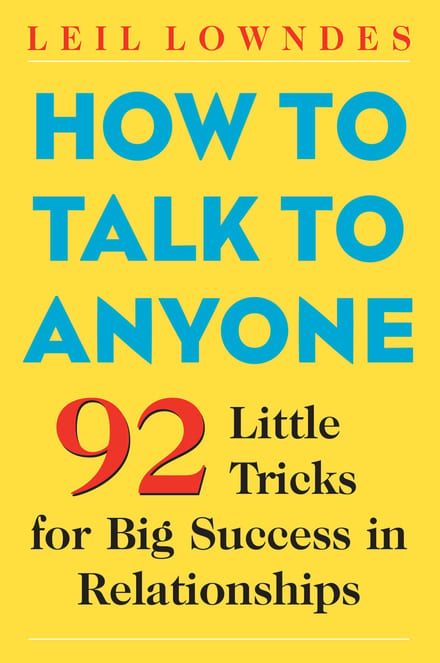
How to Talk to Anyone
92 Little Tricks for Big Success in Relationships
The full book runs ~352 pages — roughly 6 hours of reading. You get the key ideas here in 6 minutes.
The key ideas
- Delay your smile so it feels earned, not automatic
- Give conversational hooks—details people can grab onto and comment on
- Keep the spotlight on others by asking and echoing them
- Master insider lingo to belong in any room fast
- Deliver indirect, specific praise that sounds genuine, not sycophantic
- Watch body language and let others keep their dignity
The summary
Charisma looks like a gift some people are simply born with. Leil Lowndes takes it apart into something far more encouraging: a set of small, specific, learnable behaviors. How long you hold a gaze before you smile. Whether your answers hand people something to grab onto. Whose interests the conversation keeps circling back to. Get those small moves right and people find you magnetic — not because you performed, but because you made them feel interesting.
Your face talks before you do
The moment you meet someone’s eyes, resist the reflex to smile instantly. Look at them for a beat first, then let a warm smile spread across your face. That tiny delay makes the smile feel meant for them rather than handed out to everyone. Hold eye contact even while someone else is speaking, especially with the person you most want to reach. Turn your whole body toward a new acquaintance the way you’d turn toward a smiling child. Picture them as an old friend you haven’t seen in years and your expression softens on its own. Don’t fidget — it reads as dishonest. Most of the impression you leave is nonverbal anyway, so your posture and attention do more work than any clever line.
Give people something to grab onto
When someone asks where you’re from, don’t just name the town — add a detail they can react to. Same with your work: skip the bare job title and offer something anyone can comment on. When you introduce two people, hand them a conversational hook or a shared point so they aren’t starting from a blank page. And instead of the tired “What do you do?”, try “How do you spend most of your time?” — it opens a real answer.
Then, once they’re talking, keep the spotlight on them. Imagine a stage light fixed on your conversation partner; the longer you keep it off yourself, the more fascinating they’ll find you. A simple mechanic keeps it going: repeat the last few words they said and they’ll keep talking. Start your own sentences with “you,” which pulls people in because it’s about them. And when you first meet someone, keep your complaints and problems locked away — lead with what’s positive until you know them better.
Get inside their world
You can belong in almost any room faster than you’d think. A single exposure to an unfamiliar field hands you roughly 80 percent of its lingo, so ask people to teach you the jargon of their profession and read what your audience reads. Once you’re talking, mirror their movements and pace, subtly, to build comfort. Echo their own words back to them — repetition quietly forges connection. Sprinkle in “we,” “us,” and “our” to create a sense of shared ground. These aren’t ways to fake closeness so much as ways to signal that you’re paying attention and meeting people where they are.
Praise that doesn’t sound like flattery
Direct compliments can curdle into flattery; indirect praise almost never does. When you hear something good about someone, carry it back to them — an overheard compliment lands with far more weight than one delivered to their face for effect. Slip small, genuine affirmations into conversation as you go. For a connection you really want to make, pick out one specific, unusual quality in the person and save it for a single “killer compliment” delivered privately near the end — used sparingly, it sticks. When someone praises you, praise the praise right back: “That’s very kind of you.” Ask people what matters most in their lives, remember it, and bring it up later with real appreciation.
Phones, parties, and keeping score
On the phone you lose your face, so become the star of your own radio show and turn your smiles and nods into audible warmth. Say people’s names — everyone likes the sound of their own. Open by asking whether it’s a good time to talk before launching in. At gatherings, don’t clutch a drink or plate in front of you like a shield; pause in the doorway to take in the room before you wade in, and afterward jot down a few notes about the people you met so you can pick up the thread next time. Read the body language constantly broadcasting excitement or boredom, and adjust to it. When someone commits a small gaffe, look past it and let them keep their dignity. In the end, Lowndes says, everyone silently keeps score of the good and bad you do them — so make sure your balance with each person stays firmly on the good side.
The bottom line
People find you fascinating in almost exact proportion to how fascinating you make them feel. Keep the spotlight on them, give them details they can grab onto, and mind the small signals that say you’re genuinely paying attention. Read this if you want concrete moves that work in real conversations, not one more reminder to “just be yourself.”
Fact check
Popular books repeat findings that later research has complicated. Where How to Talk to Anyone makes a testable claim, here's what the evidence actually shows.
Most of the impression you leave on someone is carried by nonverbal behaviour rather than by what you say.
The 7-38-55 split behind this figure comes from two 1967 Mehrabian studies in which listeners judged whether a single spoken word conveyed liking or dislike while the word, the tone and the face disagreed with each other. Mehrabian's own site says the equations were derived from experiments on communications of feelings and attitudes, and that unless a communicator is talking about their feelings or attitudes, the equations are not applicable. Nonverbal warmth does shape how people read you, but neither study measured what share of ordinary conversation is nonverbal, and nothing in the research puts that share anywhere near 93 percent.
- Mehrabian A, Wiener M. Decoding of inconsistent communications. J Pers Soc Psychol. 1967;6(1):109-114. PubMed
- Mehrabian A, Ferris SR. Inference of attitudes from nonverbal communication in two channels. J Consult Psychol. 1967;31(3):248-252. PubMed
- Mehrabian A. Silent Messages: A Wealth of Information About Nonverbal Communication. Accessed July 30, 2026. Source
Subtly mirroring another person's posture and movements makes them like you more.
Chartrand and Bargh's 1999 experiment found that participants mimicked by a confederate liked that confederate more and experienced the interaction as smoother, so the basic effect is real. The word 'subtly' is doing most of the work, though: a later three-experiment study (N = 71, 149 and 180) found subtle mimicry raised liking compared with none, while strong mimicry lowered both liking and trust, and once participants noticed they were being copied the effect turned negative regardless of dose. Mirroring helps at a level people cannot consciously detect, which is a harder thing to aim for deliberately than the advice implies.
- Chartrand TL, Bargh JA. The chameleon effect: the perception-behavior link and social interaction. J Pers Soc Psychol. 1999;76(6):893-910. PubMed
- Wessler J, Loschelder DD, Fendel JC, Friese M. The too-much-mimicry effect: strong (vs. subtle) mimicry impairs liking and trust in distributive negotiations. J Nonverbal Behav. 2024;48(2):253-276. Source
Fidgeting reads as dishonest, and watching someone's body language will tell you when they aren't being straight with you.
DePaulo and colleagues pooled 1,338 estimates covering 158 candidate cues to lying and found that most behaviours showed no discernible link to deceit, or only a weak one. Liars came across as slightly more tense and less forthcoming overall, but no single movement gave them away. A companion meta-analysis of 206 studies and 24,483 judges put unaided lie detection at 54 percent correct — barely above the 50 percent from guessing — and found people read audible cues more accurately than visible ones. Squirming signals nervousness, and nervousness is not evidence of dishonesty.
Frequently asked questions
What is How to Talk to Anyone about?
Lowndes takes charisma apart into small, specific, learnable behaviors rather than a gift you're born with — how long you hold a gaze before smiling, whether your answers give people something to grab onto, whose interests the conversation keeps circling back to. Get those small moves right and people find you magnetic, because you've made them feel interesting.
What are the key takeaways from How to Talk to Anyone?
Let your face lead: delay your smile a beat so it feels meant for the person, hold eye contact, and turn your whole body toward them. Give people conversational hooks instead of bare answers, and keep the spotlight on them — a technique she frames as an imaginary stage light. Get inside their world by learning the jargon of their field, mirroring their pace, and using 'we' and 'us.' Use indirect praise and the saved-up 'killer compliment,' and mind the small signals in phone calls and at parties, since everyone quietly keeps score.
Who should read How to Talk to Anyone?
Read it if you want concrete moves that work in real conversations, not one more reminder to 'just be yourself.' It suits anyone who wants to feel more at ease and magnetic when meeting people.
Is How to Talk to Anyone worth reading?
Its appeal is specificity: instead of vague encouragement, it hands you dozens of discrete tactics — the delayed smile, repeating someone's last words, starting sentences with 'you,' the private 'killer compliment.' Because the advice is so tactical, some readers may find certain moves feel calculated, and Lowndes frames them as signals of genuine attention rather than manipulation. If you want actionable technique over theory, it delivers plenty.