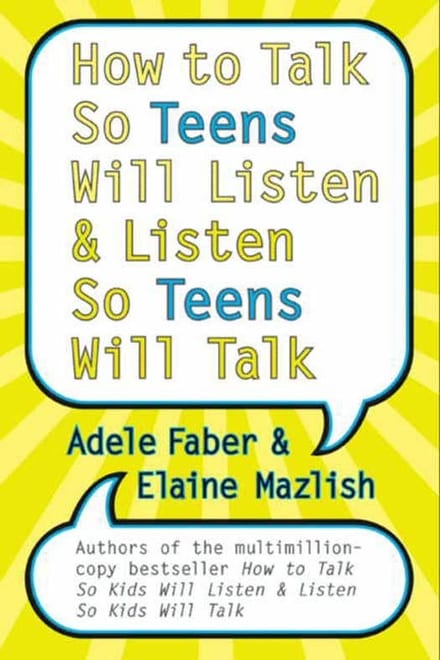
Book summary
How to Talk So Kids Will Listen & Listen So Kids Will Talk
The full book runs ~274 pages — roughly 5 hours of reading. You get the key ideas here in 2 minutes.
The key ideas
- Acknowledge and name feelings before correcting behavior
- Explain consequences instead of issuing threats
- Solve problems together through dialogue, not punishment
- Let kids struggle toward independence instead of rescuing them
- Praise specifically and genuinely, never generically
- Never label kids — labels become self-fulfilling
The summary
When your child melts down in the cereal aisle or digs in against bedtime, the reflex is to issue an order or threaten a punishment. But punishment teaches a child to resent you, not to understand what went wrong — and a kid who stops misbehaving only to dodge a penalty has learned the wrong lesson. Real cooperation starts somewhere quieter: with the child feeling understood. Once you acknowledge what they’re feeling and explain the reasons behind your requests, they stop fighting you and start thinking for themselves. Nearly everything in this book flows from that single shift.
Acknowledge feelings before anything else
A surprising amount of misbehavior is just an unheard feeling getting louder. A child who senses their emotions are being ignored will escalate until someone finally notices, which is why dismissals like “You’re fine, stop crying” pour fuel on the fire. The fix is simpler than it sounds: name what your kid is feeling. “You must be feeling very hungry. You haven’t eaten in a while now. I wish I could magically make a hot dog for you right now.” Nothing about the situation has changed, but the child feels seen, and that alone takes the heat out of the moment. The one requirement is sincerity — kids can spot a going-through-the-motions response instantly, so if you sound dismissive or sarcastic, you lose their trust.
Explain consequences instead of issuing threats
When a child acts up, demands and threats — “Get in bed right now or you’re grounded” — make things worse. They cast you as the adversary and give the child no reason to cooperate beyond fear. Explaining the real consequence works better: “When you stay up past your bedtime you will feel very tired the next morning. Then you won’t be able to stay awake and have any fun at school.” Now she has information instead of an ultimatum. She isn’t obeying you so much as grasping the logic and deciding, on her own, that it isn’t worth it. That’s a decision that holds up when you’re not in the room.
Solve problems together, not through punishment
Because punishment breeds resentment rather than understanding, the stronger move is a conversation. Share what you need and how you feel, ask about theirs, then work out a solution together: “When you come home late I get worried about your safety. I need to know you’re okay because I care about you. What do you think about sending me periodic updates to assure me that you’re safe, if you must stay out late?” This tells the child their opinion counts. It also gets them thinking independently about their own behavior and arriving at an agreement they helped write — which makes them far more likely to keep it.
Let them struggle toward independence
Rescue your child from every problem and you teach a quieter lesson: that they can’t cope without you. Kids who grow too dependent end up feeling helpless and worthless, and that frustration curdles into belligerence. So encourage independence — let them make their own choices, and let them seek advice from people other than you. Yes, it’s uncomfortable to watch a child fumble something you could fix in seconds. Resist the urge. Stepping back is how they become self-sufficient people who can make their own decisions. Have patience, and let them explore and learn for themselves.
Praise specifically, never generically
Encouragement builds confidence and self-esteem, but only when it’s genuine and specific. “Nice drawing!” lands flat because it tells the child nothing about what was actually good. “I’m very impressed by your drawing. I especially like how you filled in the colors with lines” hands them something concrete to be proud of. Vague praise can even feel manipulative or fake, which chips away at trust, while specific praise proves you were paying attention.
Never label your child
Labels are limiting, and worse, they’re self-fulfilling. Call your child violent and she may lean into being violent. Call her stubborn and she’ll happily keep it up. Tell her she’s a slow learner and she’ll accept it as permanent truth and quietly underperform at school. A label boxes a kid into a fixed identity and, in effect, gives them permission to stop trying to change.
The bottom line
Children cooperate when they feel understood, not when they’re threatened or punished — so name their feelings, explain your reasoning, and solve problems side by side instead of laying down the law. It teaches them to think for themselves rather than obey out of fear. Read this if you’re worn down by power struggles and want a calmer, more respectful way to reach your kids.
Fact check
Popular books repeat findings that later research has complicated. Where How to Talk So Kids Will Listen & Listen So Kids Will Talk makes a testable claim, here's what the evidence actually shows.
Punishment teaches a child to resent you rather than to understand what went wrong, so explaining the real consequence works better than a penalty.
Across 111 effect sizes covering 160,927 children, spanking was linked to more aggression, more antisocial behaviour, worse mental health and lower moral internalisation; 13 of 17 outcomes were significantly worse and none were better. An earlier meta-analysis found the one thing physical punishment reliably delivered was immediate compliance, paired with weaker internalisation of the rule — exactly the trade the book warns about. The research base is strongest for physical punishment specifically, so the authors' wider case against all penalties rests on less direct evidence than the spanking finding does.
- Gershoff ET, Grogan-Kaylor A. Spanking and child outcomes: Old controversies and new meta-analyses. J Fam Psychol. 2016;30(4):453-69. PubMed
- Gershoff ET. Corporal punishment by parents and associated child behaviors and experiences: a meta-analytic and theoretical review. Psychol Bull. 2002;128(4):539-79. PubMed
Labels become self-fulfilling — tell a child she is a slow learner and she will accept it and underperform.
Expectancy effects are real but small, and they tend to fade rather than compound. The main review of the teacher-expectation literature concludes that classroom self-fulfilling prophecies are typically modest, do not accumulate greatly across different adults or over time, and that most of the correlation between what adults expect and how children perform exists because the expectations were accurate in the first place. Effects are larger for children from stigmatised groups. Labelling is worth avoiding — it just does not act as the switch the book describes.
- Jussim L, Harber KD. Teacher expectations and self-fulfilling prophecies: knowns and unknowns, resolved and unresolved controversies. Pers Soc Psychol Rev. 2005;9(2):131-155. PubMed
Specific, descriptive praise builds a child's confidence, while vague or overblown praise backfires.
This is one of the book's best-evidenced points. Across six studies, children praised for intelligence rather than effort enjoyed the task less, persisted less and performed worse after a setback, and came to treat ability as fixed. Inflated praise — "incredibly beautiful" instead of "beautiful" — reduced challenge-seeking precisely in the children with low self-esteem that adults tend to aim it at. In 53 families observed at home, the share of effort-focused praise parents gave toddlers aged 14-38 months predicted those children's belief at ages 7-8 that ability grows with work.
- Mueller CM, Dweck CS. Praise for intelligence can undermine children's motivation and performance. J Pers Soc Psychol. 1998;75(1):33-52. PubMed
- Brummelman E, Thomaes S, Orobio de Castro B, Overbeek G, Bushman BJ. "That's not just beautiful--that's incredibly beautiful!": the adverse impact of inflated praise on children with low self-esteem. Psychol Sci. 2014;25(3):728-735. PubMed
- Gunderson EA, Gripshover SJ, Romero C, Dweck CS, Goldin-Meadow S, Levine SC. Parent praise to 1- to 3-year-olds predicts children's motivational frameworks 5 years later. Child Dev. 2013;84(5):1526-41. PubMed
Naming what a child is feeling takes the heat out of the moment even though nothing about the situation has changed.
Putting a feeling into words dampens the emotional response measurably, and it does so without the person trying to feel better. Labelling the emotion in a photograph reduced amygdala activity while raising right ventrolateral prefrontal activity — the signature of deliberate emotion regulation. In spider-fear exposure, participants who said their fear out loud showed lower skin conductance a week later than those who reappraised, distracted themselves, or simply endured it, and the more fear words they used, the more their fear dropped. The mechanism is solid; whether it settles a specific supermarket tantrum has not been tested directly.
- Lieberman MD, Eisenberger NI, Crockett MJ, Tom SM, Pfeifer JH, Way BM. Putting feelings into words: affect labeling disrupts amygdala activity in response to affective stimuli. Psychol Sci. 2007;18(5):421-8. PubMed
- Kircanski K, Lieberman MD, Craske MG. Feelings into words: contributions of language to exposure therapy. Psychol Sci. 2012;23(10):1086-91. PubMed
Frequently asked questions
What is How to Talk So Kids Will Listen & Listen So Kids Will Talk about?
It argues that punishment teaches a child to resent you rather than understand what went wrong, and that real cooperation starts with the child feeling understood. Once you acknowledge what they're feeling and explain the reasons behind your requests, kids stop fighting you and start thinking for themselves. Nearly everything in the book flows from that single shift.
What are the key takeaways from How to Talk So Kids Will Listen & Listen So Kids Will Talk?
Acknowledge feelings before anything else — naming what a child feels takes the heat out of a moment, as long as you're sincere. Explain real consequences instead of issuing threats, so the child grasps the logic and decides for themselves. Solve problems together by sharing your needs and asking theirs. Let children struggle toward independence rather than rescuing them. Praise specifically ('I like how you filled in the colors with lines'), never generically. And never label a child, because labels are limiting and self-fulfilling.
Who should read How to Talk So Kids Will Listen & Listen So Kids Will Talk?
Read it if you're worn down by power struggles and want a calmer, more respectful way to reach your kids. It's for parents who'd rather teach a child to think than to obey out of fear.
Is How to Talk So Kids Will Listen & Listen So Kids Will Talk worth reading?
It does well at turning a respectful philosophy into scripts you can actually say — naming feelings, explaining consequences, praising specifics — that lower the temperature of daily conflicts. The approach asks for patience and consistency, including the discomfort of watching a child fumble something you could fix in seconds. Parents wanting fast obedience or firm discipline may find it slow, but for reducing power struggles the concrete techniques are its clear payoff.