Book summary
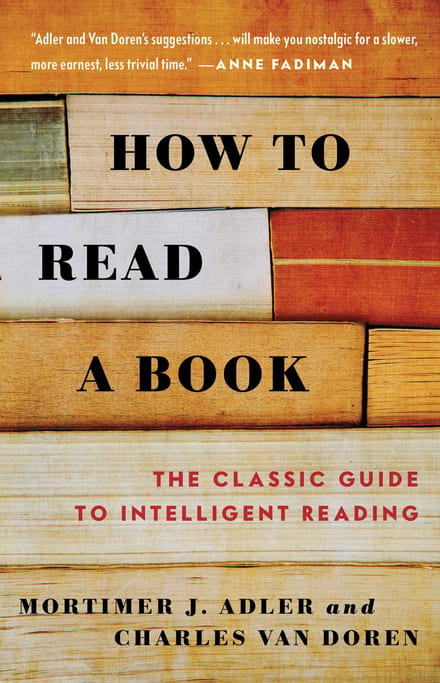
How to Read a Book: The Classic Guide to Intelligent Reading
The full book runs ~398 pages — roughly 7 hours of reading. You get the key ideas here in 4 minutes.
The key ideas
- Distinguish reading for information from reading for understanding.
- Inspect a book's structure before committing to close reading.
- Ask four questions: what, how, is it true, so what.
- Come to terms with words, propositions, and arguments.
- Suspend judgment until you can restate the author's case.
- Match your method to the genre; syntopical reading masters subjects.
The summary
Most people stopped learning to read somewhere around fourth grade. Schools teach word recognition and literal comprehension — what Mortimer Adler and Charles van Doren call elementary reading — and then act as if the job is finished. It isn’t. A demanding book asks for method, not just attention, and the gap between passive and active reading decides how much you actually take away. Passive reading is reading to fall asleep; active reading is reading to understand, and it works like a catcher meeting a pitcher’s throw — you have to reach out and grab what’s coming, not let it sail past.
The distinction that organizes the whole book is reading for information versus reading for understanding. Information is anything already within your grasp: the facts in a news article, the steps in a manual. Understanding is what you’re after when the material starts out over your head and you have to climb to reach it. That work is lonely, because a book is an absent teacher who can’t answer your questions. Adler lays out four levels that build on each other — elementary (what does the sentence say), inspectional (what is the book about), analytical (chewing and digesting it for full understanding), and syntopical (reading many books on one subject together) — and argues that a healthy democracy needs far more analytical readers than it has.
Inspect the book before you read it
The most undervalued level is inspectional reading, a fast survey that tells you a book’s shape and worth before you commit hours to it. It has two moves. First, systematic skimming: work the title page, preface, table of contents, and index, then dip into key chapters and the opening and closing pages, where authors tend to lay out and sum up their case. Second, a superficial read — go straight through without stopping to wrestle with the hard parts, just to get the gist. Skip this and you’ll get lost in the weeds before you ever see the field. Done well, it also tells you whether the book even deserves the deeper effort.
Analytical reading is a conversation with four questions
When a book earns close reading, run everything through four questions: What is it about as a whole? What is being said in detail, and how? Is it true? And what of it? They keep you in genuine dialogue with the author. Start by classifying the book — fiction or expository, and if expository, practical or theoretical, then history, science, or philosophy. X-ray it: state its main point in a single sentence, outline how the major parts fit together, and name the problems the author set out to solve.
Then come to terms. A word is not a term. “Reading” is a word with many meanings; a term is a word pinned to one unambiguous meaning, and finding the author’s key terms — usually the technical ones, the ones he emphasizes, or the ones that trip you up — is what lets you follow him at all. From there, hunt for the key sentences and the propositions inside them, remembering that a sentence is a unit of language while a proposition is a unit of thought, and a single sentence can carry several. Reconstruct the arguments, sorting the inductive from the deductive and noticing the assumptions underneath. Throughout, treat reading as a conversation you write down: structural notes on the contents, conceptual notes in the margins, dialectical notes that set this book against others.
Judge only after you can restate the case
Criticism is part of the job, but criticism that arrives too early is worthless. You haven’t earned the right to agree or disagree until you could restate the author’s position in your own words. “To agree without understanding is inane. To disagree without understanding is impudent.” Agreement takes just as much judgment as dissent — you can be wrong by nodding along as easily as by objecting. When you do disagree, be specific about which of four faults applies: the author is uninformed, misinformed, illogical, or his analysis is incomplete. Keep the line between knowledge and opinion clear, and give reasons rather than reflexes. The point isn’t to win; it’s to get at the truth, and detecting an argument’s real shape is also your best defense against propaganda — as they warn, “what reaches the heart without going through the mind is likely to bounce back and put the mind out of business.”
Read each genre on its own terms
The method bends to fit what you’re reading. Practical books — a cookbook, a political treatise — hand you rules or principles, but reading alone won’t solve anything; you have to act on them. Imaginative literature runs on the opposite gear: fiction, poetry, and plays exist to deliver an experience, so don’t resist the emotional pull or judge a novel like a treatise. Read stories quickly for their unity; stage a play in your head and read it aloud; read a poem straight through, then again out loud for its rhythm. Judge these works by the quality of the experience they create, not by whether they’re factually true. Science and mathematics turn on the specific problems the author is solving; philosophy on fundamental questions worked out through reflection; social science usually on several books at once.
The summit is syntopical reading, where you master a subject rather than a single book. Survey the field to build a bibliography, force every author onto neutral, shared terminology, frame questions that all of them answer, and map out exactly where they agree and clash. At that point you’ve stopped absorbing one person’s view and started constructing your own.
The bottom line
Reading well is an active, learnable craft: survey a book’s shape first, work through its terms and arguments, and refuse to judge until you could explain its case back to the author. Read this if you’re serious about learning from books instead of just collecting opinions about them.
Frequently asked questions
What is How to Read a Book about?
It contends that most people never learned to read past a grade-school level of word recognition, and that a demanding book asks for method, not just attention. The heart of the book is the gap between passive reading and active reading — reaching out to grab a writer's meaning rather than letting it sail past — and a set of levels that build toward genuine understanding.
What are the key takeaways from How to Read a Book?
Adler and van Doren lay out four levels: elementary, inspectional, analytical, and syntopical. Inspectional reading is a fast survey — systematic skimming plus a superficial read — to judge a book's shape and worth before you commit. Analytical reading runs a book through four questions (What is it about? What's said in detail? Is it true? What of it?), and requires coming to terms with the author's key words and arguments. Never judge until you can restate the case in your own words, and read each genre — practical, imaginative, science, philosophy — on its own terms.
Who should read How to Read a Book?
Read it if you're serious about learning from books instead of just collecting opinions about them. It's for readers who want to get more out of difficult, worthwhile material.
Is How to Read a Book worth reading?
It's a thorough, structured system: the inspectional-reading survey and the four analytical questions are practical tools you can apply immediately, and the rule against judging before you can restate the argument is a genuine discipline. It also adapts the method to fiction, poetry, science, and reading many books on one subject. The trade-off is that its approach is deliberate and effortful, so readers looking for speed or light reading habits may find it heavier than they want.