Book summary
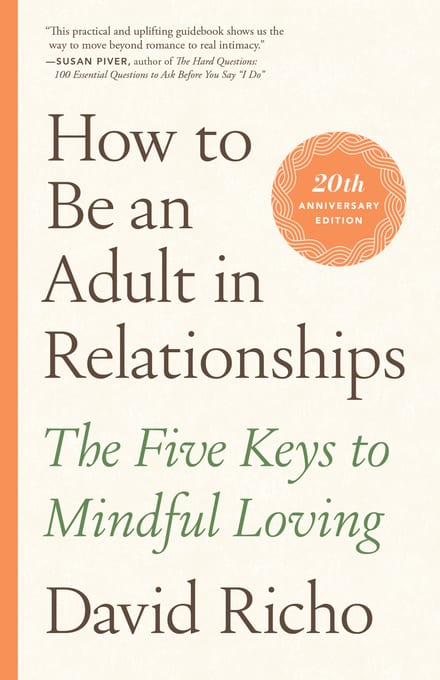
How to Be an Adult in Relationships: The Five Keys to Mindful Loving
The full book runs ~276 pages — roughly 5 hours of reading. You get the key ideas here in 3 minutes.
The key ideas
- Practice the five A's: attention, acceptance, appreciation, affection, allowing.
- Expect a partner to meet only 25% of your needs.
- Grieve childhood wounds instead of demanding a partner fix them.
- Face engulfment and abandonment fears: admit, allow, act anyway.
- Drop the ego's need to be right over intimacy.
- Let expired relationships go honestly rather than clinging.
The summary
Love isn’t a feeling that arrives and sweeps you along. “Love is not so much a feeling as a way of being present,” David Richo writes, and that reframing is the whole book. You don’t wait to feel loving before you show up for someone; you practice presence, and the feeling follows. Richo distills that practice into five actions he calls the five A’s, and they’re what every good relationship runs on — given and received.
Love is something you do
The five A’s are attention, acceptance, appreciation, affection, and allowing. Attention means listening mindfully to a person’s feelings, needs, and stories. Acceptance means letting them be who they are without asking them to hide parts of themselves — and being accepted the same way. Appreciation means valuing each other’s strengths and limits and backing each other’s goals. Affection is the physical warmth: hugs, kisses, a smile across a room. Allowing is the hardest: letting life and love be as they are, giving your partner the freedom to live by their own deepest wishes without trying to control the outcome. We feel loved when we get all five; we love well when we give them.
A partner can’t fill the childhood hole
Here’s the number that reorders everything: in a healthy relationship, you look to a partner for no more than 25 percent of your nurturance and find the rest within yourself. That’s hard to swallow if you grew up without the five A’s. Emotional deprivation in childhood leaves scars, and people from unhappy families often tolerate mistreatment or recreate the old dysfunction, because they internalized the belief that they were defective instead of seeing their caregivers’ failures for what they were. The wound tempts you to demand that a romantic partner finally supply what your parents didn’t — a job no one can do.
Healing starts with grief. Share the painful memories with someone compassionate enough to listen and validate rather than fix, and sit with the feelings, naming and exploring them until something deeper surfaces. Then let them go through mindfulness: sit quietly, follow your breath, and when a thought or emotion rises, notice it, accept it, and return to the breath. Take care of yourself first, because contentment with yourself makes room for the right person. As Richo puts it, once you love yourself, people no longer look good to you unless they are good for you.
Fear runs the show unless you face it
Two fears haunt intimacy: engulfment, the fear of losing your freedom by getting too close, and abandonment, the fear you won’t survive emotionally if your partner leaves. Both trace back to a fear of what you’ll feel as closeness deepens — which means the real fear is of yourself, of your own vulnerability. That vulnerability isn’t a flaw to scold yourself for; it’s the very quality that makes you lovable. Face it with the Triple-A move: admit the fear, allow yourself to feel it without judgment, and act as if you didn’t have it — if you fear abandonment, practice time apart; if you fear engulfment, practice closeness. Leave fear unfaced and it quietly takes the wheel, and you’ll either cling or bolt.
Ego is the enemy of intimacy
When partners fight to be right instead of to make the relationship work, ego is running things, not love. The ego is the sense of a separate, defended self, and it blocks the unity that intimacy asks for. It shows up two ways: the impoverished ego (“I’m powerless, it’s someone else’s fault, no one cares about me”) that fakes humility, and the inflated ego (“I’m right, I’m perfect”) that fakes self-respect. The healthy ego, by contrast, carries real self-respect and offers unconditional love — which requires letting go of the ego’s demands for entitlement and control. Practically, that includes retiring the small weapons: sarcasm, ridicule, teasing, barbed kidding. They’re passive-aggression, and they corrode closeness.
Phases, and knowing when to let go
Relationships move through three predictable stages: early romance, a stretch of conflict, and, ideally, deeper commitment. The conflict phase isn’t proof you chose wrong; it’s where the actual work happens, and couples who put in mutual effort come out the other side with a grounded bond rather than fading passion. Be clear upfront about the commitment you want and the values you share, and promise not to remake yourself to hold someone. Sometimes, though, the honest move is to leave. Clinging to an expired relationship does more harm than ending it peacefully. When happiness, trust, sex, and the five A’s have all drained away, name your reasons, grieve the loss, and treat the ending as a chance to grow rather than a failure.
The bottom line
Love is a practice of presence — attention, acceptance, appreciation, affection, and the freedom to let your partner be — not a feeling you wait to receive. Expect a partner to meet only a quarter of your needs, grieve the childhood wounds behind wanting more, and face your fears before they run the show. Read this if you keep repeating the same painful patterns and want to stop asking love to fix you.
Frequently asked questions
What is How to Be an Adult in Relationships about?
David Richo reframes love as something you do, not a feeling you wait to receive, "Love is not so much a feeling as a way of being present." He distills that practice of presence into five actions, the five A's, that every healthy relationship runs on, given and received, and shows how mindfulness and self-work make real intimacy possible.
What are the key takeaways from How to Be an Adult in Relationships?
The five A's are attention, acceptance, appreciation, affection, and allowing, the last meaning giving your partner freedom without controlling the outcome. A partner can supply no more than about 25 percent of your nurturance, so demanding they fill a childhood hole sets everyone up to fail; healing that wound starts with grief and mindfulness. Two fears, engulfment and abandonment, run intimacy unless you face them with Richo's Triple-A move (admit, allow, act as if). Ego, whether impoverished or inflated, is the enemy of closeness, and relationships move through romance, conflict, and deeper commitment, with the honest move sometimes being to let go.
Who should read How to Be an Adult in Relationships?
Read it if you keep repeating the same painful patterns and want to stop asking love to fix you. It's for people ready to do the inner work of showing up as an adult rather than looking to a partner to complete them.
Is How to Be an Adult in Relationships worth reading?
The five A's give a simple, memorable framework for what loving presence actually looks like, and the 25-percent rule is a bracing corrective to romantic fantasy. Its mindfulness-and-inner-child language leans spiritual, which won't suit everyone, and it asks for genuine self-examination rather than quick tips, but for breaking repeating relationship patterns it's substantial.