Book summary
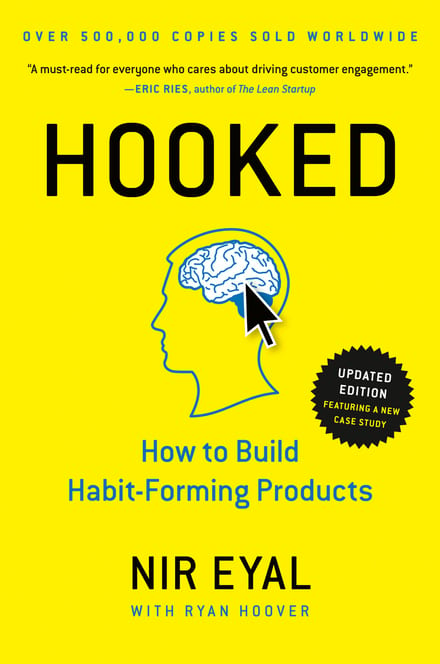
Hooked: How to Build Habit-Forming Products
How to Build Habit-Forming Products
The full book runs ~242 pages — roughly 4 hours of reading. You get the key ideas here in 5 minutes.
The key ideas
- Attach the product to an internal trigger: boredom, loneliness, fear of missing out.
- Increase ability before motivation — removing steps beats trying to persuade.
- Make rewards variable; anticipation, not the payoff, drives the craving.
- Ask for a small investment after the reward, never before.
- Store value users can't take with them: content, followers, reputation, skill.
- Ask whether you'd use it yourself before you hook anyone.
The summary
Seventy-nine percent of smartphone owners check their phone within fifteen minutes of waking. A third of Americans say they’d rather give up sex than lose their cell phone. None of this is accidental. A habit is an automatic behavior triggered by a situational cue, and the products you reach for without deciding to were built by people who understood exactly that. Companies that manufacture habits stop paying for attention, and Nir Eyal reverse-engineers how they do it into a four-phase loop he calls the Hook.
The money explains the effort. Habits compound: Evernote found 0.5 percent of users paying after their first month and 26 percent by month forty-two. Harvard’s John Gourville argues a rival doesn’t need to be better, it needs to be nine times better, because old routines are that stubborn. Bing is roughly as good as Google. Nobody switches.
The four phases of the Hook
- Trigger — the cue that starts the behavior.
- Action — the simplest thing a user does in anticipation of a reward.
- Variable reward — a payoff that arrives unpredictably.
- Investment — a bit of work that improves the product and loads the next trigger.
External triggers sit in your environment: an ad, a friend’s invitation, an app icon, a notification. The ones worth having are owned triggers, the alerts you gave permission to appear — paying forever to bring users back bankrupts you. Internal triggers are the real prize — associations stored in memory, usually attached to an uncomfortable feeling like boredom, loneliness, or the fear of missing out. Eyal profiles a Stanford student he calls Yin, who posts dozens of Instagram photos a day and insists she doesn’t have a problem: “I just use it whenever I see something cool.” What fires is a small dread that the moment will vanish.
What people say they want rarely matches what they do, so Eyal borrows Toyota’s 5 Whys: ask why five times about a hypothetical email user named Julie and you get from “she wants to send messages” to “she fears being out of the loop.” Fear you can design for.
Ability beats motivation
B.J. Fogg’s model holds that behavior occurs only when motivation, ability, and a trigger arrive together — B = MAT — and Eyal is blunt: spend on ability first. Persuasion is slow and expensive; removing steps works. Apple made the iPhone camera launchable from the lock screen and owned the quick snapshot. Twitter’s 140-character limit, dismissed at the time as a gimmick, made composing nearly free.
Variability creates the craving
Olds and Milner found that mice would forgo food and cross an electrified grid to keep stimulating the nucleus accumbens. Stanford’s Brian Knutson later showed that region fires not when the reward lands but while you’re anticipating it: the craving does the pulling, not the payoff. Unpredictability multiplies it. Skinner’s pigeons pecked the lever far more once pellets started arriving at random.
Eyal sorts these rewards into three kinds. Rewards of the tribe are social: Facebook likes, Stack Overflow’s upvotes and badges. Rewards of the hunt chase resources and information — slot machines, which take a billion dollars a day in American casinos, or Pinterest cropping images at the fold so you keep scrolling. Rewards of the self are mastery and completion: inbox zero, leveling up in World of Warcraft. Email delivers all three, which is why it’s so hard to leave alone.
Two things break the spell. One is coercion: threaten someone’s autonomy and they rebel, a reflex called reactance. A meta-analysis of 42 studies found that ending a request with “but you are free to accept or refuse” doubles compliance. The other is finite variability, surprise that runs out. FarmVille reached 83.8 million monthly players and Zynga was worth over $10 billion in March 2012; by November the stock was down more than 80 percent, because CityVille and ChefVille were the same game again.
The user has to do a bit of work
The last phase runs against every instinct about frictionless design: after the reward, ask for effort. Ariely, Norton, and Mochon had students fold origami and bid on it; the folders valued their own lopsided cranes five times higher than strangers did. We overvalue what we’ve worked on, and we stay consistent with what we’ve already done: 76 percent of homeowners accepted an ugly DRIVE CAREFULLY lawn sign after first agreeing to a small window sticker, against 17 percent asked cold.
That investment does two jobs. It stores value that makes the product better with use — LinkedIn profile data, Twitter followers, an eBay reputation, hard-won Photoshop skill — none of which transfers to a rival. And it loads the next trigger: every Snapchat sent invites a reply, and connecting Any.do to your calendar earns it the right to ping you when your meeting ends.
The morality of manipulation
Eyal doesn’t dodge what he’s teaching. Manipulation is an experience crafted to change behavior, and by that definition Weight Watchers qualifies as squarely as a slot machine. His Manipulation Matrix asks makers two questions: would you use this yourself, and does it materially improve users’ lives? Two yeses make you a facilitator, the only quadrant with a clean conscience and the best odds, since you know the user firsthand. Believing it helps people you’d never be makes you a peddler; using it without claiming it helps anyone makes you an entertainer; two noes make you a dealer. Ian Bogost built Cow Clicker to mock FarmVille, then shut it down when players got genuinely obsessed.
The bottom line
Habits aren’t willed into being, they’re assembled: a trigger, an action easy enough to happen without thinking, a reward you can’t predict, and a small investment that makes the next pass likelier. Run that loop often enough against a real emotional itch and people stop needing to be asked. Read it if you build products, or want to know why you keep opening the app you mean to delete.
Fact check
Popular books repeat findings that later research has complicated. Where Hooked makes a testable claim, here's what the evidence actually shows.
Unpredictable rewards create craving in a way reliable ones do not, because the brain's reward circuitry fires while you anticipate the payoff rather than when it arrives.
Both halves hold up. Imaging eight volunteers playing for money found nucleus accumbens activity rising with the anticipation of larger rewards — and tracking how happy the cue made them — while anticipation of punishment produced no such response. Recordings from dopamine neurons then turned up a second, slower signal that builds until the moment a reward is due and peaks when the odds sit at 50/50, meaning uncertainty is coded in its own right, not just as a byproduct of size. One detail drifts in the retelling: Olds and Milner's 1954 self-stimulation experiment used rats with electrodes in the septal area, and the food-refusal and shock-crossing results came from later work in that line.
- Knutson B, Adams CM, Fong GW, Hommer D. Anticipation of increasing monetary reward selectively recruits nucleus accumbens. J Neurosci. 2001;21(16):RC159. PubMed
- Fiorillo CD, Tobler PN, Schultz W. Discrete coding of reward probability and uncertainty by dopamine neurons. Science. 2003;299(5614):1898-902. PubMed
- Olds J, Milner P. Positive reinforcement produced by electrical stimulation of septal area and other regions of rat brain. J Comp Physiol Psychol. 1954;47(6):419-27. PubMed
Getting someone to agree to something small makes them dramatically likelier to agree to something large — 76 percent accepted an ugly lawn sign after a window sticker, against 17 percent asked cold.
The foot-in-the-door effect exists, but nothing close to that gap has been reproduced. Researchers who ran a direct replication of the original 1966 experiment in two countries note that Freedman and Fraser's effect size has never been obtained again: in 2003 the tactic worked in Ukraine and failed in Poland, and by 2013 it was statistically insignificant in both. A review of the wider literature concluded the technique runs on several different mechanisms at once, which is why it sometimes does nothing and can even reduce compliance. Eyal's underlying point about prior commitment still stands; the headline percentages are the outlier, not the norm.
- Gamian-Wilk M, Dolinski D. The Foot-in-the-Door Phenomenon 40 and 50 Years Later: A Direct Replication of the Original Freedman and Fraser Study in Poland and in Ukraine. Psychol Rep. 2020;123(6):2582-2596. PubMed
- Burger JM. The foot-in-the-door compliance procedure: a multiple-process analysis and review. Pers Soc Psychol Rev. 1999;3(4):303-25. PubMed
Ending a request with "but you are free to accept or refuse" doubles compliance, according to a meta-analysis of 42 studies.
The 42-study meta-analysis is real and did find the technique effective across request types, though its effect shrank whenever the person didn't have to decide on the spot. A pre-registered 2023 re-examination pooled 52 experiments covering 19,528 people and put the overall effect at g = 0.44 — then found it vanished among the seven studies rated low risk of bias (g = 0.11, 95% CI −0.18 to 0.40). Its reproducibility diagnostics for this literature came out close to the floor, with an R-index of 9.8 percent and an expected discovery rate of 6 percent. Something is probably there in face-to-face asking, but a reliable doubling is not what the evidence now shows.
- Carpenter CJ. A Meta-Analysis of the Effectiveness of the "But You Are Free" Compliance-Gaining Technique. Communication Studies. 2013;64(1):6-17. Source
- Fillon AA, Souchet L, Pascual A, Girandola F. The effectiveness of the "But-you-are-free" technique: Meta-analysis and re-examination of the technique. Meta-Psychology. 2023;7:MP.2020.2640. Source
Frequently asked questions
What is Hooked about?
The products you reach for without deciding to were engineered that way, and Eyal reverse-engineers how into a four-phase loop called the Hook: trigger, action, variable reward, investment. Run the loop often enough against a real emotional itch and users come back on their own, which is why companies that manufacture habits stop paying for attention. The economics are stark — Evernote saw 0.5 percent of users paying after month one and 26 percent by month forty-two, and Harvard's John Gourville argues a rival has to be nine times better to dislodge an existing routine.
What are the key takeaways from Hooked?
Attach your product to an internal trigger, an uncomfortable feeling like boredom, loneliness or fear of missing out, and use Toyota's 5 Whys to find it. Invest in ability before motivation — B.J. Fogg's B = MAT model says behavior needs all three, and removing steps is cheaper than persuading, as the iPhone's lock-screen camera and Twitter's 140 characters showed. Make the reward variable, since Knutson found the brain fires while anticipating rather than when the payoff lands, and sort your rewards into tribe, hunt and self. Then ask for a small investment after the reward, never before: it stores value that doesn't transfer to a rival and loads the next trigger.
Who should read Hooked?
Read it if you build products, or if you want to understand why you keep opening the app you keep meaning to delete.
Is Hooked worth reading?
It's compact and unusually concrete, and it doesn't dodge the ethics — the Manipulation Matrix asks whether you'd use the product yourself and whether it materially improves users' lives, with only the facilitator quadrant coming out clean. The warnings are as useful as the playbook: coercion triggers reactance, and finite variability runs out, as when Zynga was worth over $10 billion in March 2012 and down more than 80 percent by November because CityVille and ChefVille were the same game again. If you're looking for a defense against these techniques rather than instructions for using them, you'll be reading against the grain of the book.