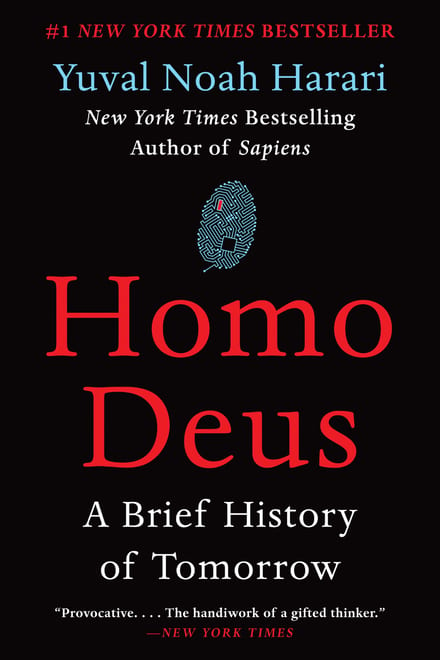
Book summary
Homo Deus: A Brief History of Tomorrow
A Brief History of Tomorrow
The full book runs ~576 pages — roughly 11 hours of reading. You get the key ideas here in 5 minutes.
The key ideas
- In 2010 famine killed about a million people; obesity killed three million.
- Google founded a company whose stated mission is to solve death.
- American GDP sextupled between 1950 and 2000 while measured well-being stayed flat.
- Modernity's bargain: humans traded cosmic meaning for power, then invented humanism.
- Brain scans and split-brain patients dissolve the single free self liberalism assumes.
- Dataism is the successor creed: listen to the algorithms, not your feelings.
The summary
In 2010 famine and malnutrition killed about a million people. Obesity killed three million. That same year terrorists killed 7,697 people worldwide, which makes Coca-Cola a deadlier threat to the average American than al-Qaeda. In 2012 human violence accounted for 620,000 deaths and diabetes for 1.5 million: sugar is now more dangerous than gunpowder. The claim isn’t that suffering has ended. It’s that famine, plague and war have stopped being forces of nature and become manageable problems — when they break out we convene a commission of inquiry instead of praying. History tolerates no vacuum.
Death becomes a technical problem
The scale of what got solved is easy to forget. Between 1692 and 1694, 2.8 million French people — fifteen per cent of the population — starved while Louis XIV dallied with his mistresses at Versailles. When smallpox landed in Mexico in March 1520 the country held 22 million people; by December, 14 million.
Against that record, modern culture treats death as a glitch. A doctor will tell you that you have flu, tuberculosis or cancer, but never that you have death — every cause is a technical problem awaiting a technical fix. Google founded a subsidiary, Calico, whose stated mission is to solve death, and put 36 per cent of Google Ventures’ $2 billion portfolio into life sciences; the fund’s head says living to 500 is possible. Equality is out; immortality is in.
Harari doesn’t buy the timeline. Modern medicine hasn’t extended the natural human lifespan by a single year — it saved us from dying early. Galileo made it to seventy-seven, Newton to eighty-four, Michelangelo to eighty-eight, without antibiotics. And what money might buy is a-mortality, not immortality: no expiry date, but still killable by a truck.
The glass ceiling on happiness
The second project goes worse. Between 1950 and 2000 American GDP rose from $2 trillion to $12 trillion, yet measured well-being in the 1990s sat roughly where it had been in the 1950s. South Korea went from poor dictatorship to rich democracy and tripled its suicide rate, from nine per 100,000 to thirty.
Two things hold that ceiling down. Expectations balloon as conditions improve, so contentment never catches up. And happiness is biochemical rather than circumstantial: pleasant sensations subside by design. A squirrel that felt permanent bliss after one nut would stop hunting for nuts and leave no descendants. So the pursuit turns pharmaceutical. In 2011, 3.5 million American children took ADHD medication; British prescriptions went from 92,000 in 1997 to 786,000 in 2012. People have quarrelled about schools for millennia, but this is the first era in which changing the pupils’ biochemistry looks like the efficient move.
Modernity’s deal and its escape clause
Underneath sits a bargain Harari reduces to one line: humans give up meaning in exchange for power. No cosmic script means no consolation when things go wrong, but also no ceiling on ambition. The escape clause is humanism, which installed human feeling where God used to sit. A woman in 1300 confessed an affair and was told to give ten gold coins to the crusade and walk to Canterbury. Her descendant tells a therapist, who asks how she feels about it. The voter knows best, the customer is always right, beauty is in the eye of the beholder — three slogans, one creed.
The gun that fires in the third act
Then the sciences humanism relies on start dismantling it. Put someone in a scanner and tell them to press a switch whenever they feel like it, and their brain gives the choice away seconds before they know they’ve made it. Split-brain patients are stranger still: shown a chicken claw on one side and a snow scene on the other, a patient pointed at a chicken with one hand and a snow shovel with the other, then explained that you need a shovel for the chicken shed. The talking hemisphere had no idea, so it invented something plausible.
Kahneman found the same machinery in everyone. Volunteers held a hand in 14°C water for a minute, then did a longer version — that same minute plus thirty seconds as the water warmed by a degree. Eighty per cent chose to repeat the longer, objectively worse trial, because it ended better. There’s an experiencing self that feels everything and remembers nothing, and a narrating self that keeps only peaks and endings and makes all the big decisions. The single authentic inner voice liberalism is built on isn’t there.
When intelligence stops needing consciousness
Computers have gained enormous intelligence since the 1950s and precisely zero consciousness — and for armies and corporations, intelligence is mandatory, consciousness optional. Frey and Osborne put 47 per cent of American jobs at high risk of automation within two decades: 99 per cent for telemarketers, 96 for chefs, 89 for bakers and bus drivers, 0.7 for archaeologists. A robot-run San Francisco pharmacy filled two million prescriptions without error. At a showdown in Oregon, an audience judged a computer’s composition to be genuine Bach and the human composer’s piece to be the machine’s.
The threat isn’t a robot uprising. It’s Waze: a tool you consult becomes a tool you obey, then a tool that decides. Meanwhile medicine shifts from healing the sick, which was egalitarian, to upgrading the healthy, which isn’t — and elites who no longer need millions of healthy workers may stop paying for them.
The bottom line
The successor Harari names is dataism: the universe is data flows, and anything’s value is its contribution to processing them. Humanism told you to listen to your feelings; dataism says listen to the algorithms, because they know how you feel. He insists these are possibilities, not prophecies, and leaves one question: what happens when non-conscious systems know you better than you know yourself. Read it if you want the long view on where biotech and AI are pushing us, and can stomach an author who predicts bluntly, then tells you not to trust him.
Fact check
Popular books repeat findings that later research has complicated. Where Homo Deus makes a testable claim, here's what the evidence actually shows.
Obesity now kills roughly three times as many people as famine and malnutrition.
The obesity side holds up: the Global Burden of Disease programme attributed 4.0 million deaths worldwide in 2015 to high body-mass index, and nearly 40% of those were in people who were overweight rather than obese. The other side of the comparison undercounts badly. Putting famine and malnutrition together at about a million leaves out most undernutrition deaths, which a Lancet series estimated at 3.1 million children a year — 45% of all deaths under age five in 2011. Harari's underlying point, that mass starvation has stopped being the ordinary human condition, survives; the three-to-one ratio does not.
- GBD 2015 Obesity Collaborators. Health effects of overweight and obesity in 195 countries over 25 years. N Engl J Med. 2017;377(1):13-27. PubMed
- Black RE, Victora CG, Walker SP, et al. Maternal and child undernutrition and overweight in low-income and middle-income countries. Lancet. 2013;382(9890):427-451. PubMed
Frey and Osborne showed that 47% of American jobs are at high risk of automation within two decades.
Frey and Osborne did estimate that about 47% of US employment sits in occupations they scored as highly susceptible to computerisation, across 702 occupations. But that is a susceptibility score for whole occupations, not a forecast of jobs eliminated on a timetable. Redoing the exercise task by task — which credits the parts of a supposedly high-risk job that resist automation, and the variation between workers holding the same job title — the OECD put the automatable share at 9% on average across 21 countries, from 6% in Korea to 12% in Austria. Same underlying data, roughly a fifth of the headline figure.
- Frey CB, Osborne MA. The future of employment: how susceptible are jobs to computerisation? Technol Forecast Soc Change. 2017;114:254-280. Source
- Arntz M, Gregory T, Zierahn U. The Risk of Automation for Jobs in OECD Countries. OECD Social, Employment and Migration Working Papers. Paris: OECD Publishing; 2016. Source
Modern medicine has not added a single year to the natural human lifespan — it has only stopped people dying early.
On the ceiling, Harari has real support: the age at death of the world's oldest person has not risen since the 1990s, and gains in survival tail off after age 100, which one analysis of global demographic data reads as evidence of a fixed maximum lifespan. The blanket version is wrong, though. Death rates at advanced ages have fallen far enough that human senescence itself appears postponed by about a decade, with people reaching old age in better health rather than simply escaping early death. That is added years of old age, not just fewer young deaths.
American incomes rose sixfold after 1950 while measured well-being stayed flat, so prosperity has hit a happiness ceiling.
The flat national trend holds. Easterlin's re-test across developed, developing and post-socialist countries found no long-run link between rising national income and happiness over spans of ten years or more, even though the two move together through booms and slumps. Within a country at one moment, money keeps buying well-being: 1,725,994 experience-sampling reports from 33,391 employed US adults show both day-to-day feeling and life satisfaction rising steadily with log income, with no plateau above $75,000. An adversarial collaboration between the researchers on both sides then found the flattening pattern applies only to the least happy people. So the ceiling is a fact about national averages over time, not about individuals.
- Easterlin RA, McVey LA, Switek M, Sawangfa O, Zweig JS. The happiness-income paradox revisited. Proc Natl Acad Sci U S A. 2010;107(52):22463-22468. PubMed
- Killingsworth MA. Experienced well-being rises with income, even above $75,000 per year. Proc Natl Acad Sci U S A. 2021;118(4):e2016976118. PubMed
- Killingsworth MA, Kahneman D, Mellers B. Income and emotional well-being: a conflict resolved. Proc Natl Acad Sci U S A. 2023;120(10):e2208661120. PubMed
Frequently asked questions
What is Homo Deus about?
Famine, plague and war have stopped being uncontrollable forces of nature and become manageable problems — in 2010 obesity killed three times as many people as famine and malnutrition. Homo Deus asks what fills the gap at the top of the human agenda, and answers: immortality, happiness and godlike power. It then argues that the humanism organising modern life is being dismantled by the very sciences chasing those goals.
What are the key takeaways from Homo Deus?
Death has been reframed as a technical problem rather than a metaphysical one, which is why Google funds a company whose stated mission is to solve it. Happiness runs into a glass ceiling built from ballooning expectations and biochemistry — American GDP went from $2 trillion to $12 trillion between 1950 and 2000 with no matching rise in well-being. Modernity's bargain traded cosmic meaning for power, and humanism plugged the hole by making human feeling the source of all authority. Now brain scans, split-brain patients and Kahneman's experiments show there is no single free self to consult, while intelligence decouples from consciousness — and dataism waits to replace humanism with the instruction to listen to the algorithms instead.
Who should read Homo Deus?
Anyone who wants the long historical view on where biotechnology and artificial intelligence are pushing us, rather than a news-cycle take. It suits readers who enjoy having a comfortable assumption — free will, the individual self, the sanctity of human experience — taken apart carefully.
Is Homo Deus worth reading?
Yes, largely because of the statistics and historical set-pieces that carry the argument: 2.8 million French people starving in the 1690s, Mexico losing 8 million people to smallpox in nine months, 47 per cent of American jobs rated at high risk of automation. The weakness is that Harari makes bold predictions and then reminds you they are possibilities rather than prophecies, which can feel like having it both ways. Skip it if you want practical guidance — this is a diagnosis of where we're heading, not advice on what to do about it.