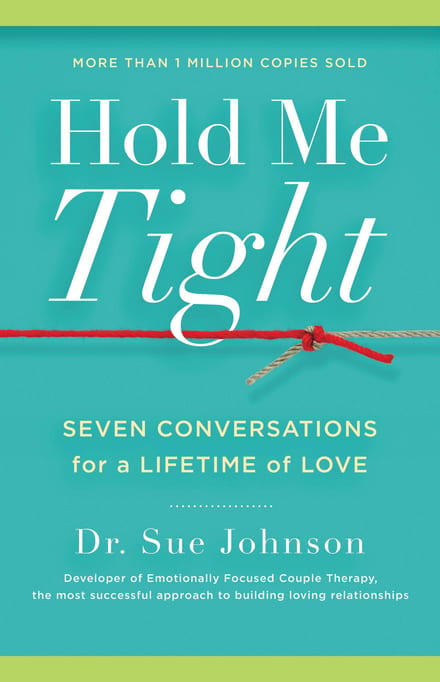
Book summary
Hold Me Tight
Seven Conversations for a Lifetime of Love
The full book runs ~320 pages — roughly 6 hours of reading. You get the key ideas here in 5 minutes.
The key ideas
- Love is survival biology, not weakness or neediness
- Disconnection, not conflict, destroys relationships
- Attack the negative pattern, not your partner
- Raw spots trigger reactions wildly out of proportion
- Voice your fear, then name what you need
- Secure bonds fuel great sex and heal trauma
The summary
Most couples think they’re fighting about money, chores, or how often they have sex. Sue Johnson says they’re really asking one buried question: Are you there for me? Can I count on you when it counts? Underneath the slammed doors and the cold silences, each partner is trying to find out whether the other will respond when they reach out. This isn’t weakness or excessive neediness. Love, Johnson argues, is a survival mechanism as basic as hunger, and losing a secure connection triggers a primal panic wired into us long before we could name it.
The science backs the intensity. John Bowlby’s attachment theory showed that the drive to form close bonds is an innate human imperative—children starved of emotional contact fail to develop normally even when fed and sheltered, and adults show the same patterns when a loved one feels out of reach. Emotional isolation turns out to be a graver health risk than smoking; marital distress raises the risk of depression tenfold and wears down the immune and hormonal systems. The reverse is just as real: simply holding a loving partner’s hand can calm the neurons that register pain. The more securely we’re held, Johnson notes, the more independent and adventurous we can actually be.
The pattern is the enemy, not your partner
The real problem in a distressed relationship isn’t conflict—it’s disconnection. When a partner feels emotionally unsafe, the amygdala takes over and pushes them into one of two automatic moves: press harder, criticizing and clinging to pull the other close, or shut down and retreat to avoid getting hurt. Those two reflexes lock together into a self-feeding loop. The most common version is what Johnson calls the Protest Polka—one partner attacks and demands, the other defends and withdraws, and every round drives them further apart. Couples caught in it have more than an 80% chance of divorce. When it grinds on long enough, both partners give up and disappear into a stage she calls Freeze and Flee, the point where a marriage is most likely to end.
This is why communication tips and problem-solving drills so often fail: they don’t touch the attachment fear underneath. The turn comes when both people stop blaming each other and see the pattern itself as the villain, with the two of them as its victims.
Raw spots run the show
Every partner carries raw spots—tender places left by past or present moments when a core attachment need got dismissed or ignored. Hit one, and the reaction looks wildly out of proportion to whatever set it off. One of Johnson’s clients froze and shut down when his wife asked for more sex; the request landed on old wounds from a critical ex-wife and a father who had questioned his manhood. What we show in these moments—anger, stonewalling—usually masks the softer truth underneath: sadness, shame, fear. Learning to spot your own raw spots, and your partner’s, is what makes it possible to step out of the loop.
From fear to need
The cure Johnson prescribes is emotional responsiveness, the heart of Emotionally Focused Therapy, where 70 to 75% of couples recover and build lasting, happy relationships. She boils responsiveness down to three questions, A.R.E.: Accessibility—can I reach you? Responsiveness—can I rely on you to respond? Engagement—will you value me and stay close?
The most transformative conversation moves in two steps. First, answer honestly: what am I most afraid of? Then translate that fear into a clear request—what do I need most from you? One client managed to say it plainly: “I want you to stay with me and come close, to show me you care when I don’t feel strong. I want you to touch me and hold me and tell me I matter to you.” Naming the fear and the need out loud gives your partner something they can actually respond to, instead of a fight they can only lose.
Sex, healing, and keeping it alive
Emotional safety and a good sex life feed each other, and trouble in bed is often the canary in the mine. Johnson describes “Sealed-Off Sex” that’s all performance and no closeness, and “Solace Sex” driven by anxiety and a hunger for reassurance—and sets against them “Synchrony Sex,” where two securely bonded partners can relax, play, and speak their needs without fear. Non-demand touching, tender contact with no goal of intercourse, is one of the best ways to rebuild both physical and emotional trust.
None of this holds without maintenance. Love, Johnson writes, “has to be made like bread, remade all the time.” Build small daily rituals of parting and reunion, deal with the attachment wound in a conflict before chasing a practical fix, and keep a shared story of how you found your way back from disconnection. A secure bond is also our best resource for surviving trauma—experts agree the strongest predictor of how a trauma affects us isn’t the severity of the event but whether we can seek comfort from someone we love.
The bottom line
Treat the panicked pursue-and-retreat loop as the shared enemy, then say the fear underneath it out loud and ask directly for what you need. Read this if you and your partner keep having the same fight and can’t work out what it’s actually about.
Fact check
Popular books repeat findings that later research has complicated. Where Hold Me Tight makes a testable claim, here's what the evidence actually shows.
Emotionally Focused Therapy brings 70 to 75% of distressed couples to recovery, and the gains hold.
The recovery rate traces back to a 1999 review co-authored by Johnson herself, which pooled a small set of early randomised trials. The largest independent meta-analysis since — 33 randomised trials, 2,730 participants — found EFT produced a medium improvement in relationship satisfaction (g = 0.73 at post-test, g = 0.66 at six months), the strongest result of any couple therapy tested but well short of three-quarters of couples recovering. Durability past a year is essentially untested for EFT: the only 12-month data in that meta-analysis came from behavioural couple therapy, where the effect had faded to g = 0.06. The authors also flag possible publication bias.
- Rathgeber M, Bürkner PC, Schiller EM, Holling H. The Efficacy of Emotionally Focused Couples Therapy and Behavioral Couples Therapy: A Meta-Analysis. J Marital Fam Ther. 2019;45(3):447-463. PubMed
- Johnson SM, Hunsley J, Greenberg L, Schindler D. Emotionally focused couples therapy: status and challenges. Clin Psychol Sci Pract. 1999;6(1):67-79. Source
Couples locked in the pursue-and-withdraw pattern have more than an 80% chance of divorcing.
The striking numbers in this literature are model accuracies from small samples, not the odds facing any particular couple. Gottman and Levenson's 14-year study reported a model that classified divorce with 93% accuracy, but it was fitted on 79 couples of whom 21 divorced. When Heyman and Slep tested that style of prediction on archival data, accuracy and predictive value dropped sharply once the equations were cross-validated on fresh cases and the population divorce rate was taken into account. Demand-and-withdraw really does track lower relationship quality; a fixed 80%-plus divorce probability is not something the research establishes.
Emotional isolation is a graver health risk than smoking.
Weak social ties are a genuine mortality risk, but the research that established this says comparable to well-known risk factors, not worse than them. Holt-Lunstad's meta-analysis of 148 studies covering 308,849 people found a 50% higher likelihood of surviving follow-up among people with stronger social relationships (OR 1.50), and the effect held across age, sex, baseline health and cause of death. Her 2015 review, which controlled for more confounders, put the increases at 29% for social isolation, 26% for loneliness and 32% for living alone. Both papers conclude the influence is comparable with established mortality risks — the ranking above smoking is an extrapolation the studies do not make.
- Holt-Lunstad J, Smith TB, Layton JB. Social relationships and mortality risk: a meta-analytic review. PLoS Med. 2010;7(7):e1000316. PubMed
- Holt-Lunstad J, Smith TB, Baker M, Harris T, Stephenson D. Loneliness and social isolation as risk factors for mortality: a meta-analytic review. Perspect Psychol Sci. 2015;10(2):227-237. PubMed
Holding a loving partner's hand calms the brain circuits that register threat and pain.
In the study Johnson draws on, 16 married women facing the threat of an electric shock showed reduced activity in the neural systems that carry threat responses while holding their husband's hand; a stranger's hand helped less, and the happiest marriages produced the largest calming effect in the right anterior insula and hypothalamus. The same group later reproduced the result in 110 participants of varied racial and economic backgrounds: partner handholding lowered both self-reported distress and activity in a salience-and-vigilance network, and the effect scaled with how much support people felt they had. The original sample was small, and the finding concerns anticipating a shock rather than pain relief during one.
- Coan JA, Schaefer HS, Davidson RJ. Lending a hand: social regulation of the neural response to threat. Psychol Sci. 2006;17(12):1032-1039. PubMed
- Coan JA, Beckes L, Gonzalez MZ, Maresh EL, Brown CL, Hasselmo K. Relationship status and perceived support in the social regulation of neural responses to threat. Soc Cogn Affect Neurosci. 2017;12(10):1574-1583. PubMed
Frequently asked questions
What is Hold Me Tight about?
Sue Johnson argues that couples who think they're fighting about money, chores, or sex are really asking one buried question: Are you there for me, can I count on you when it counts? Drawing on attachment science, she frames love as a survival mechanism as basic as hunger, so the real problem in a distressed relationship isn't conflict but the panic of disconnection.
What are the key takeaways from Hold Me Tight?
The pattern is the enemy, not your partner: when one feels unsafe, the amygdala pushes each into a self-feeding loop Johnson calls the Protest Polka, one attacks and demands while the other defends and withdraws. Underneath are "raw spots," tender places from past wounds that make reactions look wildly out of proportion. Her cure is emotional responsiveness, captured in A.R.E., Accessibility, Responsiveness, Engagement, and the key conversation names your deepest fear and then translates it into a clear request. She also distinguishes disconnected "Sealed-Off" and anxious "Solace" sex from secure "Synchrony Sex," and insists love has to be remade daily like bread.
Who should read Hold Me Tight?
Read it if you and your partner keep having the same fight and can't work out what it's actually about. It's for couples stuck in a repeating loop who want to reach the attachment fear beneath it.
Is Hold Me Tight worth reading?
Its big advantage over typical relationship advice is that it targets the attachment fear underneath conflict rather than surface communication drills, and it's grounded in Emotionally Focused Therapy, where 70 to 75% of couples recover. Readers who want quick fights-over-dishes fixes may find the emotional depth demanding, but for understanding why the same argument keeps recurring, it's unusually clarifying.