Book summary
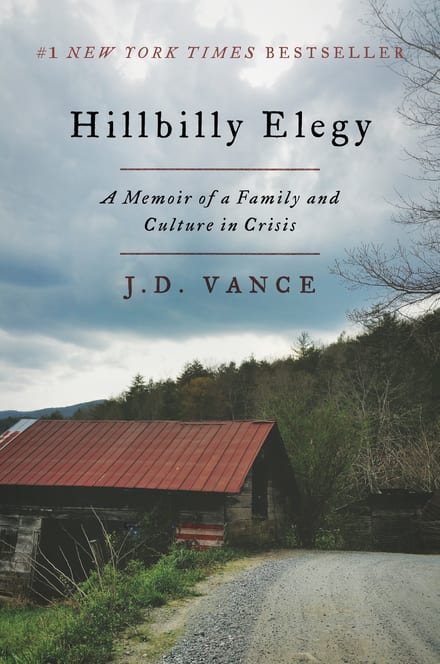
Hillbilly Elegy: A Memoir of a Family and Culture in Crisis
The full book runs ~272 pages — roughly 5 hours of reading. You get the key ideas here in 4 minutes.
The key ideas
- Chaos breeds learned helplessness worse than material poverty itself
- One stubborn, stable adult can rewrite a child's fate
- Scots-Irish loyalty and rage pass down through generations
- Marine discipline taught Vance that effort controls outcomes
- Social mobility demands new manners, not just more money
- Culture and internal narrative shape escape as much as policy
The summary
J.D. Vance’s argument is that Appalachian poverty is passed down through household chaos and a settled belief that nothing you do changes your fate — not through economics alone. That’s why his memoir spends far less time on policy than on what it does to a kid to grow up in a house where plates fly across the kitchen and your own mother threatens to crash the car with you in it. Vance made it out, but he’s clear that the book isn’t a trophy for his success; it’s an attempt to show what poverty actually feels like from the inside, and how narrow the exit really is.
A tradition of loyalty and rage
Vance’s people are Scots-Irish, migrants who settled the Appalachian hills and later chased factory work north to towns like Middletown, Ohio, where his family landed even though he counts Jackson, Kentucky, as his true home. For them, as he puts it, poverty is the family tradition, and few earn college degrees. What they hand down instead is a fierce code of loyalty, honor, and justice, told through stories a boy absorbs whole — like the one where Uncle Pet beat a man unconscious and cut him up with an electric saw for insulting Pet’s mother. The rage was domestic too. His grandmother, Mamaw, once poured gasoline on Papaw and set him alight as he slept, and their eleven-year-old daughter put the fire out. Papaw eventually stopped drinking, but the pattern had already reached the next generation: Vance’s mother, Bev, moved through a string of husbands, prescription-drug addiction, a suicide attempt, and an arrest for domestic violence before he finished high school. As Vance writes, everyone in the family “could go from zero to murderous in a heartbeat.”
Chaos, not poverty, is the real inheritance
The thing that gets transmitted isn’t a lack of money; it’s the conviction that your choices don’t count. Psychologists call it learned helplessness, and Vance names it as the exact thing he’d most like to change about the white working class — “the feeling that our choices don’t matter.” When your mother’s sobriety collapses for the fourth time no matter what anyone does, when men appear and vanish and every promise dissolves, you quietly stop believing effort leads anywhere. He watched it curdle into denial: in Middletown, where he says 30% of young men worked fewer than twenty hours a week, he couldn’t find a single one who thought of himself as lazy. He felt the distortion in himself, too, mistaking his lack of knowledge for stupidity because as a child he didn’t yet grasp that intelligence and knowledge aren’t the same thing. The pessimism is measurable — only 44% of working-class whites expect their kids to do better than they did, against well over half of Black, Latino, and college-educated Americans — and it isn’t irrational when you’ve watched effort fail over and over in your own living room.
One stubborn adult can rewrite the script
Vance got out because Mamaw refused to let him accept the family verdict. When Bev’s life became unlivable — the attacks, the rehab, the relapses, another marriage — he moved in with his grandmother for good during high school, and almost immediately his grades rose and he stayed clear of the drugs and drink taking down his peers. She pushed him toward Ohio State, but feeling unready he joined the Marines instead, and boot camp handed him the one lesson school never had: that discipline actually controls outcomes, that agency is real. He came back from Iraq, finished his OSU degree in under two years while working several jobs, and made it into Yale Law School.
There he met his future wife, Usha, who helped him read a world of wealth and unwritten rules he’d never been taught. That’s part of Vance’s larger point: mobility isn’t only money, it’s a lifestyle change, and the norms that kept you alive in Middletown can become liabilities in a professional room. His prescription is cultural rather than legislative. He credits family, education, and religion — noting that regular churchgoers commit fewer crimes, live longer, earn more, and finish college more often — and he insists working-class whites stop blaming Obama or Bush or faceless companies and ask what they can do themselves. It’s the claim that made the book divisive, but he isn’t denying real barriers; he’s arguing the internal story matters as much as the external one, and that the internal story in Appalachia has turned toxic. The demons don’t fully release you, either. Even after Yale, he had to drive back to Middletown to cover his mother’s motel bill after her fifth husband threw her out for using heroin.
The bottom line
Poverty hardens into permanence when children learn that their choices don’t matter — and one stubborn, stable adult who refuses to let a kid believe that can change the whole trajectory. Read this if you want to understand why jobs and money alone won’t lift the despair in America’s white working class, or if you need proof that escaping a destructive family is possible but never clean.
Fact check
Popular books repeat findings that later research has complicated. Where Hillbilly Elegy makes a testable claim, here's what the evidence actually shows.
Poverty is handed down mainly through household chaos and learned helplessness rather than through lack of money.
The psychological half is real, but the ranking does not survive the causal evidence: giving poor families money, with no cultural intervention attached, changes children's outcomes on its own. When casino revenue started paying every enrolled member of an Eastern Cherokee community roughly $4,000 a year, children in the poorest households gained about a year of schooling by age 21 and were 22% less likely to have committed a minor offence at ages 16-17. A randomized trial that gave low-income US mothers unconditional monthly cash found differences in their infants' brain activity at one year, with effect sizes comparable to scalable education programmes. Chaos and expectations matter; the evidence does not support placing them above material deprivation.
- Akee RKQ, Copeland WE, Keeler G, Angold A, Costello EJ. Parents' incomes and children's outcomes: a quasi-experiment using transfer payments from casino profits. Am Econ J Appl Econ. 2010;2(1):86-115. Source
- Troller-Renfree SV, Costanzo MA, Duncan GJ, et al. The impact of a poverty reduction intervention on infant brain activity. Proc Natl Acad Sci U S A. 2022;119(5):e2115649119. PubMed
Regular churchgoers commit fewer crimes, live longer, earn more and finish college more often.
The longevity leg is the strongest. Among 74,534 women followed for two decades in the Nurses' Health Study, attending religious services more than once a week went with 33% lower all-cause mortality than never attending (hazard ratio 0.67), but that same analysis traced much of the gap to ordinary channels rather than religion itself: social support accounted for 23% of it, smoking 22%, depressive symptoms 11%. On income, an economic study using local religious-market density as a natural experiment estimated that doubling attendance raises household income by about 9% and cuts welfare receipt by 16%. The direction of Vance's claim is defensible; what it cannot show is that people who currently do not attend would get these outcomes if they started.
- Li S, Stampfer MJ, Williams DR, VanderWeele TJ. Association of Religious Service Attendance With Mortality Among Women. JAMA Intern Med. 2016;176(6):777-785. PubMed
- Gruber J. Religious Market Structure, Religious Participation, and Outcomes: Is Religion Good for You? NBER Working Paper 11377. National Bureau of Economic Research; May 2005. Source
One stubborn, stable adult can rewrite a child's trajectory even in a chaotic home.
Resilience research supports the direction. In a representative survey of 6,188 Wisconsin adults, those who recalled six or seven positive childhood experiences, including non-parent adults who took a genuine interest in them, had 72% lower adjusted odds of adult depression or poor mental health than those recalling two or fewer (OR 0.28), and the pattern held at every level of childhood adversity. The limits are that these are adults' retrospective self-reports gathered at a single point in time, and that the field's own summary of the evidence is that resilience is common and comes from ordinary protective systems functioning normally rather than from one exceptional rescuer. Vance's own escape also ran through the Marine Corps, the GI Bill and Ohio State, not Mamaw alone.
- Bethell C, Jones J, Gombojav N, Linkenbach J, Sege R. Positive Childhood Experiences and Adult Mental and Relational Health in a Statewide Sample: Associations Across Adverse Childhood Experiences Levels. JAMA Pediatr. 2019;173(11):e193007. PubMed
- Masten AS. Ordinary magic. Resilience processes in development. Am Psychol. 2001;56(3):227-238. PubMed
Frequently asked questions
What is Hillbilly Elegy about?
J.D. Vance's memoir argues that Appalachian poverty is passed down through household chaos and a settled belief that nothing you do changes your fate, not through economics alone. Rather than dwell on policy, he shows what it does to a child to grow up amid flying plates, addiction, and broken promises, and how narrow the exit from that world really is.
What are the key takeaways from Hillbilly Elegy?
The real inheritance isn't a lack of money but learned helplessness, the conviction that your choices don't count, which Vance names as the thing he'd most like to change about the white working class. He shows how a fierce code of loyalty and rage gets handed down through family stories, how one stubborn, stable adult (his grandmother, Mamaw) can rewrite a child's trajectory, and how the Marines taught him that discipline actually controls outcomes. His prescription is cultural rather than legislative, family, education, and religion, and personal responsibility alongside real barriers, arguing the internal story matters as much as the external one.
Who should read Hillbilly Elegy?
Read it if you want to understand why jobs and money alone won't lift the despair in America's white working class, or if you need proof that escaping a destructive family is possible but never clean.
Is Hillbilly Elegy worth reading?
As an intimate, unflinching portrait of poverty from the inside, it's vivid and hard to forget, and its central insight about learned helplessness rings true. It's also openly divisive, its emphasis on personal responsibility over structural barriers is the claim critics push back on hardest, so read it knowing it's one man's argument and memoir, not a settled account of a whole region.