Book summary
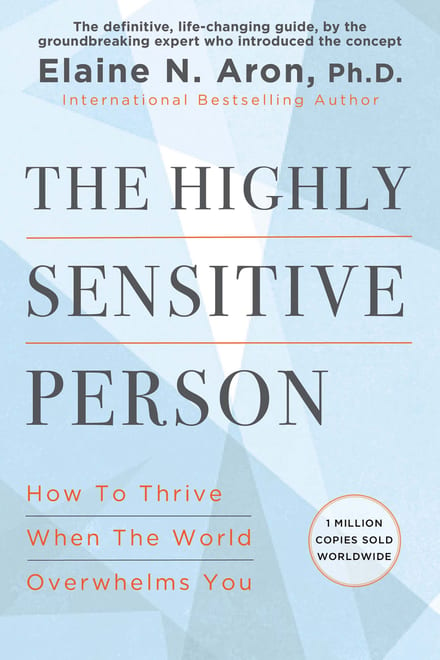
The Highly Sensitive Person: How to Thrive When the World Overwhelms You
The full book runs ~272 pages — roughly 5 hours of reading. You get the key ideas here in 3 minutes.
The key ideas
- Recognize sensitivity as biology, affecting 15-20% of people from birth
- Distinguish sensitivity from shyness: it's overarousal, not fear of judgment
- Reframe overstimulation instead of blaming yourself for being weak
- Budget stimulation with boundaries, downtime, sleep, and nature
- Choose work and relationships that reward depth over speed
- Seek therapists and doctors who respect your heightened reactions
The summary
If a busy day leaves you wrung out while everyone else seems energized, or you catch details no one else notices, you may be one of the roughly 15 to 20 percent of people born with a highly sensitive nervous system. Elaine Aron’s core point is that this is a temperament, not a flaw—and not shyness, anxiety, or weakness. Your system simply processes input more deeply and reaches saturation faster. The goal isn’t to toughen up into someone bolder. It’s to build a life that works with your wiring instead of against it.
It’s biology, not weakness
High sensitivity is real and measurable. Researchers have found physiological differences in sensitive people: higher resting heart rates, more brain activity while processing information, and elevated levels of stress hormones like cortisol. The likely explanation is a more active “pause-to-check” system—a neural habit of taking in and weighing information more thoroughly before acting. That’s why you might hesitate in a new situation (you’re gathering data) and why a loud restaurant or a tense meeting drains you (your brain is doing more work). The trait shows up from birth: sensitive infants react more strongly to new people, sounds, and smells; sensitive children get fewer stretches of deep sleep, wake more easily, and have unusually vivid dreams. None of that makes you fragile. It makes you thorough.
Crucially, the trait is neutral—neither good nor bad on its own. In the right setting, depth of processing is a genuine strength, which is why sensitive people so often become the advisors, artists, therapists, and deep thinkers who balance out more aggressive tendencies. Carl Jung went further, seeing sensitive individuals as having special access to the unconscious and calling them potential “educators and promoters of culture.” The trouble is that Western culture prizes boldness and volume, so many sensitive people grow up feeling defective. If you spent childhood hearing “you’re too sensitive,” you likely absorbed the idea that something was wrong with you. Nothing was. The mismatch was between your wiring and your surroundings.
Sensitivity is not shyness
The two get confused constantly, but they’re different things. Shyness is a learned fear of social judgment; sensitivity is an inherited tendency to process deeply and hit overload fast. When a sensitive person feels uneasy in a crowd, the cause is usually overarousal—too much noise, too many faces—not fear of rejection. That distinction is freeing, because it changes the story you tell yourself from “I’m awkward” to “I’m overstimulated and need a breather.” About 70 percent of highly sensitive people are introverts who favor deep one-on-one conversation over big gatherings, and that listening, reflecting style is every bit as valuable as the extroverted one. In a group, you can lower your arousal by stepping outside for a minute, adjusting your posture and breathing, or finding another quiet person to talk with. Build a comfortable social persona and explain your trait when it helps. You don’t need to become an extrovert—just to honor your own rhythm.
Live on a stimulation budget
Thriving comes down to treating your nervous system like a budget: there’s only so much stimulation you can absorb before you need to recharge, so spend it deliberately. That means real boundaries—turning down the extra project when you’re stretched, leaving the party early, leaving room to decompress between demanding activities. Protect your sleep, since sensitive people need more of it and suffer more without it, and lean on physical resets like time in nature and practices such as meditation or prayer, what Aron calls forms of “transcendence.” Her image is to care for your sensitive body as you would an infant. Early caregiving shapes how well you do this as an adult: children raised by caregivers who were either smothering or neglectful often struggle to self-soothe later. The aim is balance—guarding your limits without walling yourself off from life.
Choose work and love that fit
Point the trait toward environments that reward it. At work, lean into your strengths—intuition, conscientiousness, creativity, an eye for detail—and design around the overload. Self-employment, roles with autonomy, or a quieter carved-out workspace tend to suit sensitive people best; the goal is a vocation where your passion meets a real need. In love, sensitive people tend to fall harder and feel more intensely, which is a gift or a flood depending on how you handle it. Conflict is the hard part, because overarousal can make you shut down or snap. A few tools help: reflective listening (saying back what you heard to confirm you understood), positive metacommunication (“I know we’re fighting, but I love you”), and calling a time-out mid-argument before things spiral. If severe childhood stress is part of your history, know that sensitive people carry a higher risk of anxiety and depression until they face both the past and the trait—and that therapy, especially approaches that take the inner life seriously, usually beats reaching first for medication.
The bottom line
High sensitivity is an inherited trait that makes you experience the world more deeply and tire of it faster—not a defect to be fixed. The path forward is to budget your energy, hold your boundaries, and seek out places where depth is prized. Read this if you’ve ever been told you’re “too much,” or if you’re worn out by a world that seems built for someone else.
Fact check
Popular books repeat findings that later research has complicated. Where The Highly Sensitive Person makes a testable claim, here's what the evidence actually shows.
Roughly 15 to 20 percent of people are born with a highly sensitive nervous system, a distinct minority temperament.
When researchers ran a data-driven analysis on 906 adults who completed Aron's own Highly Sensitive Person scale, sensitivity came out as a continuous, normally distributed trait rather than an on/off category. Where groups could be drawn at all, there were three rather than two: 31% high-sensitive, 40% medium, and 29% low-sensitive. Individual differences in sensitivity are real and heritable, but the familiar 15-20% figure reflects a chosen cut-off, and a later critical review by many of the same researchers still lists categorical-versus-continuous as an open question in the field.
- Lionetti F, Aron A, Aron EN, Burns GL, Jagiellowicz J, Pluess M. Dandelions, tulips and orchids: evidence for the existence of low-sensitive, medium-sensitive and high-sensitive individuals. Transl Psychiatry. 2018;8(1):24. PubMed
- Greven CU, Lionetti F, Booth C, et al. Sensory Processing Sensitivity in the context of Environmental Sensitivity: A critical review and development of research agenda. Neurosci Biobehav Rev. 2019;98:287-305. PubMed
Highly sensitive people show measurable physiological differences: faster resting heart rates, more brain activity while processing information, and elevated cortisol.
The brain half has some support. An fMRI study found more sensitive participants showed greater activation in the insula, cingulate cortex and other regions tied to empathy and sensory integration when viewing others' emotional faces, though the sample was 18 people. The autonomic and hormonal half fares worse: when 101 adolescents went through a standardized lab stress test with eight cortisol samples and continuous monitoring, sensitivity predicted only how stressed they said they felt, not heart rate, heart-rate variability, skin conductance or cortisol.
- Weyn S, Van Leeuwen K, Pluess M, et al. Individual differences in environmental sensitivity at physiological and phenotypic level: Two sides of the same coin? Int J Psychophysiol. 2022;176:36-53. PubMed
- Acevedo BP, Aron EN, Aron A, Sangster MD, Collins N, Brown LL. The highly sensitive brain: an fMRI study of sensory processing sensitivity and response to others' emotions. Brain Behav. 2014;4(4):580-594. PubMed
High sensitivity is a trait in its own right, separate from shyness, introversion and neuroticism.
The introversion half holds up better than the neuroticism half. A meta-analysis of 8 studies and 6,790 people found sensitivity had no reliable correlation with extraversion in either children or adults, so the trait is not introversion under another name, though that null result also sits awkwardly with the book's figure that about 70 percent of sensitive people are introverts. Neuroticism is the harder problem: sensitivity correlated r = 0.40 with neuroticism in adults and 0.42 in children, and a companion meta-analysis of 19 studies and 5,326 people found r = 0.34 with negative affect in adults. The study that identified the three sensitivity groups likewise found the most sensitive group scored significantly higher in neuroticism than the other two.
- Lionetti F, Pastore M, Moscardino U, Nocentini A, Pluess K, Pluess M. Sensory Processing Sensitivity and its association with personality traits and affect: A meta-analysis. J Res Pers. 2019;81:138-152. Source
- Lionetti F, Aron A, Aron EN, Burns GL, Jagiellowicz J, Pluess M. Dandelions, tulips and orchids: evidence for the existence of low-sensitive, medium-sensitive and high-sensitive individuals. Transl Psychiatry. 2018;8(1):24. PubMed
Frequently asked questions
What is The Highly Sensitive Person about?
Elaine Aron makes the case that roughly 15 to 20 percent of people are born with a highly sensitive nervous system that processes input more deeply and reaches overload faster. Her core point is that this is a temperament, not a flaw, and not shyness, anxiety, or weakness, so the goal isn't to toughen up but to build a life that works with your wiring instead of against it.
What are the key takeaways from The Highly Sensitive Person?
Sensitivity is real biology, measurable in higher resting heart rates, more brain activity, and elevated cortisol, driven by a more active "pause-to-check" system, and it's neutral, a genuine strength in the right setting. It is not the same as shyness: unease in a crowd is usually overarousal, not fear of rejection. Aron's practical advice is to live on a "stimulation budget" with real boundaries, protected sleep, and physical resets like nature and meditation, and to choose work and love that fit, autonomous or quieter roles, plus conflict tools like reflective listening and calling a time-out mid-argument.
Who should read The Highly Sensitive Person?
Read it if you've ever been told you're "too sensitive" or "too much," or if you're worn out by a world that seems built for someone else. It's for people who suspect their intensity is wiring rather than weakness.
Is The Highly Sensitive Person worth reading?
For readers who recognize themselves in the description, it's genuinely reframing, replacing years of "something's wrong with me" with a neutral explanation and a concrete plan for managing overload. Its 15-to-20-percent framing and self-identifying trait can feel loosely defined to skeptics, and people who don't fit the profile won't get much from it, but for the intended reader the relief and practical guidance are the point.