Book summary
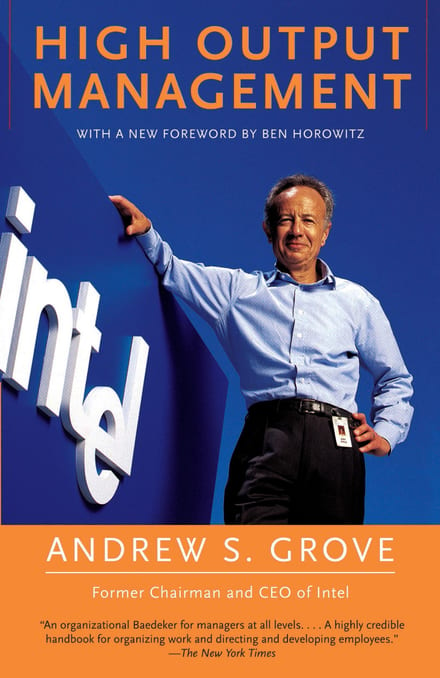
High Output Management
The full book runs ~235 pages — roughly 4 hours of reading. You get the key ideas here in 4 minutes.
The key ideas
- Multiply output through leverage: training, decisions, and clear objectives
- Model work as production; find and fix the bottleneck
- Catch defects early—problems get costlier the further they travel
- Measure output and leading signals, never activity or hours
- Match leadership style to each person's task-relevant maturity
- Diagnose failure: can't do it, or won't do it?
The summary
Management isn’t about how much you personally get done. It’s about how much output you produce through everyone you touch. That’s the spine of Andrew Grove’s classic, written by the engineer who built Intel: your output as a manager is the combined output of your whole team, so the only sane way to spend your time is on the handful of acts that multiply what everyone else can do.
Grove even applies the logic to you as an individual. “You are in a business with one employee: yourself,” he writes, in competition with millions who can do your work and may be hungrier for it — so you have to keep earning your competitive advantage. Scale that up to a team and the manager’s job becomes clear: gather information, make decisions, and influence others, tilting the calendar toward training, timely calls, and clear objectives, while treating everything low-impact as a tax on the system.
Think like a production engineer
Grove ran chip fabrication plants, and he wants every manager to see work as a production process. Anything — cooking breakfast, closing a sale, shipping code — has inputs, steps, and a single limiting step, the bottleneck, that sets the pace of the whole thing. Your task is to find that step and relieve it, adjusting equipment, staffing, or inventory around it rather than optimizing everywhere at once.
Two consequences follow. First, value builds as material moves through the process, so a defect gets more expensive the farther it travels — catch the bad wafer, the wrong hire, the flawed feature as early as you can, while it’s still cheap to fix. Second, you can only manage what you can see, and daily operations are a “black box.” So pick a few key indicators that are quantifiable and predictive — leading and trending signals of future performance, not measures of activity like hours worked. Grove likes stagger charts, which lay forecasts against actual results over time and make chronic over-promising impossible to hide. The danger is sharpest in knowledge work, where output and mere activity blur together; stressing output raises productivity, while stressing activity often does the opposite.
Leverage decides everything
The idea Grove keeps returning to is leverage: output per action. High-leverage moves — training a person, delegating well, applying your rare expertise at the right moment — ripple across the organization. Negative leverage is just as real, and comes from delaying decisions, micromanaging, abdicating responsibility, or interrupting people over trivia.
Meetings are where much of this plays out, and Grove treats them as the medium of managerial work rather than a distraction from it — provided each has a purpose. One-on-ones for coaching, staff meetings for coordination, operational reviews, and ad hoc mission-oriented meetings each do a distinct job. But if more than a quarter of your time goes to ad hoc meetings, something is malorganized. For decisions, he offers six questions: what needs deciding, when, who decides, who must be consulted first, who can ratify or veto, and who needs to be informed. The ideal is free discussion, a clear decision, then full group support — made at the lowest competent level, by the people closest to the facts.
Planning ties it together through management by objectives, the ancestor of today’s OKRs: set objectives and measurable key results that cascade through the organization, pairing long-term direction with short-term feedback so you can course-correct. And remember the hidden cost of every commitment — “by saying ‘yes’… you are implicitly saying ’no’ to something else.” As companies grow, they trade off centralization (leverage, consistency) against decentralization (speed), and most settle into a hybrid of mission-oriented and functional teams, with dual reporting to get both.
Getting peak performance from people
A manager is a coach: motivation comes from within, so the work is to build an environment where motivated people can climb. Grove uses Maslow’s hierarchy — physiological needs up through safety, belonging, esteem, and finally self-actualization, the level at which the drive to do excellent work has no ceiling.
When someone underperforms, there are only two possibilities: they can’t do the job, or they won’t. His test is brutal and useful — if their life depended on doing the work, could they? If yes, it’s a motivation problem; if no, it’s a capability problem, and each needs a different fix. Leadership style should likewise flex to a person’s task-relevant maturity. Someone new to a task needs structured, specific direction; someone with moderate experience needs two-way communication and support; a seasoned performer needs you to set objectives and step back. Reviews are a high-stakes tool here: share the written version beforehand, be frank, listen, and don’t make it about yourself.
Above all, train. Grove calls training one of the highest-leverage things a manager can do, and does the math to prove it: spend 12 hours preparing a course for 10 people who collectively work 20,000 hours a year, lift their performance by just 1%, and you’ve bought 200 hours of output — a 16-fold return on your time. The cost of skipping it is just as concrete. An untrained Intel operator who couldn’t recognize an out-of-tune machine kept running it, causing delays and scrapping over a million dollars of silicon wafers.
The bottom line
Your output is the output of everyone you influence, so spend your scarce hours on the few acts that multiply it: training people, setting clear objectives, deciding promptly, and catching defects while they’re still cheap. Read this if you manage anyone, especially in technical or operational work where process discipline and this kind of leverage decide whether a team compounds or stalls.
Fact check
Popular books repeat findings that later research has complicated. Where High Output Management makes a testable claim, here's what the evidence actually shows.
Motivation climbs a fixed ladder of needs — people only reach for esteem and self-actualization once the levels below are satisfied.
The needs Maslow named look real and close to universal; the ladder does not. Across a sample of 123 countries, fulfilling each type of need predicted well-being largely independently of whether the other needs were fulfilled — people gained from social and respect needs without first having basic and safety needs settled. Basic needs mattered most for how people rated their lives overall, and social and respect needs most for positive feelings, but the strict ordering that makes the pyramid a pyramid did not show up.
- Tay L, Diener E. Needs and subjective well-being around the world. J Pers Soc Psychol. 2011;101(2):354-365. PubMed
Leadership style should be matched to a person's task-relevant maturity — structured direction for novices, objectives-and-step-back for veterans.
Adjusting how much direction you give is sensible practice, but the theory Grove borrows from — Hersey and Blanchard's situational leadership — has fared poorly in direct tests. A study built specifically to check the theory's core assumption, that subordinate maturity moderates how a leader's task and relationship behaviors relate to effectiveness, reported that the results did not support it, and that the theory's more complex predictions showed little support either. The advice is defensible on general grounds; the prescriptive style-matching grid behind it is not well validated.
- Blank W, Green SG, Weitzel JR. A test of the situational leadership theory. Pers Psychol. 1990;43(3):579-597. Source
Training people is one of the highest-return things a manager can spend time on.
A meta-analysis of organizational training found sample-weighted mean effect sizes of about 0.6 on every criterion measured: 0.60 for trainee reactions, 0.63 for learning (234 effects, 15,014 people), 0.62 for on-the-job behavior (122 effects, 15,627 people) and 0.62 for organizational results. That is a medium-to-large effect, and it backs Grove's argument that a manager's hours spent teaching multiply output elsewhere. His specific 16-fold return is arithmetic resting on an assumed 1% performance lift rather than a measured one, but the direction of the argument holds.
- Arthur W Jr, Bennett W Jr, Edens PS, Bell ST. Effectiveness of training in organizations: a meta-analysis of design and evaluation features. J Appl Psychol. 2003;88(2):234-245. PubMed
Frequently asked questions
What is High Output Management about?
Andrew Grove, the engineer who built Intel, argues that a manager's output isn't what they personally get done, it's the combined output of everyone they touch. The whole book follows from that: spend your scarce hours on the handful of actions that multiply what your team can produce, and treat everything low-impact as a tax on the system.
What are the key takeaways from High Output Management?
Grove tells managers to think like production engineers, find the single limiting bottleneck and relieve it, and catch defects early when they're still cheap to fix, tracking a few quantifiable, predictive indicators rather than measures of mere activity. He treats meetings as the medium of managerial work (one-on-ones, staff meetings, reviews), offers a six-question checklist for clean decisions, and champions management by objectives, the ancestor of OKRs. His biggest theme is doing high-impact acts, training people, delegating well, applying rare expertise at the right moment, and he does the math showing training ten people can return sixteen times the hours you invest.
Who should read High Output Management?
Read it if you manage anyone, especially in technical or operational work where process discipline decides whether a team compounds or stalls. It's aimed squarely at working managers, not distant executives.
Is High Output Management worth reading?
Decades on it remains one of the sharpest, most concrete management books, precisely because Grove reasons from an engineer's first principles and backs claims with numbers rather than slogans. Its examples lean on 1980s chip manufacturing, so a few surface details feel dated, but the core ideas, output through others, high-impact actions, indicators over activity, translate cleanly to modern work.