Book summary
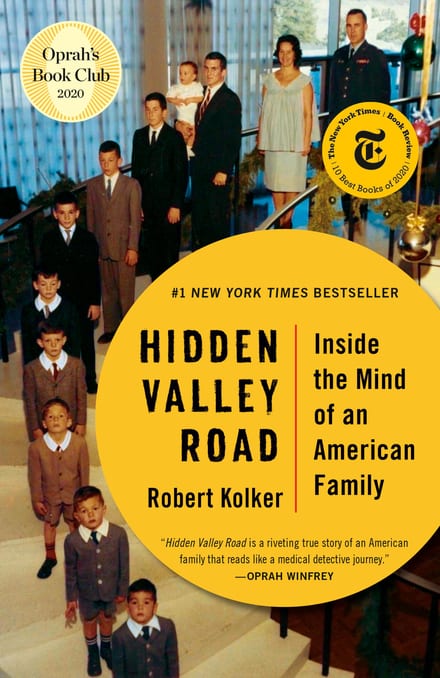
Hidden Valley Road: Inside the Mind of an American Family
The full book runs ~400 pages — roughly 7 hours of reading. You get the key ideas here in 5 minutes.
The key ideas
- Traces schizophrenia across six brothers in one Colorado family
- Debunks the mother-blaming 'schizophrenogenic' theory of the 1960s
- Reveals biology: enlarged ventricles, faulty sensory gating, missing α7 receptors
- Links SHANK gene mutations to a spectrum of mental illness
- Points to choline as a promising prenatal prevention
- Counts the human cost borne by the well siblings
The summary
Between the 1960s and the 1980s, six of the twelve Galvin children — all of them boys — developed schizophrenia. That single, staggering fact turned an ordinary Colorado family into one of the most important case studies in the history of mental illness. Robert Kolker tells two stories at once: how the Galvins’ shared DNA helped drag schizophrenia research away from decades of mother-blaming folklore and toward genetics and brain science, and how the healthy children paid for that contribution with childhoods and adult lives shaped entirely by the illness around them.
Twelve children, and then the unraveling
Mimi and Don Galvin married young, had twelve children in quick succession, and settled on Hidden Valley Road as Don built a career in the new Air Force. The first signs looked like ordinary adolescent trouble. The two oldest boys, Donald and Jim, brawled. Jim was expelled for sneaking into a jet. Donald smashed dishes and once jumped into a bonfire. It was easy to file all of it under teenage chaos — until Donald, after a relationship collapsed, admitted to a psychiatrist that he’d attempted suicide and killed a cat he couldn’t explain killing. The diagnosis was a “possible schizophrenic reaction.” At home he shouted that the CIA was shooting at him. Then Jim began hearing voices and compulsively switching stove burners on and off. When his wife reported it, his parents brushed her off and never mentioned Donald. The pattern would repeat until six brothers were ill.
The cost of keeping it quiet
In the 1960s, the reigning theory blamed the “schizophrenogenic mother” — a woman supposedly too cold or too smothering, either way at fault. That, plus the era’s brutal treatments of shock therapy, restraints, and heavy tranquilizers, made Mimi and Don refuse to commit their sons. So the sick brothers stayed home, and the household absorbed the consequences. Donald moved the furniture outside and lay naked reciting scripture. The two youngest sisters, Margaret and Mary, fled to their brother Jim’s house for relief, only for Jim to molest them when drunk; frightened and unsure, they kept it secret for years. In 1973 Brian, the fourth son, shot his girlfriend Noni and then himself. Two years later Don suffered a disabling stroke, and soon Peter, the youngest boy, began speaking gibberish and turning violent. Mary got out, escaping to a Connecticut boarding school and renaming herself Lindsay to start clean — though the family’s pull never quite let go.
From blaming mothers to reading brains
By the late 1970s, science was finally turning from parents toward biology. The neuropsychiatrist Richard Wyatt found that people with schizophrenia tended to have enlarged fluid-filled ventricles near the amygdala and hippocampus, and that larger ventricles tracked with drugs working less well. In 1984 the psychiatrist Lynn DeLisi began gathering genetic data from families with multiple cases, and the Galvins were close to ideal; Mimi provided blood from across the family. The pivotal insight came from Robert Freedman’s study of sensory gating — the brain’s ability to tune out a repeated stimulus. Most people react less to a sound the second time; people with schizophrenia react as though every time is the first. Freedman argued this same hypersensitivity explained the mathematician John Nash, who detected patterns no one else could and also feared enemies who weren’t there. Testing the Galvins, Freedman traced the problem to the brain’s α7 nicotinic receptor, of which people with schizophrenia have roughly half the normal number. Nicotine eased symptoms briefly; a drug called DMXBA worked better but went undeveloped once its patent neared expiry. Most promising, Freedman found that choline, a common nutrient, could switch on the gene that builds α7 receptors — leading to efforts to add it to prenatal vitamins, with encouraging early results.
What the family’s DNA revealed
DeLisi kept working the Galvin DNA for decades, even after a corporate buyout killed her funding and she had to rebuild the project with a new partner. Together they pinpointed a mutation in SHANK2, a gene governing communication between synapses, and their 2016 work tied the SHANK genes to a whole spectrum of conditions including autism and bipolar disorder. That reframed schizophrenia itself: less a single disease than a cluster of neurodevelopmental disorders. As the psychiatrist John McGrath put it, psychosis may be more like a fever — a symptom thrown off by many underlying illnesses — than a disease in its own right.
The bottom line
The Galvins gave science a genetic key to schizophrenia, but the payoff has come slowly: Jim and Joe died in their fifties from medication-related heart trouble, drug development stays sluggish, and prevention research remains starved of money. When DeLisi returned in 2016, it was Lindsay — the sister who ran the farthest — who had become the family’s caretaker, proof that we are never only our genes but also the people we’re raised among. Read this if you want a human, unflinching account of how one family’s private catastrophe reshaped our understanding of the mind.
Fact check
Popular books repeat findings that later research has complicated. Where Hidden Valley Road makes a testable claim, here's what the evidence actually shows.
People with schizophrenia have roughly half the normal number of α7 nicotinic receptors in the brain.
The finding rests on a 1995 postmortem study of eight schizophrenia brains and eight age-matched controls, in which α-bungarotoxin binding in the hippocampus was significantly lower and seven of the eight patients fell below the control range. It has not replicated cleanly: a 2011 autoradiography study of temporal-lobe tissue could not reproduce the decrease in schizophrenia, and instead found binding raised in bipolar disorder. The α7 receptor remains a serious lead in sensory-gating research, but the specific shortfall is a small-sample result rather than a settled measurement.
- Freedman R, Hall M, Adler LE, Leonard S. Evidence in postmortem brain tissue for decreased numbers of hippocampal nicotinic receptors in schizophrenia. Biol Psychiatry. 1995;38(1):22-33. PubMed
- Thomsen MS, Weyn A, Mikkelsen JD. Hippocampal α7 nicotinic acetylcholine receptor levels in patients with schizophrenia, bipolar disorder, or major depressive disorder. Bipolar Disord. 2011;13(7-8):701-707. PubMed
Choline taken during pregnancy improves infants' sensory gating and could prevent schizophrenia later in life.
The gating half is real. In a placebo-controlled trial of 100 pregnant women given phosphatidylcholine from the second trimester, 76% of treated infants suppressed the second P50 response at five weeks versus 43% on placebo (effect size 0.7) — though the difference was gone by week 13. A follow-up of the same children at 40 months found fewer attention problems and less social withdrawal, but with only 23 and 26 children per arm. No trial has followed these children into the age range when schizophrenia appears, so prevention is a hypothesis the biomarker supports, not a demonstrated result.
- Ross RG, Hunter SK, McCarthy L, et al. Perinatal choline effects on neonatal pathophysiology related to later schizophrenia risk. Am J Psychiatry. 2013;170(3):290-298. PubMed
- Ross RG, Hunter SK, Hoffman MC, et al. Perinatal phosphatidylcholine supplementation and early childhood behavior problems: evidence for CHRNA7 moderation. Am J Psychiatry. 2016;173(5):509-516. PubMed
A SHANK2 mutation found through the family's DNA ties schizophrenia, autism and bipolar disorder into a single spectrum of neurodevelopmental illness.
The SHANK2 result is one variant in one family. Whole genomes of 90 people across nine multiplex families turned up a novel private missense SHANK2 variant carried by seven siblings with schizophrenia-spectrum disorders; the authors present it as a candidate for further work, not an established cause. The largest test since — exomes from 24,248 people with schizophrenia and 97,322 controls — implicated ten genes at exome-wide significance (SETD1A, CUL1, XPO7, TRIO, CACNA1G, SP4, GRIA3, GRIN2A, HERC1, RB1CC1), and SHANK2 was not among them. The wider point survives: that same study found rare-variant risk overlapping across schizophrenia, autism, epilepsy and severe neurodevelopmental disorders.
- Homann OR, Misura K, Lamas E, et al. Whole-genome sequencing in multiplex families with psychoses reveals mutations in the SHANK2 and SMARCA1 genes segregating with illness. Mol Psychiatry. 2016;21(12):1690-1695. PubMed
- Singh T, Poterba T, Curtis D, et al. Rare coding variants in ten genes confer substantial risk for schizophrenia. Nature. 2022;604(7906):509-516. PubMed
Enlarged brain ventricles are a real physical marker of schizophrenia.
This is among the most consistently replicated structural findings in the illness. A meta-analysis of 39 studies of the ventricle-to-brain ratio called the difference between patients and controls an indisputable characteristic of schizophrenia — while adding that it is smaller than early reports suggested and too small to be useful for diagnosis or for telling subtypes apart. A later meta-analysis of 13 longitudinal MRI studies found the ventricles keep enlarging after illness onset faster than in controls (effect size 0.45, 95% CI 0.19-0.71).
- Van Horn JD, McManus IC. Ventricular enlargement in schizophrenia. A meta-analysis of studies of the ventricle:brain ratio (VBR). Br J Psychiatry. 1992;160:687-697. PubMed
- Kempton MJ, Stahl D, Williams SC, DeLisi LE. Progressive lateral ventricular enlargement in schizophrenia: a meta-analysis of longitudinal MRI studies. Schizophr Res. 2010;120(1-3):54-62. PubMed
Frequently asked questions
What is Hidden Valley Road about?
Robert Kolker tells the true story of the Galvin family, in which six of twelve children, all boys, developed schizophrenia between the 1960s and 1980s. He interweaves two threads: how the family's shared DNA helped pull schizophrenia research away from decades of mother-blaming and toward genetics and brain science, and how the healthy siblings paid for that contribution with lives shaped entirely by the illness around them.
What are the key takeaways from Hidden Valley Road?
The book traces the shift from the cruel "schizophrenogenic mother" theory to biological understanding, through Richard Wyatt's finding of enlarged brain ventricles, Lynn DeLisi's decades of genetic work, and Robert Freedman's research on sensory gating and the α7 nicotinic receptor, which pointed to choline as a possible preventive. It shows the human cost of keeping mental illness secret, the abuse and trauma the well siblings absorbed, and reframes schizophrenia itself as less a single disease than a cluster of neurodevelopmental disorders, with the SHANK2 gene linking it to autism and bipolar disorder.
Who should read Hidden Valley Road?
Read it if you want a human, unflinching account of how one family's private catastrophe reshaped our understanding of the mind. It suits readers drawn to both intimate family stories and the science of mental illness.
Is Hidden Valley Road worth reading?
It does something rare, braiding rigorous medical history with a deeply personal family saga so neither feels dry nor sensational. The subject matter is heavy, abuse, suicide, and untreated psychosis run through it, so it's a hard read emotionally, and the scientific payoff it chronicles has come slowly, but that honesty is part of its power.