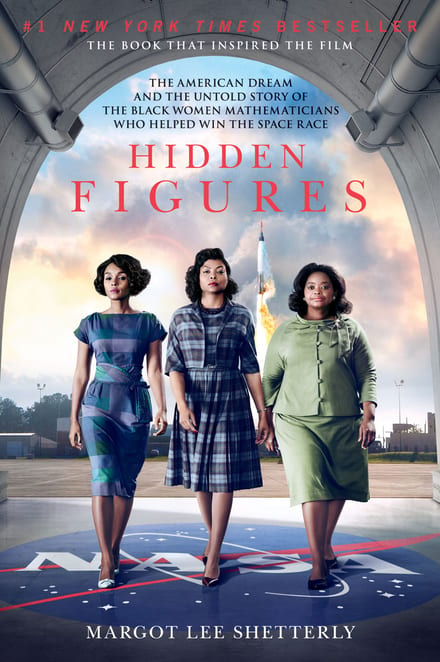
Book summary
Hidden Figures: The American Dream and the Untold Story of the Black Women Mathematicians Who Helped Win the Space Race
The American Dream and the Untold Story of the Black Women Mathematicians Who Helped Win the Space Race
The full book runs ~368 pages — roughly 7 hours of reading. You get the key ideas here in 5 minutes.
The key ideas
- Hired women to do arithmetic from 1935, explicitly for lower pay
- Opened the door through Executive Order 8802, not through enlightenment
- Segregated the West Computers into their own office across campus
- Cost Dorothy Vaughan her supervisor job when the unit dissolved
- Sent Mary Jackson to petition a city for classroom access
- Corrects the 2016 film: no Al Harrison, no crowbar scene
The summary
This is not four biographies with a space program attached. Shetterly’s argument is that the American space effort ran on a job category — computer, meaning a person who did arithmetic for a living — and that wartime pressure pushed Black women into it in numbers nobody afterward bothered to count. Get the category right and the four careers stop reading as miracles. They read as what happens when a door opens six inches and people already qualified walk through it.
“Computer” was a job title
Langley Memorial Aeronautical Laboratory started hiring women to crunch numbers in 1935 — before the war, before rockets, before NASA existed. Wind-tunnel tests threw off arrays of data somebody had to reduce by hand on Friden adding machines. On Shetterly’s account the reasoning was stated openly: women were thought more detail-oriented, their smaller hands better suited to repetitive work, and “a ‘girl’ could be paid significantly less than a man for doing the same job.” Freed from the arithmetic, male engineers could do the part classified as thinking. Nobody knows how many held the job — an early study of the Langley computers put the total in the several hundreds, and Shetterly’s own estimate runs to the thousands.
The opening for Black women came from politics, not enlightenment. Pressed by labor and civil rights leaders, chiefly A. Philip Randolph, Franklin Roosevelt signed Executive Order 8802 on 25 June 1941, barring discrimination by race, creed, color or national origin in defense work and government. On the ground that looked like a help-wanted ad: Langley advertised in Norfolk’s Journal and Guide, a Black newspaper, for machine shop workers, laborers, janitors — and African American women with mathematics degrees. The women who answered were mostly top graduates of historically Black colleges. They did the same work as the white computers hired alongside them, in a separate office on the west side of campus — hence the West Computers.
The segregation was paperwork, and so was its end
Jim Crow at Langley was administered rather than merely felt. White computers could live in the Anne Wythe Hall dormitory; Black computers found their own housing. NASA’s own history has Miriam Mann, one of the West Computers, finding a “colored” sign on the tables at the rear of the cafeteria. Shetterly’s telling goes further: the sign read COLORED COMPUTERS, and Mann took it — into her purse, again and again, until it stopped coming back.
The unit died by memo: on 5 May 1958 NACA associate director Floyd L. Thompson signed the order dissolving West Area Computing, and ten women were absorbed into existing program offices. Sit with what that cost Dorothy Vaughan. Hired in December 1943 and promoted in 1949 to run the unit — the NACA’s first Black supervisor — she lost that job when the unit went. She became an expert FORTRAN programmer and worked on the Scout launch vehicle program, but by NASA’s own account sought and never got another management post before retiring in 1971.
Out of the pool, one at a time
Mary Jackson was hired in April 1951 and, two years later, offered work with engineer Kazimierz Czarnecki in the Supersonic Pressure Tunnel. The promotion path ran through University of Virginia courses taught at the then-segregated Hampton High School, so she had to ask the City of Hampton for permission to sit with her white colleagues. Shetterly’s framing is unsentimental: a woman trying to make herself more useful to her country had to petition a segregating city for permission to learn. She got the promotion in 1958 and became NASA’s first Black female engineer — by NASA’s reckoning, possibly the only one in the field that decade.
Katherine Johnson arrived in June 1953 and was loaned to the Flight Research Division within two weeks. Told that women did not sit in on the engineers’ briefings, she asked whether there was a law against it. In 1960 she and Ted Skopinski coauthored the report on placing a satellite over a chosen point on Earth — the first time a woman in that division got author credit. Before John Glenn’s Friendship 7 flight on 20 February 1962, with the trajectory equations already loaded into IBM machines, his preflight checklist had Johnson rerun the numbers by hand. “If she says they’re good,” she remembered him saying, “then I’m ready to go.”
Christine Darden came to Langley in 1967 as one of the last of the human-computer generation, and eventually asked her supervisor why men with the same master’s in applied mathematics were hired as engineers while she sat in the pool. She was moved to engineering, handed sonic boom as a first assignment, and became the first African American woman at Langley to reach the Senior Executive Service.
What the movie made up
The 2016 film is a good film and a poor source. Shetterly has said the book is historically accurate and that the filmmakers, building everything around Glenn’s flight, had to collapse timelines and deflate characters.
Three specifics. Al Harrison, Kevin Costner’s boss, does not exist — a composite standing in for the men who actually ran the Space Task Group. That group was run by Robert Gilruth. The scene where Harrison takes a crowbar to a “colored” bathroom sign never happened; Theodore Melfi’s defense was that somebody in the story needed to do the right thing. And the bathroom problem was mostly Mary Jackson’s, not Johnson’s — Johnson’s documented response was to ignore the arrangement and use the white restroom.
The bottom line
Shetterly’s case is that these women were not exceptions to a system but products of one — a labor category, a wartime order, and a Black professional middle class that already existed, unrecorded. The heroism is real; the point is that it was also ordinary, repeatable, and thrown away for decades because nobody wrote it down.
Read it if you want the history rather than the movie, or if you work anywhere that quietly decides which job titles count as thinking.
Fact check
Popular books repeat findings that later research has complicated. Where Hidden Figures makes a testable claim, here's what the evidence actually shows.
The 2016 film is a faithful record of the events in Shetterly's book — most memorably, that a white supervisor desegregated Langley's bathrooms by taking a crowbar to a "colored" sign.
Director Theodore Melfi told Vice he invented that scene, defending it on the grounds that "there needs to be white people who do the right thing." Katherine Johnson's own account was the opposite of rescue: asked about the segregated restrooms she said, "I just went on in the white one." Costner's Al Harrison is not a historical person either — the Space Task Group was headed by Robert R. Gilruth, named project manager when NASA established the group at Langley in 1958. Shetterly has said the book itself is "100 percent historically accurate" and that the filmmakers, by building the story around John Glenn's flight, "had to collapse some of the timelines and deflate some of the characters."
Langley's segregated West Area Computing unit was ended by administrative paperwork in 1958, not by any confrontation, and its supervisor Dorothy Vaughan lost her management job with it.
The memo survives. On 5 May 1958 NACA associate director Floyd L. Thompson circulated an order dissolving the West Area Computers Unit and listing the reassignments of its ten remaining women — Dorothy J. Vaughan among them — to branches including Gas Dynamics, Supersonic Tunnels and Analytical Computing. Vaughan had run the unit since her 1949 promotion, which made her the NACA's first Black supervisor; NASA's own biography records that she sought but never received another management position, becoming an expert FORTRAN programmer and working on the Scout Launch Vehicle Program before retiring in 1971.
A sign reading COLORED COMPUTERS marked the West Computers' table in the Langley cafeteria, and Miriam Mann removed it again and again until it stopped reappearing.
The setting is documented; the anecdote rests on one teller. NASA's history of the Langley computers, drawing on an account written by Mann's daughter, records that Mann "found a 'colored' sign on tables in the rear of the cafeteria and restrooms designated 'colored girls.'" The sign's exact wording and the repeated removals come from Shetterly's reporting rather than from any surviving record — Smithsonian magazine's retelling quotes her directly on it ("That was incredible courage"). No archival document of the sign has surfaced, so the story stands or falls on Shetterly's interviews with the families.
John Glenn would not fly until Katherine Johnson had checked the computer's trajectory numbers by hand, and she was the first woman in her division credited as an author of a research report.
Both hold up in NASA's own records. As part of the preflight checklist for the February 1962 Friendship 7 mission, Glenn asked engineers to have Johnson rerun by hand the same equations that had been programmed into the IBM machines — "If she says they're good," she remembered him saying, "then I'm ready to go." The 1960 report she coauthored with Ted Skopinski, Determination of Azimuth Angle at Burnout for Placing a Satellite Over a Selected Earth Position, was the first time a woman in the Flight Research Division received author credit. One detail the film adds: Johnson was not in Mission Control for the launch — by her own account she watched the transmission from her desk.
Frequently asked questions
What is Hidden Figures about?
Shetterly's argument is that the American space effort ran on a job category — computer, meaning a person who did arithmetic for a living — and that wartime pressure pushed Black women into it in numbers nobody afterward counted. It follows Dorothy Vaughan, Mary Jackson, Katherine Johnson and Christine Darden at Langley. Get the category right and their careers stop reading as miracles: they read as what happens when a door opens six inches and people already qualified walk through.
What are the key takeaways from Hidden Figures?
Langley began hiring women as computers in 1935, on reasoning stated openly at the time — including that a "girl" could be paid significantly less than a man for the same work. The opening for Black women came from politics: Executive Order 8802, signed 25 June 1941, barred discrimination in defense work, and Langley advertised in a Black newspaper for women with mathematics degrees. Segregation there was administered on paper — a COLORED COMPUTERS sign that Miriam Mann kept removing — and ended the same way, by a 1958 memo dissolving West Area Computing, which cost Dorothy Vaughan the supervisor role she had held since 1949. Individual careers followed: Mary Jackson petitioned the City of Hampton to attend courses at a segregated high school, and Katherine Johnson rechecked the Friendship 7 trajectory by hand at John Glenn's request.
Who should read Hidden Figures?
Read it if you want the history rather than the 2016 film, or if you work anywhere that quietly decides which job titles count as thinking. It rewards readers interested in how labor categories, not just individual brilliance, shape who gets credited.
Is Hidden Figures worth reading?
It is worth reading precisely if you have seen the movie, which Shetterly herself describes as collapsing timelines and deflating characters. Al Harrison, Kevin Costner's boss, is a composite who did not exist — the Space Task Group was run by Robert Gilruth — and the scene where he takes a crowbar to a "colored" bathroom sign never happened. The book's case is quieter and harder: these women were products of a system, not exceptions to one, and the record was thrown away for decades because nobody wrote it down.