Book summary
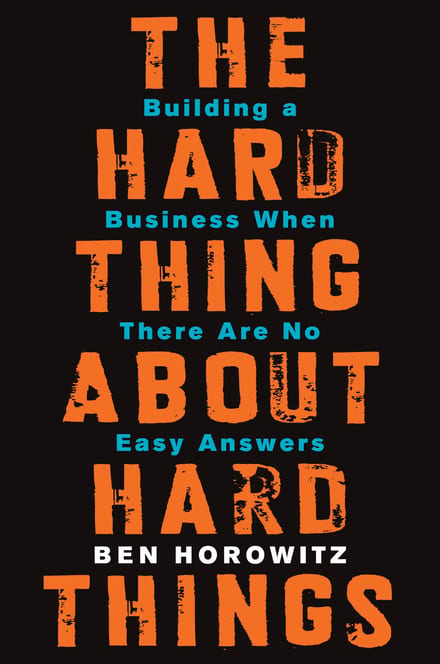
The Hard Thing About Hard Things: Building a Business When There Are No Easy Answers
The full book runs ~145 pages — roughly 3 hours of reading. You get the key ideas here in 4 minutes.
The key ideas
- Embrace The Struggle; it reveals what you're made of.
- Tell hard truths early; transparency builds two-way trust.
- Handle layoffs fast, honestly, and generously—own the failure.
- Hire for present strengths, not imagined future needs.
- Switch between peacetime creativity and wartime decisiveness.
- Take care of people, products, profits—in that order.
The summary
Building a company sounds like a game of vision and strategy. In practice, Ben Horowitz says, it’s mostly the opposite: making one ugly decision after another when every option is bad. You lay off people who trusted you. You demote a friend who helped build the place. You stand in front of the team and explain why the dream just became a nightmare. Horowitz co-founded Loudcloud with Marc Andreessen during the dot-com bubble, nearly went bankrupt, and clawed his way to selling the reborn company — Opsware — to Hewlett-Packard for $1.65 billion. His verdict on what separates the founders who survive: not brilliance, but the refusal to quit.
The Struggle is the job
Every founder starts with the same fantasy — build something world-changing, get rich, change lives. Then reality arrives. Horowitz names the collision The Struggle, and he describes it precisely: “The hard thing isn’t setting a big, hairy, audacious goal. The hard thing is laying people off when you miss the big goal… The hard thing is waking up in the middle of the night in a cold sweat when the dream turns into a nightmare.” Great hires turn entitled. The org chart you carefully drew becomes a communication mess. The macro (a market crash) and the micro (a bad hire) both come for you.
Horowitz lived it. When the bubble burst and funding vanished, he took Loudcloud public despite it being nowhere near ready, because going public was the only source of cash left. Then came 9/11 and the edge of bankruptcy. He sold off the cloud business Loudcloud was named for and bet everything on its buggy internal software, Opsware. That’s the wartime CEO in action: survival over optics. He shipped Opsware with its flaws to learn from the real world, then saved a make-or-break contract by offering a client value beyond what the product was built to do. His answer to the psychological weight is the racecar driver’s trick — don’t stare at the wall you might hit, focus on the road ahead.
Tell the truth early, especially about layoffs
Hiding bad news from your team is poison. Horowitz calls the opposite instinct “positivity delusion” — the belief that employees need shielding from hard realities. They don’t. Transparency breeds trust, and telling people the truth before rumors metastasize builds a culture where honesty runs both directions.
Nowhere is this tested like a layoff. Announce it immediately; delay only breeds anxiety and speculation. Own the failure — the company missed its goals, and that’s on leadership, not the people being let go. Treat the departing well, with generous severance and honest references, because it’s right and because you’ll want to hire again someday. But never dress it up. As Horowitz puts it, “If you are going to eat sh*t, don’t nibble.” And never berate anyone in public. In the end, stakeholders don’t care how hard you tried or what the choices cost you. Excuses are irrelevant; results are everything.
Hire for right now, and give real feedback
People are your only real asset, but hiring is a minefield. Horowitz’s rule is to hire for strengths, not the absence of weaknesses — find someone exceptional at the thing you most need, even with rough edges elsewhere. And hire for today’s problem, not an imagined future one. Bringing in a big-company executive too early invites two dangerous mismatches: a rhythm mismatch, where they wait for instructions instead of taking initiative, and a skillset mismatch, where they’re expert at running a large organization but helpless at building from nothing.
Even brilliant people need training — “a lot of companies think their employees are so smart that they require no training. That’s silly.” Set clear expectations, and remember that “sometimes an organization doesn’t need a solution; it just needs clarity.” Give feedback straight; the “shit sandwich,” where you bury criticism between two compliments, reads as insincere to anyone senior. Screen for team-oriented ambition so you don’t hire selfish climbers, and use precise titles and promotion criteria to hold politics down. Above all: “Take care of the people, the products, and the profits — in that order.”
Peacetime and wartime need different leaders
Companies live in two very different climates. In peacetime, you’re extending a lead and can afford to nurture creativity — think of Google letting engineers spend 20 percent of their time on side projects that sometimes became real products. In wartime, you’re fighting for survival and have to move fast and decisively, the way Andy Grove saved Intel by pivoting from memory chips to microprocessors when the company faced extinction. Horowitz spent years in wartime, and it demanded bluntness and speed over consensus.
Great CEOs, he insists, are made, not born. They do two things well: they find the right direction and get everyone to follow it, through a clear vision, authentic communication, and decisive execution. Some are “Ones,” who love setting direction, and some are “Twos,” who excel at execution; the best build the muscles they lack. When Horowitz asks successful CEOs how they did it, the mediocre ones credit their strategic genius. The great ones all say the same three words: “I didn’t quit.”
The bottom line
The hard thing about hard things is that there’s no formula — just you, the problem, and a set of bad options, where the only skill that reliably matters is making the best move when there are no good ones. Read this if you’re building something and need to hear that survival, not genius, is the real win.
Frequently asked questions
What is The Hard Thing About Hard Things about?
Ben Horowitz strips away the vision-and-strategy fantasy of running a company and describes what building one actually feels like: making one ugly decision after another when every option is bad. Drawing on nearly going bankrupt with Loudcloud before selling the reborn Opsware to HP for $1.65 billion, he argues that what separates founders who survive isn't brilliance but the refusal to quit.
What are the key takeaways from The Hard Thing About Hard Things?
Horowitz names "The Struggle," the grinding reality of layoffs, cold-sweat nights, and dreams turning into nightmares, and prescribes brutal honesty: announce layoffs immediately, own the failure as leadership's, and never dress it up ("if you are going to eat sh*t, don't nibble"). Hire for strengths and today's problem, not the absence of weaknesses or an imagined future, and give straight feedback rather than a "shit sandwich." He distinguishes peacetime CEOs who nurture creativity from wartime CEOs who move fast for survival, and insists great CEOs are made, not born, their common trait being simply "I didn't quit."
Who should read The Hard Thing About Hard Things?
Read it if you're building something and need to hear that survival, not genius, is the real win. It speaks most directly to founders and executives facing the messy, no-good-options decisions that startup advice usually skips.
Is The Hard Thing About Hard Things worth reading?
Its honesty is the draw: instead of tidy formulas it offers hard-won, specific advice from someone who lived through near-collapse, which makes it more useful than most polished management books. The flip side is that Horowitz openly says there's no formula, so readers wanting a repeatable playbook will leave with grit and judgment rather than a checklist.