Book summary
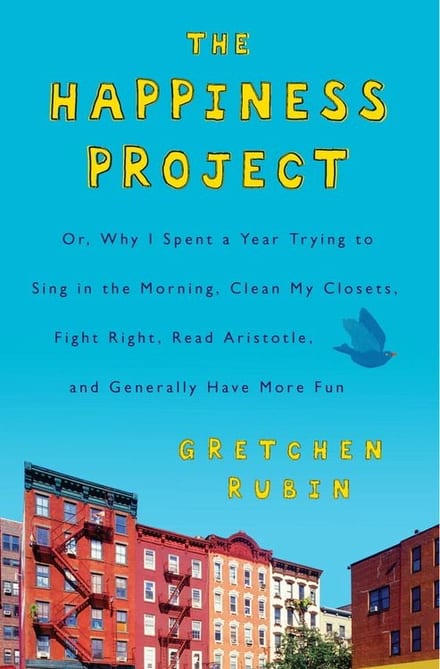
The Happiness Project
The full book runs ~336 pages — roughly 6 hours of reading. You get the key ideas here in 4 minutes.
The key ideas
- Build energy first: sleep, exercise, and decluttering fuel every mood.
- Improve marriage by changing yourself, not your partner.
- Act happy to become happy—behavior shapes emotion.
- Schedule friendship; generosity rewards giver as much as receiver.
- Spend consciously: money removes misery but never buys lasting joy.
- Practice gratitude and mindfulness to sharpen the present moment.
The summary
Happiness doesn’t arrive in a flash of insight or a dramatic life change. It accrues through unglamorous maintenance — getting enough sleep, clearing a cluttered drawer, swallowing a complaint, actually showing up for a friend. Gretchen Rubin spent a year testing that premise, assigning each month to a different corner of life and tracking whether small, deliberate tweaks to her behavior actually moved her mood. What she found backs up Aristotle’s old claim that happiness is the “chief good,” while puncturing the fantasy that we simply fall into it. You build it, one habit at a time. And often, she discovered, it’s your own choices — complaining, hoarding, gossiping — that are quietly making you unhappy.
Energy comes first
When you’re depleted, everything feels heavier and nothing appeals. Rubin treated energy as the foundation the rest of the year would rest on: sleep, movement, and diet aren’t virtuous chores but the plumbing of a decent mood. Skimp on sleep and your metabolism and immune system suffer; get light and activity and you nudge up the brain’s supply of serotonin and dopamine. She kept a food diary not to shed weight but to notice which meals left her sharp and which left her sluggish, and the noticing alone shifted what she reached for.
She also cleared clutter, physical and mental. Throwing out what she didn’t need and crossing stale tasks off the list produced a jolt of relief far larger than the effort involved. It wasn’t about perfectionism — it was about reclaiming bandwidth. When your surroundings and your to-do list stop nagging, you have more room for what actually matters.
The marriage rule: change yourself, not your partner
Rubin’s husband didn’t reform during her project. She did. She cut back on complaints, quit dumping her bad moods on him, and made herself more agreeable — not as a performance but as a practice. Two rules anchored the shift: you can’t change your partner, only yourself; and what you do every day counts for more than the occasional grand gesture. The French writer Pierre Reverdy said there’s no such thing as love, only proofs of love, and small, frequent kindnesses with no scorekeeping made both of them happier.
There’s arithmetic behind it, too. Negative acts land harder than positive ones — it takes roughly five kind gestures to offset a single sharp one. So she stopped fixating on her husband’s minor faults, examined her own behavior instead, and refused to take him for granted. The point wasn’t self-sacrifice. It was noticing that her irritation was frequently a choice, and choosing otherwise simply felt better.
Act happy to become happy
With her two daughters, Rubin resolved to be more tender and playful. She reined in her outbursts, hunted for humor in everyday chaos, and acknowledged their feelings — “I know this is tough” — rather than brushing them off. She committed to the time-consuming projects she’d been skipping as inefficient: long games, messy arts and crafts.
The payoff wasn’t just calmer kids. Time spent playing with them dropped her stress and dissolved the low guilt that she was a cold mother. And it pointed to a wider principle she leaned on all year: when you act happy, you tend to become happy. Behavior shapes emotion more reliably than the other way around. Smiling when you don’t feel like it can lift your mood; showing up cheerfully for people you love makes you feel more cheerful yourself.
Friendship, generosity, work, and money
Rubin noticed she felt guilty about neglecting friends yet rarely made the time — so she scheduled it. She helped a friend clean out a closet, started a children’s-literature reading group, and made small kindnesses routine. Generosity paid her back as much as the recipient: the surest way to be happy is to make others happy, and the surest way to make others happy is to be happy yourself.
Work mattered because it supplies connection, growth, recognition, and a sense of value, and the happiest moments came from small wins — finishing a piece, cracking a problem — rather than some distant summit. Money, like health, doesn’t manufacture happiness; it just removes a major source of misery. Since new purchases give only a brief lift before you adapt back to baseline, she allowed herself modest splurges that added real value and steered clear of the clutter-breeding kind. Conscious spending beat both deprivation and mindless accumulation.
Eternity and gratitude sharpen the present
Spiritual people, studies suggest, are happier and steadier under stress, and though Rubin isn’t religious she found meaning in contemplating death and impermanence. She kept a one-sentence daily diary, updated her will, and slipped short meditations into idle moments like waiting for a bus. A gratitude notebook made her register the day’s best moments, which made those moments feel more real. Mindfulness — attending to the present instead of rerunning the past or rehearsing the future — helped her catch an emotional spiral before it became an outburst. Even a laughter-yoga class and hypnosis tapes earned their keep by widening her sense of what actually lifted her.
The bottom line
Happiness turns out to hinge less on what happens to you than on what you do daily: sleep enough, complain less, show up for people, and act the way you want to feel. Read this if your life looks fine on paper but you suspect you’re not enjoying it nearly as much as you could.
Fact check
Popular books repeat findings that later research has complicated. Where The Happiness Project makes a testable claim, here's what the evidence actually shows.
It takes roughly five kind gestures to cancel out a single sharp one in a marriage.
The asymmetry is real — negative exchanges do weigh more than positive ones — but the 5:1 figure is a rule of thumb from small lab samples, not a measured constant. It descends from a four-year study of 73 couples in which "regulated" couples, whose positive speech acts consistently outnumbered negative ones, ended up with better satisfaction, health and marital survival. The strong prediction claims later built on that work did not survive scrutiny: a reanalysis showed accuracy and predictive value "drops precipitously" once the equations were cross-validated instead of tested on the sample that produced them.
Acting happy makes you happy — smiling when you don't feel like it lifts your mood.
It depends heavily on how you make the face. A 17-lab registered replication of the classic pen-in-mouth study found cartoons rated just 0.03 units funnier when participants held the pen in a smile position (95% CI -0.11 to 0.16) — no detectable effect. A later 19-country study of 3,878 people found that deliberately posing a smile or mimicking a smiling face did amplify and even initiate feelings of happiness, while the unobtrusive pen-in-mouth method again gave inconclusive results. Deliberately acting cheerful looks defensible; the specific covert-smile finding does not.
- Acosta A, Adams RB Jr, Albohn DN, et al. Registered Replication Report: Strack, Martin, & Stepper (1988). Perspect Psychol Sci. 2016;11(6):917-928. PubMed
- Coles NA, March DS, Marmolejo-Ramos F, et al. A multi-lab test of the facial feedback hypothesis by the Many Smiles Collaboration. Nat Hum Behav. 2022;6(12):1731-1742. PubMed
Spiritual and religious people are happier and hold up better under stress.
The association is far smaller than the popular version, and depends on which kind of religiosity you measure. Pooling 67 German-language studies gave a weighted average correlation of just .03 (95% CI .01 to .05) between religiosity/spirituality and mental health. Negative religious struggle — feeling punished or abandoned — showed a much stronger link in the opposite direction (r = -.20), and the authors note that effects in US samples run larger, which points to cultural context rather than a universal benefit.
- Hodapp B, Zwingmann C. Religiosity/Spirituality and Mental Health: A Meta-analysis of Studies from the German-Speaking Area. J Relig Health. 2019;58(6):1970-1998. PubMed
Money removes a major source of misery but doesn't manufacture happiness.
This was the standard finding for a decade: an analysis of more than 450,000 Gallup responses reported that day-to-day emotional wellbeing stopped improving above roughly $75,000 a year while life evaluation kept rising with log income. An adversarial collaboration between the original authors and their critic later revised it. Re-examining experience-sampling data, they found the flattening holds only for the least happy people; for everyone else happiness keeps climbing with log income, and accelerates in the happiest group. So the plateau Rubin describes is real for some, but not the general rule.
- Kahneman D, Deaton A. High income improves evaluation of life but not emotional well-being. Proc Natl Acad Sci U S A. 2010;107(38):16489-93. PubMed
- Killingsworth MA, Kahneman D, Mellers B. Income and emotional well-being: A conflict resolved. Proc Natl Acad Sci U S A. 2023;120(10):e2208661120. PubMed
Frequently asked questions
What is The Happiness Project about?
Gretchen Rubin spent a year testing the premise that happiness doesn't arrive in a flash but accrues through unglamorous daily maintenance, getting enough sleep, clearing clutter, complaining less, showing up for people. She assigned each month to a different corner of life and tracked whether small, deliberate behavior tweaks actually moved her mood, finding that you build happiness one habit at a time.
What are the key takeaways from The Happiness Project?
Energy comes first, sleep, movement, and clearing physical and mental clutter are the foundation everything else rests on. In marriage, change yourself, not your partner, and remember negative acts land harder, it takes roughly five kind gestures to offset one sharp one. "Act the way you want to feel": behavior shapes emotion, so acting happy tends to make you happy. And generosity, scheduled friendship, small work wins, and conscious spending all lift mood, while gratitude and mindfulness help you notice and hold onto good moments.
Who should read The Happiness Project?
Read it if your life looks fine on paper but you suspect you're not enjoying it nearly as much as you could. It's for people who don't need a dramatic overhaul, just a nudge to fix the small daily habits quietly dragging them down.
Is The Happiness Project worth reading?
Its charm and usefulness come from being a concrete, month-by-month experiment rather than abstract theory, with tactics you can copy directly. Because it's one privileged New Yorker's personal year, some resolutions won't map onto very different lives, but the underlying principle, happiness hinges on what you do daily, travels well.