Book summary
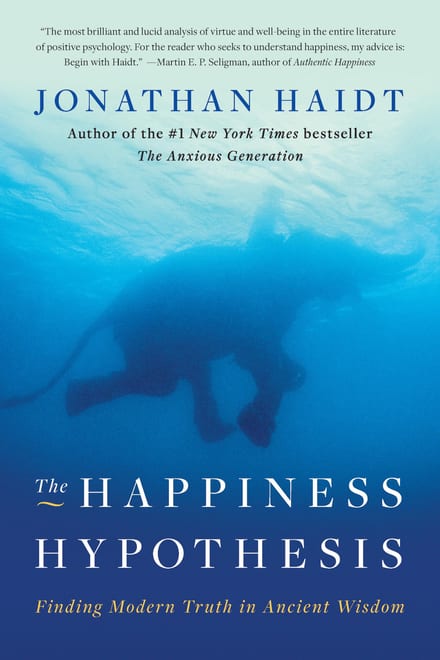
The Happiness Hypothesis
Finding Modern Truth in Ancient Wisdom
The full book runs ~317 pages — roughly 6 hours of reading. You get the key ideas here in 5 minutes.
The key ideas
- Picture the mind as an emotional elephant and rational rider.
- Retrain intuition through meditation and therapy, not willpower.
- Beat the hedonic treadmill by chasing progress, not arrival.
- Prioritize relationships as happiness's single most powerful condition.
- Grow through adversity by finding meaning in your struggles.
- Get three relationships right: people, work, something larger.
The summary
You feel like you’re steering your life, but you mostly aren’t. Your conscious reasoning is a small rider perched on a large elephant — the automatic, emotional, intuitive part of your mind — and when the elephant truly wants something, the rider has no chance. Jonathan Haidt uses this image to explain why resolutions fail, why you know what’s right yet do what’s wrong, and why moral arguments almost never change anyone’s mind. The elephant decides on gut feeling, and the rider hurries to invent reasons for the decision after the fact.
The division runs through the whole mind. The body acts partly on its own. The left brain constantly manufactures explanations for things it didn’t decide. The newer reasoning centers never took full command of the older emotional ones. And the automatic system runs nonstop while willpower — the rider’s only real tool — is a limited resource that drains fast. That’s why the Marshmallow Test predicted success: the children who waited weren’t just gritting their teeth, they were using tricks that changed what the elephant wanted, like looking away or imagining the treat as something else. Lasting change comes from training the elephant, through meditation, cognitive therapy, and sometimes medication — not from lecturing it.
Your brain leans negative by design
Evolution built you with a strong negativity bias. The amygdala fires a fear response to threats before your conscious mind even registers them, because the ancestors who overreacted to a rustle in the grass lived longer than the ones who shrugged. Your baseline mood, what Haidt calls your affective style, is largely genetic, tied to the balance of activity between the right and left frontal cortex. But it isn’t fixed; the same methods that work on the elephant can shift it over time.
Haidt condenses the research into a formula: H = S + C + V, happiness equals your biological setpoint plus your conditions plus your voluntary activities. You can’t easily move the setpoint, but conditions and activities give you more room to work than you’d expect. Chronic noise, long commutes, and a lack of control genuinely erode happiness — and above all, so does the state of your relationships.
We’re built for reciprocity and self-deception
Humans didn’t come to dominate through raw individual intelligence but through cooperation with strangers, enforced by tit-for-tat and policed by the emotions of gratitude and vengeance. Language supercharged this by enabling gossip, which tracks reputations and exposes cheats. Gossip, Haidt writes, is both policeman and teacher. But the same reciprocity reflex makes us easy to manipulate: a Hare Krishna pressing an unsolicited flower into your hand creates a sense of obligation, and a concession tends to trigger a concession in return.
We’re also natural hypocrites, sharp at spotting other people’s faults and blind to our own — most people rate themselves above average, and in experiments people try to look fair while cheating when they think no one is watching. The rider’s job is not to find the truth but to justify whatever the elephant already felt. This breeds naive realism, the conviction that we see reality plainly while everyone who disagrees must be biased. It’s why the worst cruelty tends to come not from greed or sadism but from moral idealism and threatened self-esteem.
Progress beats arrival
Most pleasure comes from making progress toward a goal, not from reaching it — the progress principle. Worse, the adaptation principle means you drift back to your baseline after almost any change. Lottery winners and people newly paralyzed both return near their old happiness within months. You’re on a hedonic treadmill, so accumulating wealth mostly raises your expectations and leaves you no better off. The ancient claim that happiness comes only from within is half right: changing your mind often beats changing your circumstances, but some external conditions still matter. Strong relationships matter enormously. Activities that produce gratifications — states of flow that draw on your strengths — outlast simple pleasures like food or luxury goods, which fade through adaptation and social comparison.
Love moves through stages, too. Passionate love is an intense, drug-like state destined to cool; companionate love, the deep affection built from a shared life, is what sustains a happy marriage. Strong social bonds strengthen the immune system, lengthen life, and lower depression, while isolation raises the risk of suicide.
Adversity, virtue, and three relationships
Trauma isn’t purely destructive. Research on post-traumatic growth finds that people who endure tragedy often report three gains: hidden strengths revealed, real friendships clarified, and priorities reordered toward people over things. Making sense of the ordeal is the key — writing about a trauma for a few days improves health not through catharsis but by helping you find meaning. Wisdom, in the end, is balancing your needs against others’ and knowing when to change yourself, change your situation, or leave. Six virtues recur across cultures — wisdom, courage, humanity, justice, temperance, transcendence — and virtue tends to pay its own way, since altruistic acts themselves produce happiness.
The bottom line
Lasting happiness comes from getting three relationships right: with other people, with your work, and with something larger than yourself — and from training the elephant rather than commanding it. Read this if you want to understand why you do what you do, and you’re open to the idea that ancient wisdom and modern psychology each hold part of the answer.
Fact check
Popular books repeat findings that later research has complicated. Where The Happiness Hypothesis makes a testable claim, here's what the evidence actually shows.
The Marshmallow Test showed that children who could delay gratification at age four went on to be markedly more successful.
A preregistered conceptual replication using a large national sample found the link is real but far weaker than the famous version. Among children whose mothers had not finished college, each extra minute of waiting at age 4 predicted about one tenth of a standard deviation more achievement at 15 — half the original bivariate correlation, and it shrank by a further two thirds once family background, early cognitive ability and home environment were controlled. Almost all of the signal came from waiting at least 20 seconds rather than the full 15 minutes, and associations with behavioural outcomes at 15 were mostly not significant.
- Watts TW, Duncan GJ, Quan H. Revisiting the Marshmallow Test: A Conceptual Replication Investigating Links Between Early Delay of Gratification and Later Outcomes. Psychol Sci. 2018;29(7):1159-1177. PubMed
Lottery winners and newly paralysed people both drift back to roughly their old level of happiness within months.
The study behind this story compared 22 lottery winners, 22 controls and 29 paralysed accident victims, and reported that winners were no happier than controls and took significantly less pleasure in mundane events — but it never showed the paralysed group returning to baseline, noting only that their idealising of the past "did not help their present happiness". Two large longitudinal studies later found disability onset cut wellbeing by 0.40 to 1.27 standard deviations with little recovery over the following seven-plus years. On the other side, a preregistered survey of Swedish lottery winners 5 to 22 years after their win found sustained higher life satisfaction with no sign of fading, though effects on moment-to-moment happiness and mental health were much smaller.
- Brickman P, Coates D, Janoff-Bulman R. Lottery winners and accident victims: is happiness relative? J Pers Soc Psychol. 1978;36(8):917-27. PubMed
- Lucas RE. Long-term disability is associated with lasting changes in subjective well-being: evidence from two nationally representative longitudinal studies. J Pers Soc Psychol. 2007;92(4):717-30. PubMed
- Lindqvist E, Östling R, Cesarini D. Long-Run Effects of Lottery Wealth on Psychological Well-Being. Rev Econ Stud. 2020;87(6):2703-2726. Source
Your happiness setpoint is largely genetic, and shows up in the balance of activity between the right and left frontal cortex.
Genes matter, but less than "largely" implies. A meta-analysis of twin and family studies put the weighted average heritability of wellbeing at 36% (95% CI 34-38) across 55,974 people, and 32% for life satisfaction, with individual study estimates scattered anywhere from 0% to 64% — leaving most of the variance to environment and circumstance. The frontal-asymmetry marker has held up worse still: pooling 16 studies of 1,883 depressed and 2,161 healthy people found essentially no difference in frontal alpha asymmetry (d = -0.007).
- Bartels M. Genetics of wellbeing and its components satisfaction with life, happiness, and quality of life: a review and meta-analysis of heritability studies. Behav Genet. 2015;45(2):137-56. PubMed
- van der Vinne N, Vollebregt MA, van Putten MJAM, Arns M. Frontal alpha asymmetry as a diagnostic marker in depression: Fact or fiction? A meta-analysis. Neuroimage Clin. 2017;16:79-87. PubMed
Writing about a trauma for a few days measurably improves your health.
Expressive writing helps, but the effect is small. A meta-analysis of 146 randomised experimental disclosure studies found an average effect of r = .075 — real and statistically significant, yet far from the transformative outcome the technique is usually credited with. The book's mechanism story is the better-supported part: benefits track making sense of the event rather than simply venting.
- Frattaroli J. Experimental disclosure and its moderators: a meta-analysis. Psychol Bull. 2006;132(6):823-65. PubMed
Frequently asked questions
What is The Happiness Hypothesis about?
Jonathan Haidt uses the image of a small rider perched on a large elephant, your conscious reasoning versus your automatic, emotional mind, to explain why willpower fails and moral arguments rarely change anyone. The elephant decides on gut feeling and the rider invents reasons after the fact, so lasting change comes from training the elephant, not lecturing it. The book weaves ancient wisdom together with modern psychology to ask what actually makes a life go well.
What are the key takeaways from The Happiness Hypothesis?
Haidt offers a formula, H = S + C + V, happiness equals your genetic setpoint plus your conditions plus your voluntary activities, and shows conditions and activities give more room than you'd expect. Other key ideas: a built-in negativity bias from the amygdala; the progress principle (satisfaction comes from moving toward a goal, not arriving) and the adaptation principle that returns you to baseline on a hedonic treadmill; reciprocity and self-deception that make us natural hypocrites prone to naive realism; and post-traumatic growth, where making meaning of an ordeal, not catharsis, is what heals.
Who should read The Happiness Hypothesis?
Read it if you want to understand why you do what you do and you're open to the idea that ancient wisdom and modern psychology each hold part of the answer. It's for reflective readers who like ideas as much as advice.
Is The Happiness Hypothesis worth reading?
It stands out for testing old philosophical claims against psychology research and landing on a clear conclusion, that lasting happiness comes from getting three relationships right, with people, with your work, and with something larger than yourself. It's more of a rich synthesis than a step-by-step program, so readers wanting a quick action list may find it dense, but its depth is the appeal.