Book summary
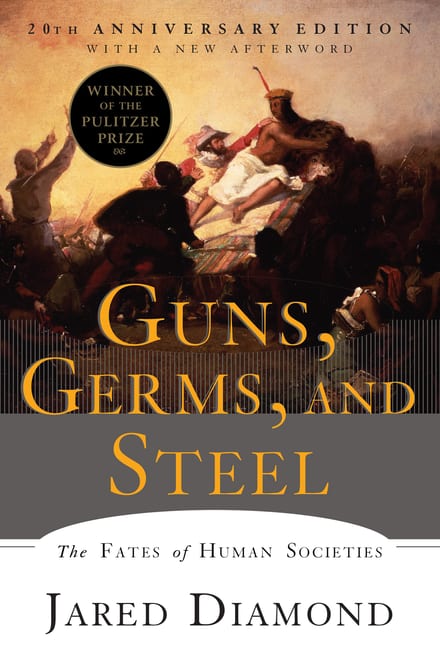
Guns, Germs, and Steel: The Fates of Human Societies
The full book runs ~528 pages — roughly 10 hours of reading. You get the key ideas here in 2 minutes.
The key ideas
- Explains European conquest through geography, not racial superiority
- Eurasia held the best domesticable plants and animals
- East-west axis spread crops and innovations across similar climates
- Farming surpluses fueled specialists, writing, and centralized governments
- Livestock bred deadly diseases that granted Eurasians immunity
- Germs, not weapons, wiped out most of the Americas
The summary
Why did some societies end up conquering others with guns, germs, and steel, instead of the other way around? The tempting answer, that one people was simply cleverer or more capable, is the one Diamond spends the whole book demolishing. His argument is that the differences between human societies were shaped by environment, not biology. The peoples of Eurasia—Asia, Europe, and North Africa—came to dominate not because of anything innate in them, but because their continent happened to hand them a set of incidental advantages that compounded over thousands of years into advanced knowledge, centralized states, and resistance to disease. Change the geography and you change the whole outcome.
Eurasia had the best raw materials for farming
Everything starts with food production, and here Eurasia held nearly all the good cards. Its climate gave it more domesticable plants than anywhere else, and the Fertile Crescent of the modern-day Middle East had ideal candidates that made it the site of the earliest independent plant domestication in the world. The advantage in animals was even more lopsided: of the fourteen ancient animal species suitable for domestication, thirteen were found in Eurasia. Its sheer size and ecological range meant more candidates to begin with, and it lost fewer of them to extinction than other continents did. Domesticated plants and animals are what let a society stop chasing its next meal, and Eurasia had a head start on both.
An east-west continent spreads ideas faster
Geography didn’t just give Eurasia better crops and livestock; it let them travel. Eurasia’s main axis runs east to west, which means that moving across it you encounter only minor seasonal differences. Crops and animals survive best in places with a similar climate, and climate stays relatively constant as you travel east or west while changing sharply as you move north or south. So a plant or animal domesticated in one part of Eurasia could spread across enormous distances without hitting a climate wall—and along the way, so could farming techniques, writing, and other knowledge. Eurasia also had fewer ecological barriers, like rainforests and deserts, choking off that flow. Because humans, like crops, are ill-suited to extreme swings in weather, the same open, east-west terrain let people migrate freely and carry their ideas with them, diffusing knowledge across the continent in a way other landmasses could not manage.
Dense populations built specialists, writing, and states
Once a region could produce food in surplus, its population grew dense, and density changed everything. When not everyone has to farm, people can specialize—as craftsmen, scholars, soldiers—and that division of labor is what eventually produced written language, a crucial tool for storing and spreading information across generations. Hunter-gatherer societies, by contrast, spent most of their energy simply finding enough to eat, with neither the surplus nor the numbers to support full-time specialists. As the largest continent with the most habitable land, Eurasia could sustain the biggest populations of all.
Those large populations also demanded a new kind of organization. More people meant more conflict, which called for more sophisticated, centralized governance, and the complex projects that supported agriculture—irrigation systems, warehouses—needed coordination that only a central authority could provide. By appealing to a powerful ruler or a religious institution, centralized governments proved better at organizing large-scale works and waging war, and so they became common across Eurasia, absorbing or conquering weaker neighbors over time.
The deadliest advantage was invisible
The most lethal edge Eurasia gained was one no one designed. Dense populations living in close contact with domesticated animals gave microbes a bridge from livestock into humans, and crowded Eurasian cities let the resulting diseases spread quickly through recurring epidemics. Those epidemics were brutal, but the survivors—and their children—came away with genetic immunity. So when Eurasians began reaching other continents, they carried germs their own bodies had long since learned to withstand but that the peoples they met had never encountered. The consequences were catastrophic: archaeologists believe that up to 95% of Native Americans died from diseases like smallpox brought by Europeans after Columbus’s arrival. The conquest of the New World was less a military triumph than a biological one, and the Eurasians who caused it had simply inherited thousands of years of exposure that other continents lacked.
The bottom line
Geography, not innate ability, decided which peoples ended up conquering which. Eurasia held the best candidates for domestication and a wide east-west span that let crops, livestock, writing, and disease immunity travel without hitting a climate wall—advantages that snowballed into guns, germs, and steel. Read this if you want to understand why the modern world looks the way it does, and why the arrow of conquest pointed the direction it did rather than the reverse.
Fact check
Popular books repeat findings that later research has complicated. Where Guns, Germs, and Steel makes a testable claim, here's what the evidence actually shows.
Up to 95% of Native Americans died from European-introduced diseases such as smallpox after Columbus arrived.
The scale of the collapse is real, but the best current quantitative estimate sits below 95%. A 2019 reconstruction put the pre-1492 population of the Americas at 60.5 million (interquartile range 44.8-78.2 million) and estimated that epidemics removed about 90% of it (IQR 87-92%) over the following century — roughly 55 million deaths, enough land abandonment to draw down atmospheric CO2. The 95% figure is the top of the scholarly range rather than the central estimate.
- Koch A, Brierley C, Maslin MM, Lewis SL. Earth system impacts of the European arrival and Great Dying in the Americas after 1492. Quat Sci Rev. 2019;207:13-36. Source
Eurasia's east-west axis let crops, livestock and ideas spread across the continent faster than they could travel north-south in the Americas or Africa.
The geographic signature Diamond predicted does show up when people go looking for it, though the tests measure downstream effects rather than crop diffusion itself. A study of 62 historical empires found a statistically significant tendency to expand more east-west than north-south, with modern states trending the same way but falling short of significance. A separate analysis found linguistic diversity persists longer in north-south-oriented territories, consistent with slower homogenization along that axis. Neither study directly clocks how fast a domesticated plant travelled, so the mechanism remains inferred.
Eurasia's killer epidemic diseases crossed over from the domesticated animals its dense populations lived alongside.
It holds for some pathogens and fails for others. Genomic dating of a 1912 measles sample put the split between measles virus and cattle rinderpest virus in the sixth century BCE, matching the rise of cities large enough to sustain the virus — close to the story Diamond tells. Tuberculosis does not fit: comparing 100 strains found that Mycobacterium bovis sits on a divergent branch rather than ancestral to the human bacillus, and the authors wrote that their findings contradict the hypothesis that M. tuberculosis evolved from M. bovis, proposing instead a common ancestor that was probably already a human pathogen.
- Düx A, Lequime S, Patrono LV, et al. Measles virus and rinderpest virus divergence dated to the sixth century BCE. Science. 2020;368(6497):1367-1370. PubMed
- Brosch R, Gordon SV, Marmiesse M, et al. A new evolutionary scenario for the Mycobacterium tuberculosis complex. Proc Natl Acad Sci U S A. 2002;99(6):3684-9. PubMed
Frequently asked questions
What is Guns, Germs, and Steel about?
Jared Diamond sets out to explain why some societies ended up conquering others, and demolishes the idea that it came down to any people being cleverer. His answer is geography: the differences between human societies were shaped by environment, not biology, and Eurasia's incidental advantages compounded over thousands of years into advanced knowledge, centralized states, and resistance to disease.
What are the key takeaways from Guns, Germs, and Steel?
Everything starts with food production, and Eurasia held the best raw materials, more domesticable plants plus thirteen of the fourteen large animal species suitable for domestication. Its east-west axis let crops, livestock, and knowledge spread across huge distances without hitting a climate wall, something the north-south continents couldn't manage. Dense populations from farming surpluses freed people to specialize, producing writing and centralized governments. And the deadliest edge was invisible: living close to animals bred diseases whose survivors gained immunity, so contact with other continents killed up to 95% of Native Americans, making conquest more biological than military.
Who should read Guns, Germs, and Steel?
Read it if you want to understand why the modern world looks the way it does, and why the arrow of conquest pointed the direction it did rather than the reverse. It suits anyone curious about the deep environmental roots of history.
Is Guns, Germs, and Steel worth reading?
It does one big thing extremely well: replacing racist "some peoples are superior" explanations with a coherent account rooted in geography and biology. The argument can feel repetitive as Diamond hammers the same environmental logic across continents, so readers who grasp the thesis early may find it long, but the sweep and the central insight make it worthwhile.