Book summary
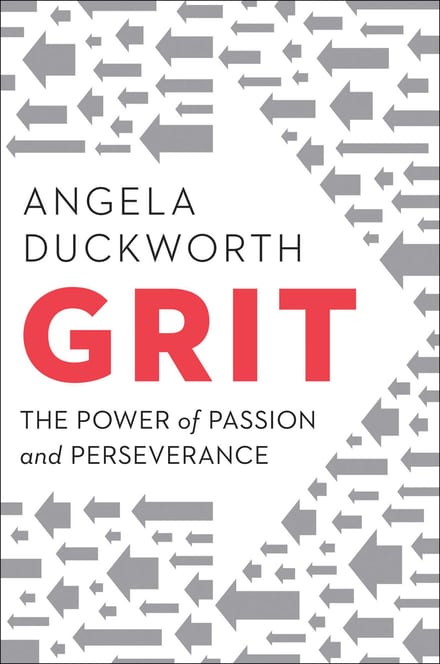
Grit: The Power of Passion and Perseverance
The full book runs ~353 pages — roughly 6 hours of reading. You get the key ideas here in 2 minutes.
The key ideas
- Outwork talent—the gifted who skip practice lose to the diligent.
- Find genuine interest before demanding sustained effort.
- Break big dreams into daily, measurable targets.
- Practice deliberately: specific goals, close attention, no autopilot.
- Treat work as a calling that serves others.
- Praise effort, not talent—grit is learned and contagious.
The summary
Effort counts twice. Angela Duckworth arrived at that formula after a puzzle from her own classroom: her strongest students weren’t the ones with the highest IQs, and some of the highest-IQ students were doing badly. Talent, she realized, only sets how fast you can build a skill. Effort shows up in the equation twice—once turning talent into skill, and again turning skill into results. Talent times effort makes skill; skill times effort makes achievement. A gifted athlete who won’t practice loses to the steady one who trains every day. The novelist John Irving had dyslexia and poor grades and simply outworked everyone; even Mozart put in eight hours a day as a child.
We say we value effort, but we worship talent
Ask people and about two-thirds of Americans will tell you hard work matters most for success. Watch what they actually admire and you see something else. In one study, musicians listened to two piano recordings, one described as the work of a natural and one as the product of years of practice, and they preferred the “natural”—even though the recordings were identical. This bias isn’t harmless. At Enron, a culture built on looking smart rewarded short-term flash and deception, and the practice of firing the bottom 15 percent every year pushed people to protect their image instead of doing durable work. The company that most prized raw talent collapsed under its own cleverness.
Interest first, then relentless daily practice
You can’t grind at something you don’t care about, and people are happiest when their work connects to a genuine interest. But interest isn’t a lightning strike; today’s tendency to hunt for the one perfect match—in a career or a relationship—sets people up for disappointment. Once you’ve found something you care about, the daily work decides the outcome. Big goals inspire, but small, measurable targets are what carry you there. If you want to play basketball, you hit nine of ten free throws today, and again tomorrow. And the hours only pay off if the practice is deliberate: specific goals, close attention, no coasting on autopilot. The top spellers at national bees didn’t have the highest verbal IQs; they scored highest on Duckworth’s Grit Scale, her questionnaire for measuring passion and perseverance over the long haul.
Purpose turns a job into a calling
Grit lasts longer when the work means something beyond yourself. Duckworth retells an old parable: three bricklayers are asked what they’re doing. The first says, “I am laying bricks.” The second, “I am building a church.” The third, “I am building the house of God.” The first has a job, the second a career, the third a calling. People who see their work as a way to help others report more happiness and hold on harder when the work gets grim. Purpose is what keeps effort from running dry.
Grit can be grown
None of this is fixed at birth. Finland has a word for the trait—sisu, much as Japan urges people to ganbaru, to dig in and persevere—and 83 percent of Finns think grit is learned rather than inherited, a belief woven into their culture. That belief matters, because how we treat children shapes it. When teachers rank students by grades, kids adopt a fixed mindset, deciding intelligence is set and choosing safe, easy tasks to avoid looking dumb. Programs that reward effort flip this: the “Knowledge is Power” approach has teachers praise students as good learners rather than naturals, and academic results improve. Committing to a single activity for at least two years measurably raises children’s grit, because sticking with something past the boring parts is the muscle itself. The same goes for adults—surround yourself with gritty people and their persistence rubs off.
The bottom line
Talent matters less than we pretend. Effort counts twice—building skill, then converting it into results—and sustained interest, deliberate practice, and a purpose larger than yourself predict success better than any aptitude score. Read this if you’ve watched less “gifted” people quietly outachieve the naturals, or you want to build more staying power in yourself or the people you’re raising.
Fact check
Popular books repeat findings that later research has complicated. Where Grit makes a testable claim, here's what the evidence actually shows.
Sustained effort predicts achievement better than talent or any aptitude score.
Grit does predict achievement, but less strongly than the aptitude measures it is supposed to beat. A meta-analysis of 584 effect sizes from 88 samples (66,807 people) found grit correlated ρ = .18 with academic performance, against roughly ρ = .50 for cognitive ability in academic and work settings. Duckworth's own 2007 paper reported grit accounting for about 4% of the variance in success outcomes across six studies. The perseverance half of grit does most of that work (ρ = .26); the sustained-interest half manages only ρ = .10.
Grit — passion and perseverance held over years — is a trait in its own right, measurable by the Grit Scale.
The scale's two halves do not behave like one trait. The meta-analysis could not confirm the higher-order structure, and grit correlated ρ = .84 with ordinary conscientiousness across 22 samples (N = 18,826), close enough to be largely the same measurement. Perseverance of effort does earn its keep, predicting academic performance even after conscientiousness is controlled, but the consistency-of-interest half — the sustained passion the book leans on — correlated only ρ = .10 with academic performance. A 2026 meta-analysis of 21 West Point samples (N = 29,102) likewise found conscientiousness the strongest non-cognitive predictor, with grit weaker.
- Credé M, Tynan MC, Harms PD. Much ado about grit: a meta-analytic synthesis of the grit literature. J Pers Soc Psychol. 2017;113(3):492-511. PubMed
- Elliott BJ, Kuncel NR. Brain, personality, and leadership: a meta-analysis of performance predictors among West Point cadets. Mil Psychol. Published online 2026. PubMed
Top finishers at the National Spelling Bee got there on grit rather than verbal intelligence.
In Duckworth's study of 175 finalists at the 2005 Scripps National Spelling Bee, grit did predict how far a speller went: one standard deviation of extra grit meant about 41% higher odds of advancing a round. But verbal IQ predicted it more strongly (odds ratio 2.22 per standard deviation, p < .003), and when grit and verbal IQ were entered in the same model grit was no longer statistically significant — a result the authors attribute partly to only 66 of the finalists completing the IQ test. A 2011 follow-up with 190 competitors found grittier spellers finished higher mainly because they put in more solitary word study.
- Duckworth AL, Peterson C, Matthews MD, Kelly DR. Grit: perseverance and passion for long-term goals. J Pers Soc Psychol. 2007;92(6):1087-1101. PubMed
- Duckworth AL, Kirby TA, Tsukayama E, Berstein H, Ericsson KA. Deliberate practice spells success: why grittier competitors triumph at the National Spelling Bee. Soc Psychol Personal Sci. 2011;2(2):174-181. Source
Teaching children that ability is built rather than inborn — praising effort instead of talent — improves their academic results.
The effect is real but small and limited to particular students. A nationally representative US trial of 12,490 ninth-graders across 65 schools found that a single short online growth-mindset session raised grades by 0.10 grade points (95% CI 0.04 to 0.16) among lower-achieving students, with no benefit for higher achievers and none in schools where peer norms ran against the message. A 2023 meta-analysis of 63 studies (N = 97,672) put the average effect on achievement at d = 0.05, falling to d = 0.02 across the six studies with the strongest designs.
- Yeager DS, Hanselman P, Walton GM, et al. A national experiment reveals where a growth mindset improves achievement. Nature. 2019;573(7774):364-369. PubMed
- Macnamara BN, Burgoyne AP. Do growth mindset interventions impact students' academic achievement? A systematic review and meta-analysis with recommendations for best practices. Psychol Bull. 2023;149(3-4):133-173. PubMed
Frequently asked questions
What is Grit about?
Grit argues that sustained passion and perseverance predict success better than raw talent. Angela Duckworth's formula is that effort counts twice: talent times effort builds skill, then skill times effort turns into achievement, so the steady worker routinely outpaces the gifted person who won't put in the hours.
What are the key takeaways from Grit?
Start with a genuine interest, since you can't grind at something you don't care about, then commit to deliberate practice, specific goals, full attention, no coasting on autopilot, chasing small measurable targets toward a big one. Purpose turns a job into a calling and keeps effort from running dry, illustrated by the three bricklayers who each see their work differently. And grit can be grown: cultures with words like Finland's sisu treat it as learned, praising effort over natural ability and sticking with one activity past the boring parts builds the muscle. Duckworth even measures the trait with her Grit Scale.
Who should read Grit?
Read it if you've watched less "gifted" people quietly outachieve the naturals, or if you want to build more staying power in yourself or the people you're raising.
Is Grit worth reading?
It's persuasive on why we overvalue talent and undervalue effort, with concrete evidence like national spelling-bee champions scoring highest on grit rather than verbal IQ. The framework is more motivating than mechanical, if you want a step-by-step system it stays fairly high-level, but as a reframe of what actually drives achievement it's convincing and practical.